Title: Nationalism
Author: Rabindranath Tagore
Original Publication Date: 1942
Pages: 143
You have to heartily concede it to Tagore, he is still no less poetic writing this essay on nationalism than if he were writing a poem.
“And yet I will persist in believing that there is such a thing as the harmony of completeness in humanity, where poverty does not take away his riches, where defeat may lead him to victory, death to immortality, and where in the compensation of Eternal Justice those who are the last may yet have their insult transmuted into a golden triumph. Let our life be simple in its outer aspect and rich in its inner gain. Let our civilization take its firm stand upon its basis of social co-operation and not upon that of economic exploitation and conflict.”(92)
And really this is what Nationalism is all about. It is maintaining the morality amidst the inevitable mechanical aspects of progress.
Nationalism is more of an essay than an academic work. This contains Tagore’s ruminations on nationalism from his extensive travels. It is divided into chapters on Nationalism in the West, Nationalism in Japan, Nationalism in India, and fittingly it is ended by a poem originally written in Bengali.
The chapter on Nationalism in the West provides us the framework with which Tagore undertook writing on nationalism. Nationalism is, as he claims, created by the concept of the ‘Nation’, “in the sense of the political and economic union of a people, is that aspect which a whole population assumes when organized for a mechanical purpose.”(12) This working definition does not stray from traditional definitions arrived at in the social sciences. Tagore however points out that the ‘Nation’ has a mechanized and amoral aspect that drains man of spirit and morality. “this strenuous effort after strength and efficiency drains man's energy from his higher nature where he is self-sacrificing and creative. For thereby man's power of sacrifice is diverted from his ultimate object, which is moral, to the maintenance of this organization, which is mechanical. Yet in this he feels all the satisfaction of moral exaltation and therefore becomes supremely dangerous to humanity.”(78) A caveat on Tagore’s term on the use of the West, the West refers exclusively to Europe and does not include the Americas (probably both by reason of his sentiments of freedom and the fact that America has just gotten a foothold on the pedestal of world superpowers at that point).
The chapter on Nationalism in Japan reveals Tagore’s admiration for the Japanese Nation and calls it the nation that the Asian region should emulate (this was published in 1942, written earlier and I would almost give anything to satiate my curiosity on Tagore’s reaction on Japan’s participation in the Second World War).
The chapter on Nationalism in India is more of an examination and admonition. Though what is curious to me is that Tagore initially justifies the establishment of the caste system as a legitimate response to the diversity present in Indian society and bolsters this stand by juxtaposing the Indian response to that of the American response which is of futile deferral and discriminatory avoidance. Though Tagore later on calls for an action that rises above the caste system and stays true to the morality he is espousing in this work.
What is so amazing in reading this is Tagore wrote a postcolonial approach in a time when such methods of intellectual discourse are yet to be conceive decades hence, in a time when future notified scholars like Said and his Orientalism and Spivak and his Subaltern are but suckling babes in conceiving their respective postcolonial theories. This point is clear when Tagore wrote that, “You (addressing Japan) must apply your Eastern mind, your spiritual strength, your love of simplicity, your recognition of social obligation, in order to cut out a new path for this great unwieldy car of progress, shrieking out its loud discords as it runs. You must minimize the immense sacrifice of man's life and freedom that it claims in its every movement.”(43)
This statement further resonates with the scholar and the Filipino in me when, “And yet someone must show the East to the West, and convince the West that the East has her contribution to make to the history of civilization.”(75)
Tagore’s writing is also defined by his unwavering idealism and incomparable desire to pursue morality. This leads to his loving belief that men, are innately good. “Man in his fullness is not powerful, but perfect. Therefore, to turn him into mere power, you have to curtail his soul as much as possible. When we are fully human, we cannot fly at one another's throats; our instincts of social life, our traditions of moral ideals stand in the way.”(30)
Tagore’s aim was noble in writing this, but as I said, this is not an academic treatise on Nationalism. Tagore presents us the danger inherent in modernization, the alienation and mechanization of the human spirit, he provides recourse for the invasion of the imperial capitalistic designs of the West, but does not actually provide for a concrete solution to the inevitable force of modernization.
I fittingly end this review by quoting the last stanza of his beautiful poem.
“Be not ashamed, my brothers,
to stand before the proud and the powerful
With your white robe of simpleness.”
“Let your crown be of humility,
your freedom the freedom of the soul.
Build God's throne daily
upon the ample bareness of your poverty
And know that what is huge is not great
and pride is not everlasting.”(97)
Other works by Rabindranath Tagore:
The Gardener (4 Stars)
Gitanjali (4 Stars)
This book forms part of my remarkably extensive reading list on Nobel Prize for Literature Awardees
Showing posts with label Academic. Show all posts
Thursday, May 29, 2014
Saturday, May 24, 2014
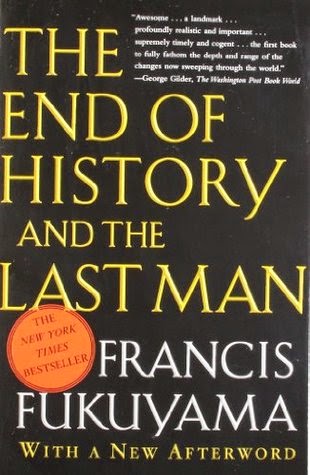
The End of History and The Last Man by Francis Fukuyama
Title: The End of History and The Last Man
Author: Francis Fukuyama
Original Publication Date: 1992
Pages: 464
"But it is not necessarily the case that liberal democracy is the political system best suited to resolving social conflicts per se. A democracy's ability to peacefully resolve conflicts is greatest when those conflicts arise between so called "interest groups" that share a larger, pre-existing consensus on the basic values or rules of the game, and when the conflicts are primarily economic in nature. But there are other kinds of non-economic conflicts that are far more intractable, having to do with issues like inherited social status and nationality, that democracy is not particularly good at resolving.”
Francis Fukuyama was born on October 27, 1952 to Yoshio Fukuyama, a second generation Japanese American, and Toshiko Kawata Fukuyama. Fukuyama’s childhood years were spent in New York city and in 1967, the family moved to State College, Pennsylvania, where he then attended high school. His Bachelor of Arts in Classics was obtained in 1974 from Cornell University and taught right after in the Yale University Department of Comparative Literature during 1974 – 1975. In 1981, he received his Doctor of Philosophy in Political Science from Harvard University by doing a dissertation on Soviet foreign policy. Francis Fukuyama was a member of the Political Science Department of the RAND Corporation which conducts researches about public policies in Santa Monica,California from 1979 to 1980, 1983 – 1989, and then in 1995 – 1996 . In 1981 and 1982, Francis Fukuyama was an official member of the Policy Planning Staff of the United States Department of State where he focused on Middle Eastern issues. In 1989, he returned to the same body, but this time as a deputy director for European political and military affairs. While he was a member of this said policy planning staff, he published an essay entitled “The End of History?” in a small foreign policy journal named The National Interest.
The End of History and the Last Man is a book expanding the essay “The End of History?” that Francis Fukuyama wrote in 1981. It sparked extraordinary debate both in the United States and abroad. Francis Fukuyama’s analytical philosophy is anchored in the fact that the article was written five months before the collapse of the Berlin wall where ideological contentions between democracies and communism were in head to head disputation. His employment at those times and his origin of education has surely predicated his preferences in writing the article and eventually the book. Being a RAND corporation researcher and as a member of the United States Department Policy Planning Staff would have surely molded his very reasons for writing such. As an officially employed citizen of the United States, one cannot deny that fact that he must advocate to the principles of the State and government that has employed, nurtured and protected him, and that is liberal democracy. We may say that because he is of the government, he wrote the “End of History?” to impinge on disintegration of the Berlin wall.
The End of History and the Last Man posits the idea of writing a universal history of human development with the end of liberal democracy. The prevalent extension of not only liberal political but also economic ideas throughout the communist world and to third world countries presupposes that mankind has reached its ideological evolutionary process. Although the occurrence of events in the simplistic sense of history still occurs, the evolution of human society has reached its end with liberal democracy and not with communism.
Francis Fukuyama points significant emphasis on the French and American Revolutions. He stresses that the amalgamated ideals formed in the momentous revolutions were the indispensable foundations of the end of man’s history, liberal democracy. His periodization ends with all states having the same form of government.
It rejects Marx’s idea of human development with communism as the end goals of the system. And just as any post – modern theory rejects grand narratives in existence,so does it support and enact one of its own. This is what Francis Fukuyama’s work is doing, it rejects the various numerous ideas of the development of human society and presents that grand narrative that societal development ends with the institutionalization of liberal democracy in every state.
Perhaps the biggest critique about Francis Fukuyama and his book The End of History and The Last man is that he has this tendency to show his biases on his writings. His position in the government of the nation is clearly felt in the arguments of the origin of liberal democracy and the end of which he speaks of in essence perpetuates the imperialistic aims of a world super power.
Author: Francis Fukuyama
Original Publication Date: 1992
Pages: 464
"But it is not necessarily the case that liberal democracy is the political system best suited to resolving social conflicts per se. A democracy's ability to peacefully resolve conflicts is greatest when those conflicts arise between so called "interest groups" that share a larger, pre-existing consensus on the basic values or rules of the game, and when the conflicts are primarily economic in nature. But there are other kinds of non-economic conflicts that are far more intractable, having to do with issues like inherited social status and nationality, that democracy is not particularly good at resolving.”
Francis Fukuyama was born on October 27, 1952 to Yoshio Fukuyama, a second generation Japanese American, and Toshiko Kawata Fukuyama. Fukuyama’s childhood years were spent in New York city and in 1967, the family moved to State College, Pennsylvania, where he then attended high school. His Bachelor of Arts in Classics was obtained in 1974 from Cornell University and taught right after in the Yale University Department of Comparative Literature during 1974 – 1975. In 1981, he received his Doctor of Philosophy in Political Science from Harvard University by doing a dissertation on Soviet foreign policy. Francis Fukuyama was a member of the Political Science Department of the RAND Corporation which conducts researches about public policies in Santa Monica,California from 1979 to 1980, 1983 – 1989, and then in 1995 – 1996 . In 1981 and 1982, Francis Fukuyama was an official member of the Policy Planning Staff of the United States Department of State where he focused on Middle Eastern issues. In 1989, he returned to the same body, but this time as a deputy director for European political and military affairs. While he was a member of this said policy planning staff, he published an essay entitled “The End of History?” in a small foreign policy journal named The National Interest.
The End of History and the Last Man is a book expanding the essay “The End of History?” that Francis Fukuyama wrote in 1981. It sparked extraordinary debate both in the United States and abroad. Francis Fukuyama’s analytical philosophy is anchored in the fact that the article was written five months before the collapse of the Berlin wall where ideological contentions between democracies and communism were in head to head disputation. His employment at those times and his origin of education has surely predicated his preferences in writing the article and eventually the book. Being a RAND corporation researcher and as a member of the United States Department Policy Planning Staff would have surely molded his very reasons for writing such. As an officially employed citizen of the United States, one cannot deny that fact that he must advocate to the principles of the State and government that has employed, nurtured and protected him, and that is liberal democracy. We may say that because he is of the government, he wrote the “End of History?” to impinge on disintegration of the Berlin wall.
The End of History and the Last Man posits the idea of writing a universal history of human development with the end of liberal democracy. The prevalent extension of not only liberal political but also economic ideas throughout the communist world and to third world countries presupposes that mankind has reached its ideological evolutionary process. Although the occurrence of events in the simplistic sense of history still occurs, the evolution of human society has reached its end with liberal democracy and not with communism.
Francis Fukuyama points significant emphasis on the French and American Revolutions. He stresses that the amalgamated ideals formed in the momentous revolutions were the indispensable foundations of the end of man’s history, liberal democracy. His periodization ends with all states having the same form of government.
It rejects Marx’s idea of human development with communism as the end goals of the system. And just as any post – modern theory rejects grand narratives in existence,so does it support and enact one of its own. This is what Francis Fukuyama’s work is doing, it rejects the various numerous ideas of the development of human society and presents that grand narrative that societal development ends with the institutionalization of liberal democracy in every state.
Perhaps the biggest critique about Francis Fukuyama and his book The End of History and The Last man is that he has this tendency to show his biases on his writings. His position in the government of the nation is clearly felt in the arguments of the origin of liberal democracy and the end of which he speaks of in essence perpetuates the imperialistic aims of a world super power.
Thursday, May 22, 2014
Rizal Without the Overcoat by Ambeth Ocampo
Title: Rizal Without the Overcoat
Author: Ambeth Ocampo
Publisher: Anvil Publishing,Inc.
Original Publication Date: 1990
Pages: 272
"Jose Rizal Mercado y Alonso (1861-96) is the Philippine national hero because an American governor gave him that recognition. President Taft did not choose Aguinaldo because he was too militaristic; Rizal fitted the ideal of national leader for the Filipinos. (Arcilla 1984:88)"<
Jose Rizal is touchy subject for most Filipino scholars. It is worth emphasizing that unlike the designation of the Narra as the National tree, or the Mango as the National fruit, ejusdem generis, there is no law designating Rizal as the Philippine national hero. So contrary to popular belief, the post of 'THE' National Hero is, in all its actuality, lodged in a genuine debate, and not merely in a verbal one.
If you are interested in reading a more academic approach of why Rizal is worthy of being labeled as the Philippine national hero, read Leon M. Guerrero's book The First Filipino.
The title is not a mere designation. Rizal Without the Overcoat endeavors to present Rizal, without the overcoat, the overcoat of the European influence embossed upon this enamored persona though his European education. In some sense, this could be certainly taken as a post-colonial approach in viewing Rizal.
The book is a compilation of articles Ambeth Ocampo wrote in a Philippine newspaper, which says a lot about his writings. Ocampo's writing has been designated as 'popular history' and it is not without any grounding at all. Popular history is history writing striving for a very wide audience of non-specialists. Reading this made me feel I was going through a Rizal trivia book, it was enjoyable (who doesn't love trivias?), and had its moments. Of course the necessary critiques of this form includes the style, analytical depth and the wealth of resources/references which in Ocampo's case has suffered from existential dearth. Be critical in reading Ocampo, you may just subliminally fall into his bandwagon.
But is there a need to remove the overcoat? Who is Rizal but the man who sought education in the foreign shores to liberate his people? Is he too not defined by the knowledge, motivations, social stimuli he encountered wearing that overcoat? Is the overcoat not a part of who Rizal truly is?
P.S.
Entirely not part of this book's review!
I seem to keep reading the statement that Rizal wrote for the people, for the masses, for the 'Indios'! Rizal did not write for the masses, the two seminal novels were originally written in Spanish, a Lingua Franca known only to the Filipino landed elite, the landlords, and even to them a limited number was capable of reading. More importantly, books were a luxury then compared to today. Noli and El Fili were inaccessible when it first came out.
Author: Ambeth Ocampo
Publisher: Anvil Publishing,Inc.
Original Publication Date: 1990
Pages: 272
"Jose Rizal Mercado y Alonso (1861-96) is the Philippine national hero because an American governor gave him that recognition. President Taft did not choose Aguinaldo because he was too militaristic; Rizal fitted the ideal of national leader for the Filipinos. (Arcilla 1984:88)"<
Jose Rizal is touchy subject for most Filipino scholars. It is worth emphasizing that unlike the designation of the Narra as the National tree, or the Mango as the National fruit, ejusdem generis, there is no law designating Rizal as the Philippine national hero. So contrary to popular belief, the post of 'THE' National Hero is, in all its actuality, lodged in a genuine debate, and not merely in a verbal one.
If you are interested in reading a more academic approach of why Rizal is worthy of being labeled as the Philippine national hero, read Leon M. Guerrero's book The First Filipino.
The title is not a mere designation. Rizal Without the Overcoat endeavors to present Rizal, without the overcoat, the overcoat of the European influence embossed upon this enamored persona though his European education. In some sense, this could be certainly taken as a post-colonial approach in viewing Rizal.
The book is a compilation of articles Ambeth Ocampo wrote in a Philippine newspaper, which says a lot about his writings. Ocampo's writing has been designated as 'popular history' and it is not without any grounding at all. Popular history is history writing striving for a very wide audience of non-specialists. Reading this made me feel I was going through a Rizal trivia book, it was enjoyable (who doesn't love trivias?), and had its moments. Of course the necessary critiques of this form includes the style, analytical depth and the wealth of resources/references which in Ocampo's case has suffered from existential dearth. Be critical in reading Ocampo, you may just subliminally fall into his bandwagon.
But is there a need to remove the overcoat? Who is Rizal but the man who sought education in the foreign shores to liberate his people? Is he too not defined by the knowledge, motivations, social stimuli he encountered wearing that overcoat? Is the overcoat not a part of who Rizal truly is?
P.S.
Entirely not part of this book's review!
I seem to keep reading the statement that Rizal wrote for the people, for the masses, for the 'Indios'! Rizal did not write for the masses, the two seminal novels were originally written in Spanish, a Lingua Franca known only to the Filipino landed elite, the landlords, and even to them a limited number was capable of reading. More importantly, books were a luxury then compared to today. Noli and El Fili were inaccessible when it first came out.
Saturday, August 24, 2013
The First Filipino by Leon Maria Guerrero
Originally posted at Goodreads
For all the years, studies and romanticisms of Rizal, he has somewhat remained, an enigma. This is not surprising.
The vast number of scholars that have attempted a great many times to deconstruct and understand Rizal on his writings have fallibly tainted Rizal’s political ideologies and perspectives in doing so. Some even failed to see that what they have deconstructed was not Rizal, but an image hewn from themselves.
Some of this were, Agoncillo who regarded Rizal as a “revolutionary reformist” or “reformist revolutionary” while Constantino declared Rizal’s genuine agenda were the Hispanization of the Indio and the assimilation of the Philippines to Spain, which proved little to clear the matter but in essence has founded the contradiction that has bedeviled nationalist historians. Romeo Cruz however puts it differently by saying that Rizal’s purported assimilation is the union of sectionalism – loyalty entrenched in the Filipino people and nationalism – this he refers to the loyalty directed to Spain. The belief that these sentiments are subversive and seditious to the national cause is wrong, for nationalism does not favor class and the nature by which it is defined.
Floro F. Quibuyen maintains that this view is inherently flawed on the aspect that most of our scholars’ personal standpoint is levied upon the Enlightenment terms when Rizal is studied. Viewing the matter in the Enlightenment terms merits a view in terms of the liberal concept of the nations–state. The state exercises power in making and enforcing laws in behalf of the people it stands for. But Rizal’s vision went beyond the liberal concepts conceived by the Enlightenment period.
Does this rudimentary predicament afflict Leon Maria Guerrero's work?
In the pursuit of veracity more than brevity, I quote and support the introduction in saying that:
"... it presents him in the guise of the original and singular philosopher he is, as well as the great stylist and thinker of clarity, precision, and profundity he also is."
An achievement in itself.
The question looms however, and whether one accepts the answer entirely depends on no one else but the reader as much as the material. Is Rizal worthy to be the first Filipino? Is it fitting?
As any historical work, the historical narrative is to be subjected upon critical objective examination. Points of contention undeniably exist, which are realistically inevitable, in the historicization. This subjective scholar preference I'm pointing exists for example on Leon Guerrero's choice with which to start his discussion (Gomburza), which also implicitly carries his nationalistic orientation (that is much to be desired).
Still, as it stands, a great scholarly work.
For all the years, studies and romanticisms of Rizal, he has somewhat remained, an enigma. This is not surprising.
The vast number of scholars that have attempted a great many times to deconstruct and understand Rizal on his writings have fallibly tainted Rizal’s political ideologies and perspectives in doing so. Some even failed to see that what they have deconstructed was not Rizal, but an image hewn from themselves.
Some of this were, Agoncillo who regarded Rizal as a “revolutionary reformist” or “reformist revolutionary” while Constantino declared Rizal’s genuine agenda were the Hispanization of the Indio and the assimilation of the Philippines to Spain, which proved little to clear the matter but in essence has founded the contradiction that has bedeviled nationalist historians. Romeo Cruz however puts it differently by saying that Rizal’s purported assimilation is the union of sectionalism – loyalty entrenched in the Filipino people and nationalism – this he refers to the loyalty directed to Spain. The belief that these sentiments are subversive and seditious to the national cause is wrong, for nationalism does not favor class and the nature by which it is defined.
Floro F. Quibuyen maintains that this view is inherently flawed on the aspect that most of our scholars’ personal standpoint is levied upon the Enlightenment terms when Rizal is studied. Viewing the matter in the Enlightenment terms merits a view in terms of the liberal concept of the nations–state. The state exercises power in making and enforcing laws in behalf of the people it stands for. But Rizal’s vision went beyond the liberal concepts conceived by the Enlightenment period.
Does this rudimentary predicament afflict Leon Maria Guerrero's work?
In the pursuit of veracity more than brevity, I quote and support the introduction in saying that:
"... it presents him in the guise of the original and singular philosopher he is, as well as the great stylist and thinker of clarity, precision, and profundity he also is."
An achievement in itself.
The question looms however, and whether one accepts the answer entirely depends on no one else but the reader as much as the material. Is Rizal worthy to be the first Filipino? Is it fitting?
As any historical work, the historical narrative is to be subjected upon critical objective examination. Points of contention undeniably exist, which are realistically inevitable, in the historicization. This subjective scholar preference I'm pointing exists for example on Leon Guerrero's choice with which to start his discussion (Gomburza), which also implicitly carries his nationalistic orientation (that is much to be desired).
Still, as it stands, a great scholarly work.
Friday, August 23, 2013
Crusades: The Illustrated History by Thomas Madden
Originally posted at Goodreads
Religion is the power that wields the sword that is faith.
The Crusades are seemingly anomalous in nature which however, save for the rai·son d'être that is still under great contention, was like any other war waged in the history of men: devoid of mercy, riddled with corruption and which ended in mutual defeat and further enmity if not in destruction. There is inherent difficulty in reconciling the Christian doctrine that emphasizes the value of life beyond any measure to those of taking it under the claims of being sanctioned by God, if ever it truly was. And by this inquiry a further irony is revealed that one has to have faith with God, the Church and Religion to question such disposition. This is why the crusades have such proclivity towards disquisition with scholars and laymen alike.
Let me start by saying what Madden's work is not. At an entire 228 pages, including the illustrations, explanatory boxes, sidebars and chronology, one can accurately deduct, even foresee, what the book contains and to what extent it manages the historical narrative of the Crusades. One who desires to be well versed in the history of the Crusades should think about picking this book up. It is not a historical book brimful of historical discourses nor is it chockfull of the rationalization for such discourses. It too lack the further essential milieu existing in derivative albeit vital events of the era. However, it should be the first book that one who desires to be well versed in the history of the Crusades should pick up, INITIALLY.
This is because Madden's book is a concise historical work, aspiring to provide a broad overview of the Crusades. Works such as Madden's are characterized by broadness in trying to present every facet of the narrative and yet they too are distinguished by the brevity at which they delve into each facet. One can say that the particular design books of such kind address is providing laymen with an outline of events and basic knowledge of the subject.
The dilemma of books of this kind is that they are presenting a convoluted and sophisticated narrative intricately entangled with man's history as simple and as concise as possible (with the use of these adjectives I feel I could not further improved on emphasizing my point). More essential to this argument is that books are written in the writer's perspective and it is he/she that determines the pivotal points in the historical narrative to include. Differences inevitably arise between works, but more importantly, the reader's interest falls into a deadlock (of which i pray should not happen, once is too much in this occasion) encountering a point in the narrative that is mentioned only in passing but is seemingly vital to the reader's conscious reasoning in understanding the very narrative itself.
Further consideration is, and this is true not only with Madden's work, the volume by which the people and events are mentioned are taxing to the memory of a non-eidetic intelligence (as i have experienced myself). This is also because the persona of the individuals involved does not create a connection, relation, or mark in passing mention, just as the events do not leave an impression. A pedigree would greatly help. Also a map for every vital period within the narrative, as these are limited in the work, would be a revelation.
A caveat however is needed. The perspective from where this is review is written is apparent. I would not relegate the work into failure even how much it would seem the words are couch in the negative. I picked up the book out of sheer curiosity of the illustrations inside. Critically speaking, the book did present the Crusade's narrative as objectively as possible save on one or two occasions where Madden claimed support for his thesis.
I have yet to compare the illustrations (composed of photos of ruins and relics complimented by the paintings of the era) to other books constituting of the same composition. As it stands, The included illustrations are visually pleasing, well detailed and I might say, well selected by virtue of their relevance and bearing with the discussions presented.
Religion is the power that wields the sword that is faith.
The Crusades are seemingly anomalous in nature which however, save for the rai·son d'être that is still under great contention, was like any other war waged in the history of men: devoid of mercy, riddled with corruption and which ended in mutual defeat and further enmity if not in destruction. There is inherent difficulty in reconciling the Christian doctrine that emphasizes the value of life beyond any measure to those of taking it under the claims of being sanctioned by God, if ever it truly was. And by this inquiry a further irony is revealed that one has to have faith with God, the Church and Religion to question such disposition. This is why the crusades have such proclivity towards disquisition with scholars and laymen alike.
Let me start by saying what Madden's work is not. At an entire 228 pages, including the illustrations, explanatory boxes, sidebars and chronology, one can accurately deduct, even foresee, what the book contains and to what extent it manages the historical narrative of the Crusades. One who desires to be well versed in the history of the Crusades should think about picking this book up. It is not a historical book brimful of historical discourses nor is it chockfull of the rationalization for such discourses. It too lack the further essential milieu existing in derivative albeit vital events of the era. However, it should be the first book that one who desires to be well versed in the history of the Crusades should pick up, INITIALLY.
This is because Madden's book is a concise historical work, aspiring to provide a broad overview of the Crusades. Works such as Madden's are characterized by broadness in trying to present every facet of the narrative and yet they too are distinguished by the brevity at which they delve into each facet. One can say that the particular design books of such kind address is providing laymen with an outline of events and basic knowledge of the subject.
The dilemma of books of this kind is that they are presenting a convoluted and sophisticated narrative intricately entangled with man's history as simple and as concise as possible (with the use of these adjectives I feel I could not further improved on emphasizing my point). More essential to this argument is that books are written in the writer's perspective and it is he/she that determines the pivotal points in the historical narrative to include. Differences inevitably arise between works, but more importantly, the reader's interest falls into a deadlock (of which i pray should not happen, once is too much in this occasion) encountering a point in the narrative that is mentioned only in passing but is seemingly vital to the reader's conscious reasoning in understanding the very narrative itself.
Further consideration is, and this is true not only with Madden's work, the volume by which the people and events are mentioned are taxing to the memory of a non-eidetic intelligence (as i have experienced myself). This is also because the persona of the individuals involved does not create a connection, relation, or mark in passing mention, just as the events do not leave an impression. A pedigree would greatly help. Also a map for every vital period within the narrative, as these are limited in the work, would be a revelation.
A caveat however is needed. The perspective from where this is review is written is apparent. I would not relegate the work into failure even how much it would seem the words are couch in the negative. I picked up the book out of sheer curiosity of the illustrations inside. Critically speaking, the book did present the Crusade's narrative as objectively as possible save on one or two occasions where Madden claimed support for his thesis.
I have yet to compare the illustrations (composed of photos of ruins and relics complimented by the paintings of the era) to other books constituting of the same composition. As it stands, The included illustrations are visually pleasing, well detailed and I might say, well selected by virtue of their relevance and bearing with the discussions presented.
Revolutionary Clergy by John Schumacher, S.J.
Originally posted at Goodreads
John Schumacher, S.J. is an amazing academician and that is giving respect to where it is due. He had written 180+ books and articles (and is still continuing to do so at this review's writing), all considerably well-researched. Ironically however, I must write down that the reason by which he can be considered a successful researcher is also the reason by which his writings (most prevalent, concerning those of nationalism) must be greatly challenged if not expounded and more thoroughly (as it is well researched as it stands) researched upon. However, before expounding on the reason for giving only three stars on John Schumacher's works, I still suggest one to read his works as they provide a distinctive perspective and approach upon the topics he has grazed.
John Schumacher offers us a different perspective on the development of nationalism. He presents the standpoint of the friars, and the clergymen present in every facet of the colonial regime. His excellent academic and scholastic training merits him an effective researcher. To such end, his works have been great historical researches, founded upon documents of great importance.
Schumacher’s works, however, can only be credited as far as merit for use of sources go (my standpoint as a scholar). His works clearly provide us with a perspective but in so much that it is examined as an objective work, it fails to impress for precisely the same reason, that he is first and foremost a man of the Church.
If he is credited well in his voluminous works and use of sources in his studies, it is apparent that his authorial bias induced that parts of contrary evidences and repudiating circumstances were left out to fit in his defense for the clergy.
(One example of the manner by which Schumacher is blatantly guilty of my claims is when he repetitively asserts his argument that Jose Rizal derived his nationalistic bearings and was greatly influenced by Father Burgos though the evidence he presents to support this claim is nothing but an indirect connection between Rizal and Burgos and nothing else was presented further. This indirect connection was between Rizal and Paciano who is Burgos' nephew, who also helped him enter Ateneo Munipal, but as i stressed, no other personal and direct connection between Rizal and Burgos was presented).
This bias in research can actually be summarized in the fact that his nationalistic ideas are modernist in nature. By this consideration, never did Schumacher really give any significance in the pre-Spanish era of Filipino culture and history that post-colonial studies actually call for.
There is this fundamental conflict within his ideas that ultimately fails to impress but in effect exposes the evident bias with the friar orders. I am led to question for what reasons were such researches done. Was it in light of clarifying matters and the genuinely love for knowledge or was it in the end aimed to defend the positions the men of the faith took those pressing times? He presents a well-researched historical inquiry that is founded on the role of the clergy that in the end, demerits his claims at worst, and at best, contaminates his ideas and conclusions. The fundamental conflicts in his arguments demerit it so some extent but more importantly it exposes his attempt to wipe clean the slate of the friar orders and is a clear representation of his authorial bias.
Researchers could very well consult his works as it does provide a significantly different perspective, and it was exceptional at doing that. By doing so, one can supplement and avoid the very dilemma we consequentially aim to address, a limited and bias understanding of things. As it stands, it will provide an excellent perspective of Filipino nationalism from the eyes of the clergy.
John Schumacher, S.J. is an amazing academician and that is giving respect to where it is due. He had written 180+ books and articles (and is still continuing to do so at this review's writing), all considerably well-researched. Ironically however, I must write down that the reason by which he can be considered a successful researcher is also the reason by which his writings (most prevalent, concerning those of nationalism) must be greatly challenged if not expounded and more thoroughly (as it is well researched as it stands) researched upon. However, before expounding on the reason for giving only three stars on John Schumacher's works, I still suggest one to read his works as they provide a distinctive perspective and approach upon the topics he has grazed.
John Schumacher offers us a different perspective on the development of nationalism. He presents the standpoint of the friars, and the clergymen present in every facet of the colonial regime. His excellent academic and scholastic training merits him an effective researcher. To such end, his works have been great historical researches, founded upon documents of great importance.
Schumacher’s works, however, can only be credited as far as merit for use of sources go (my standpoint as a scholar). His works clearly provide us with a perspective but in so much that it is examined as an objective work, it fails to impress for precisely the same reason, that he is first and foremost a man of the Church.
If he is credited well in his voluminous works and use of sources in his studies, it is apparent that his authorial bias induced that parts of contrary evidences and repudiating circumstances were left out to fit in his defense for the clergy.
(One example of the manner by which Schumacher is blatantly guilty of my claims is when he repetitively asserts his argument that Jose Rizal derived his nationalistic bearings and was greatly influenced by Father Burgos though the evidence he presents to support this claim is nothing but an indirect connection between Rizal and Burgos and nothing else was presented further. This indirect connection was between Rizal and Paciano who is Burgos' nephew, who also helped him enter Ateneo Munipal, but as i stressed, no other personal and direct connection between Rizal and Burgos was presented).
This bias in research can actually be summarized in the fact that his nationalistic ideas are modernist in nature. By this consideration, never did Schumacher really give any significance in the pre-Spanish era of Filipino culture and history that post-colonial studies actually call for.
There is this fundamental conflict within his ideas that ultimately fails to impress but in effect exposes the evident bias with the friar orders. I am led to question for what reasons were such researches done. Was it in light of clarifying matters and the genuinely love for knowledge or was it in the end aimed to defend the positions the men of the faith took those pressing times? He presents a well-researched historical inquiry that is founded on the role of the clergy that in the end, demerits his claims at worst, and at best, contaminates his ideas and conclusions. The fundamental conflicts in his arguments demerit it so some extent but more importantly it exposes his attempt to wipe clean the slate of the friar orders and is a clear representation of his authorial bias.
Researchers could very well consult his works as it does provide a significantly different perspective, and it was exceptional at doing that. By doing so, one can supplement and avoid the very dilemma we consequentially aim to address, a limited and bias understanding of things. As it stands, it will provide an excellent perspective of Filipino nationalism from the eyes of the clergy.
Wednesday, August 21, 2013
Notes on the New Society of the Philippines by Ferdinand Marcos

Title: Notes on the New Society of the Philippines
Author: Ferdinand Marcos
Original Publication Date: 1973
Pages: 214
Genre/s: History, Academic, Filipiniana
Marcos has proven too well that his political charisma can be fully translated in what he writes. Notes on the New Society of the Philippines is no exception to that (Caution: He might win you over).
Just as his tyrannical and definitively despotic regime pretentiously stood for the mere vestiges of democracy itself, so too does this book contain what the ideals Marcos has sought to ennoble which, as history judged it to be, succumbed to nothing less than corruption and iniquity.
Aside from the standard fill of making things superficially palatable, of unfounded and unsubstantiated conclusions and the not too subtly contrived authorial biases, Notes on the New Society of the Philippines can still infallibly function as the proverbial window to the soul of one of the most remembered Presidents in the Philippines, not in a noble nor revered manner (save what could be called fundamentally fanatics in existence), but still remembered.
Let us take in hindsight what he wrote in page 50 concerning the Constitution and Martial Law.
"The Constitution therefore provides for its (Martial Law) survival in a clear, orderly and democratic manner for the instrument used is not only legal but moral in the highest sense. It places the proclamation of martial law under the Rule of Law.
This resolves the eternal moral question of Ends and Means, The Constitution, being democratic in spirit and content, does not recognize means which are not integral with, or not logically follow from, its ends, even though that end may be self-preservation itself."(Emphasis mine)
And on page 127 on Martial law and its so called uniqueness.
"Our martial law is unique in that it is based on the supremacy of the civilian authority over the military and on complete submission to the decision of the Supreme Court, and most importantly of all, the people. It is unique in that it does not seek to maintain the status quo but has instead brought about radical reforms.(Emphasis mine)
We all know how that turned out to be, with old Justice Teehankee(later C.J. under Cory Aquino) barely holding out, but certainly with great conviction and nothing less of the ideal.
Much can be said and deduced with these meager passages. I do not intend to misquote nor offer an unwarranted argument lest I fall in the same boat. Deductions are clear as can ever be as echoed in the annals of history.
In hindsight, this perspective relegates the human capacity in determining morality, which I believe is an entirely different thing with what is legal. This stand does not come with surprise. Marcos has alienated the people and these words point to his mental inclination to pursue such ends, and history sufficiently offers us the more than adequate manifestations of his bearings.
And just as most writings concerning sociological and cultural matters, Notes on the New Society lies in the plain of the ideal. And if not for critically examining the facts, all would have but remained an enigma, hauntingly questioning us, what went wrong? What revelation it would have been if the ideal remained, forever to be, an ideal, but depressingly, it became a corrupted, depraved and brutally oppressive reality beyond any recognition.
Let us take in hindsight what he wrote in page 50 concerning the Constitution and Martial Law.
"The Constitution therefore provides for its (Martial Law) survival in a clear, orderly and democratic manner for the instrument used is not only legal but moral in the highest sense. It places the proclamation of martial law under the Rule of Law.
This resolves the eternal moral question of Ends and Means, The Constitution, being democratic in spirit and content, does not recognize means which are not integral with, or not logically follow from, its ends, even though that end may be self-preservation itself."(Emphasis mine)
And on page 127 on Martial law and its so called uniqueness.
"Our martial law is unique in that it is based on the supremacy of the civilian authority over the military and on complete submission to the decision of the Supreme Court, and most importantly of all, the people. It is unique in that it does not seek to maintain the status quo but has instead brought about radical reforms.(Emphasis mine)
We all know how that turned out to be, with old Justice Teehankee(later C.J. under Cory Aquino) barely holding out, but certainly with great conviction and nothing less of the ideal.
Much can be said and deduced with these meager passages. I do not intend to misquote nor offer an unwarranted argument lest I fall in the same boat. Deductions are clear as can ever be as echoed in the annals of history.
In hindsight, this perspective relegates the human capacity in determining morality, which I believe is an entirely different thing with what is legal. This stand does not come with surprise. Marcos has alienated the people and these words point to his mental inclination to pursue such ends, and history sufficiently offers us the more than adequate manifestations of his bearings.
And just as most writings concerning sociological and cultural matters, Notes on the New Society lies in the plain of the ideal. And if not for critically examining the facts, all would have but remained an enigma, hauntingly questioning us, what went wrong? What revelation it would have been if the ideal remained, forever to be, an ideal, but depressingly, it became a corrupted, depraved and brutally oppressive reality beyond any recognition.
Labels:
Academic,
Filipiniana,
History,
Marcos,
martial law,
review
Subscribe to:
Posts (Atom)