Showing posts with label philosophy. Show all posts

Monday, July 7, 2014

The Inner Beauty by Maurice Maeterlinck

Title: The Inner Beauty
Author:  Maurice Maeterlinck
Original Publication Date: 1910
Pages: 39
Genre/s: Classics, Philosophy


Nothing in the whole world is so athirst for beauty as the soul, nor is there anything to which beauty clings so readily. (5)

This has been a particularly hard piece to read, and by a necessary consequence, to write a review of. Maurice Maeterlicnk is, before anything else, a Nobel laureate (1911) who earned the coveted award for his plays which form a substantial part of the Symbolism Movement. Adherents believed that absolute truths could only be described indirectly, which necessitates a style of writing punctuated by metaphorical and suggestive prose. This is now our caveat by which we seek to assuage any difficulty in tackling this work.

The work is divided in three parts, Inner Beauty, Invisible Goodness, and Silence. This is a spiritual and ruminative work in all its aspects.

"Beauty is the only language of our soul: none other is known to it."(10)

Beauty is of course acts that we could generally and objectively categorize as good in man. Maeterlinck states that every man, even the unhappiest and the most destitute have at the depths of their being, this beauty that he speaks of. This necessarily lays down the premise that men by nature are good, or, in Maeterlinck's words, are naturally beautiful beings, who need only to acquire the habit of dipping into that nature, into that soul, and the greatest act by which we enliven this beauty is by loving.

Is it not in love that are found the purest elements of beauty that we can offer to the soul?(19)

To him, to love means losing every bit of 'ugliness' in our souls. It is the state by which we come closest to God. But to be good, to be able to love with real ardent affection, we must first go through suffering, a harrowing by which we are molded to become better and end up in tune with our soul, our inner beauty. "Grief is love's first food, and every love that has not been fed on a little pure suffering must die like the babe that one had tried to nourish on the nourishment of a man." (20)

And there would always remain between us truth which had not spoken, which we had not even thought of speaking... and only in silence could we perceive it.

And he counsels the reader to search for this intermittent pockets of silences in life which holds the 'real' secrets and calls them 'secret silences'.

One has to forgive my limited and modest uptake of Maeterlinck's philosophy as contained in this work. Admittedly, this is only one way to look and deconstruct this highly suggestive and metaphorical work. It bears mentioning that nowhere was beauty explicitly defined within the work except from derivable contextual references, and even then it was questionable and equivocal. The work, however clearly references  to spirituality and to God, to a human soul, but not religion. The chapter on Invisible Goodness clearly refers back to the Soul and its nature of goodness and nobility. The silence he refers to is also curious as he does not clarify as to whether he refers to spiritual silences or a physical world of a noiseless condition. Indeed he says that:

There is no silence more docile than the silence of love, and indeed it is the only one that we may claim for ourselves alone. The other great silences, those of death, grief or destiny, do not belong to us. They come towards their own hour, following in the track of events, and those whom they do not meet need not reproach themselves. But we can all go forth and meet the silence of love.

But then again he writes,

If I tell someone that I love him - as I may have told a hundred others - my words will convey nothing to him, but the silence that will ensue will make it clear.


This book forms part of my remarkably extensive reading list on Nobel Prize for Literature Laureates

This review, along with my other reviews, has been cross-posted at imbookedindefinitely

Friday, June 13, 2014

The Book of Questions by Pablo Neruda

Title: The Book of Questions
Author: Pablo Neruda
Original Publication Date: 1974
Pages: 96


You don’t want to answer me.
But the questions do not die.
-(Neruda, 1924)


The Book of Questions is a collection of 316 questions that compose the 74 poems. 316 questions which no rational answers exists, says the introductory part of my copy. No rational answers may exist for these questions, but the rational mind will strive beyond conventions to grasp its meanings. If you will ruminate on this 74 poems, one will find that some answers do exist, albeit spiritual and mercurial answers validated by allusive affinities.

Neruda’s recurring style, his use of nature, and things from nature are indispensable aspects of his, but the only correspondence one will find between the poems is that they are questions, for various thematic characteristics are at play here.

There are some poems one must simply take in visually and revel in the imagery they invoke discarding their literariness.

If all rivers are sweet
where does the sea get its salt?
(Poem V)

For whom do the pistils of the sun burn in the shadow of the eclipse?
How many bees are there in a day?
(Poem XXI)

Some are consummately surrealistic.

What happens to swallows who are late for school?
Is it true they scatter
transparent letters across the sky?
(Poem VII)

Others would seem to be derived from pure sadness.

Do tears yet spilled
wait in small lakes?

Or are they invisible rivers
that run towards sadness?
(Poem LX)

Some are allusions and undeniably metaphors for diurnal activities.

Why does agriculture laugh at the pale tears of the sky?
(Poem XXX)

Some unequivocally express Neruda’s political beliefs.

And to position sad Nixon
with his buttocks over the brazier?
Roasting him on low
with North American napalm?
(Poem XV)

What forced labor does Hitler do in hell?
Does he paint walls or cadavers? Does he sniff the fumes of the dead?
Do they feed him the ashes of so many burnt children?
Or, since his death, have they given him blood to drink from a funnel?
Or do they hammer into his mouth the pulled gold teeth?
(Poem LXX)


And a handful refers to his personal thoughts on the reception of his poetry by the posterity.

What will they say about my poetry who never touched my blood?
(Poem X)

Some too were infused with wit.

And why did cheese decide
to perform heroic deeds in France?
(Poem XX)


The book of questions may just have something for everyone.


Other work by Pablo Neruda:
Twenty Love Poems and a Song of Despair (3 Stars

This book forms part of my remarkably extensive reading list on Nobel Prize for Literature Laureates

Saturday, May 24, 2014

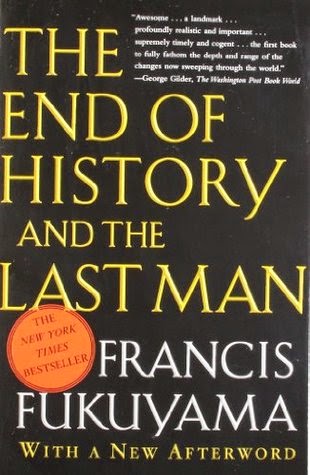
The End of History and The Last Man by Francis Fukuyama

Title: The End of History and The Last Man
Author:  Francis Fukuyama
Original Publication Date: 1992
Pages: 464

"But it is not necessarily the case that liberal democracy is the political system best suited to resolving social conflicts per se. A democracy's ability to peacefully resolve conflicts is greatest when those conflicts arise between so called "interest groups" that share a larger, pre-existing consensus on the basic values or rules of the game, and when the conflicts are primarily economic in nature. But there are other kinds of non-economic conflicts that are far more intractable, having to do with issues like inherited social status and nationality, that democracy is not particularly good at resolving.”

Francis  Fukuyama was born on  October  27,  1952 to Yoshio  Fukuyama,  a second  generation  Japanese  American,  and  Toshiko  Kawata  Fukuyama. Fukuyama’s childhood years were spent in New York city and in 1967, the family moved to State College, Pennsylvania, where he then attended high school. His Bachelor of Arts in Classics was obtained in 1974 from Cornell  University  and  taught  right  after  in  the  Yale  University  Department  of Comparative Literature during 1974 – 1975.  In 1981,  he  received  his  Doctor  of  Philosophy  in  Political  Science  from  Harvard University by doing a dissertation on Soviet foreign policy. Francis Fukuyama was a member of the Political Science Department of the RAND Corporation which conducts researches about public policies in Santa Monica,California  from  1979  to  1980,  1983  –  1989,  and  then  in  1995  –  1996 . In 1981 and 1982, Francis Fukuyama was an official member of the Policy Planning Staff of the United States Department of State where he focused on Middle Eastern issues. In 1989, he returned to the same body, but this time as a deputy director for European political and military affairs. While he was a member of this said policy planning staff, he published an essay entitled “The End of History?” in a small foreign policy journal named The National Interest.

The End of History and the Last Man is a book expanding the essay “The End of History?” that Francis Fukuyama wrote in 1981. It sparked extraordinary debate both in the United States and abroad. Francis Fukuyama’s analytical philosophy is anchored in the fact that the article was written five months  before the collapse of  the Berlin wall  where ideological  contentions between democracies and communism were in head to head disputation. His  employment  at  those  times  and  his  origin  of  education  has  surely predicated his preferences in writing the article and eventually the book. Being a RAND corporation researcher and as a member of the United States Department Policy Planning Staff would have surely molded his very reasons for writing such. As an officially employed citizen of the United States, one cannot deny that fact that he must advocate to the principles of the State and government that has employed, nurtured  and  protected  him,  and  that  is  liberal  democracy.  We  may  say  that because he is of the government, he wrote the “End of History?” to impinge on disintegration of the Berlin wall.

The End of History and the Last Man posits the idea of writing a universal history of human development with the end of liberal democracy. The prevalent extension  of  not  only  liberal  political  but  also  economic  ideas  throughout  the communist  world  and  to  third  world  countries  presupposes  that  mankind  has reached its ideological evolutionary process. Although the occurrence of events in the  simplistic  sense  of  history  still  occurs,  the  evolution  of  human  society  has reached its end with liberal democracy and not with communism.

Francis Fukuyama points significant emphasis on the French and American Revolutions. He stresses that the amalgamated ideals formed in the momentous revolutions were the indispensable foundations of the end of man’s history, liberal democracy.  His  periodization  ends  with  all  states  having  the  same  form  of government.

It rejects Marx’s idea of human development with communism as the end goals of the system. And just as any post – modern theory rejects grand narratives in existence,so does it support and enact one of its own. This is what Francis Fukuyama’s work is doing, it rejects the various numerous ideas of the development of human society and  presents  that  grand  narrative  that  societal  development  ends  with  the institutionalization of liberal democracy in every state.

Perhaps the biggest critique about Francis Fukuyama and his book The End of History and The Last man is that he has this tendency to show his biases on his writings. His position in the government of the nation is clearly felt in the arguments of the origin of liberal democracy and the end of which he speaks of in essence perpetuates the imperialistic aims of a world super power.

The Gardener by Rabindranath Tagore

Title: The Gardener
Author: Rabindranath Tagore
Original Publication Date: 1913
Pages: 87


“It is a game of giving and withholding, revealing and screening
  again; some smiles and some little shyness, and some sweet useless struggles.
This love between you and me is simple as a song.

No mystery beyond the present; no striving for the impossible; no
  shadow behind the charm; no groping in the depth of the dark.
This love between you and me is simple as a song.

We do not stray out of all words into the ever silent; we do not
  raise our hands to the void for things beyond hope.
It is enough what we give and we get.
We have not crushed the joy to the utmost to wring from it the
  wine of pain.
This love between you and me is simple as a song.”

One of my favorite excerpts from this wonderful book. It is amazing to read Rabindranath Tagore, a Bengali polymath, a hundred and one years after he received his Nobel Prize for Literature, a hundred and one years after being the first non-European awardee of the Nobel. The Gardener is a book of poetry. In the beginning, a modest servant pleads to the queen to be her gardener. She asks the reason why. He answers, the simplicity of which carries a subtle unfathomable heartbreaking depth. But perhaps, the servant turned gardener was compelled, inescapably, by an unrequited impermissible love for the queen, the kind that makes you queasy and uncharacteristically giddy all around, for much of this book contains aphorism, euphemisms, and ruminations for love in its varying forms, shortcomings and eternal joys, or perhaps the Gardener wanted the queen to know the real beauty of life, as ponderings in life too are contained in it. Tagore's use of colloquial language is spiritual and mercurial. There is depth in his rich use of imagery and allegories and one can read this in varying degrees but it is strange that at the same time it is straightforward in its delivery that it taxes credulity knowing this has been written a century before. And I think, it too is wonderful how he ended this work. Strange and beautiful.

"Who are you, reader, reading my poems an hundred years hence?
I cannot send you one single flower from this wealth of the
  spring, one single streak of gold from yonder clouds.
Open your doors and look abroad.”

“From your blossoming garden gather fragrant memories of the
  vanished flowers of an hundred years before.
In the joy of your heart may you feel the living joy that sang
  one spring morning, sending its glad voice across an hundred
  years."


This book forms part of my remarkably extensive reading list on Nobel Prize for Literature Awardees

Thursday, May 22, 2014

Penguin Island by Anatole France

Title: Penguin Island
Author: Anatole France
Original Publication Date: 1908
Pages: 284


“As if men could live in society without disputes and without quarrels, and as if civil discords were not the necessary conditions of national life and progress… The progress of civilization manifested itself among them by murderous industry, infamous speculation, and hideous luxury.”

Penguin Island is not about penguins, but it is about history. It is a cynical retelling of the human history commenced in the era before pre-history to the modern ages, done in satire. It is certainly satirical and cynical but to what extent is fictional retelling and actual telling is indeterminate. After all, one can simply consider this a bold and fearless work, claiming that what Anatole France has written here is the natural truth of the world that people naively fail to see or perfunctorily acknowledge.

The novel begins when a monk, Mael, who ingenuously unknown to him to have been led by the devil, comes across Penguins, and irretrievably baptizes them on the strength of the precarious belief perpetuated by a sharp dulling of the senses imposed by old age that the said Penguins were humans. The act carries extensive repercussions as the Council of Heaven convenes presided by the Father, deliberating on Mael’s action. The Council, like most parliamentary bodies, fraught with innumerable opinions hastily decides, for the sake of arriving at a decision, to turn the Penguins into humans. “The sacrament of baptism," answered St. Patrick, "is void when it is given to birds, just as the sacrament of marriage is void when it is given to a eunuch.”(44) Hence, a new line of humans were henceforth born into the world. They came to be known as the Penguins and this is their history.

France chose certain points in human history to emulate. He starts off with the Ancient Times, where the concept of private property was to be brutally established. He brings us next to the Middle Ages and the Renaissance, followed by the Modern Times and ends with the Future Times. The story is infused with fictional aspects like the inclusion of the histories of dragons and other notable mythical creatures. The following are the recurring and prevalent points in the eras France chose to write with.

The penguin people were transformed by the power of God. But he cannot fill them with the knowledge and moralities needed in life; these were to be their test. They were but suckling infants in these aspects. France plays this aspect out with the recurring theme of corruption of the penguin (human) soul in its pursuit of knowledge, readily stating at times that man is no different from the common animal. “The separation between man and animal is not complete since there are monsters who proceed from both.”(68)That the penguins were purer, unadulterated, untarnished until they were turned humans was how France sought to impart the point that what we have gained, made us lost the things that were worth keeping. “I notice with sadness, my son, that since they became men the inhabitants of this island act with less wisdom than formerly.” (90) Hence, the annals of Penguin history were peppered with the undulating momentum of the decadence of their pure souls.

The church sought to rectify this dilemma. The didactic needs were exclusively satisfied by the monks of the order of Mael. From this relationship stems an age long conundrum the real world is no stranger to. France incorporated this idea when he extensively wrote on the politics, further leading to the excessive entanglement of the church and the state that screwed us many times over. “The splendour of the truth in those times illumined all souls that had not been corrupted by sophisms. This is the explanation of the unity of belief. A constant practice of the Church doubtless contributed also to maintain this happy communion of the faithful—every Penguin who thought differently from the others was immediately burned at the stake.”(108) In the real world, kings appointed bishops, the priest approved the rule of the ruling king by preaching hell and purgatory to dissidents, the pope calls the people to arms, labeling wars holy in an attempt to conscript the people, farmers and kings alike.

France’s thoughts on the development of the state and the establishment of regimes from the monarchy to the republic are highly intuitive. “Every system of government produces people who are dissatisfied.” (153) We have to remember that this was first published in 1908. His political insights carry incomparable probative value and relevance to our times.<b><i> “The life of a people is but a succession of miseries, crimes, and follies. This is true of the Penguin nation, as of all other nations.”(139)Thus, he moves on, even discussing capitalism, the necessity of war, and its profitability. “The number of wars necessarily increases with our productive activity. As soon as one of our industries fails to find a market for its products a war is necessary to open new outlets.”(150) The forethought France was armed when he wrote this is outstanding, in a time when capitalism has yet to meet the progenitor of its existing unrelenting critiques, the Great Depression in the 1930’s, and where America has yet to be seen as a perpetuator of capitalism and neo-colonialism, we could already read this  “Alca (penguin homeland) is becoming Americanised. Everywhere we are destroying all that is free, unexpected, measured, restrained, human, or traditional among the things that are left us.”(268)

It would seem that France subtly wrote that women controlled the world. “Since the coming of these nuns the innocence and peace of the monks are at an end." "I readily believe it," answered the blessed Mael. "For woman is a cleverly constructed snare by which we are taken even before we suspect the trap. Alas! the delightful attraction of these creatures is exerted with even greater force from a distance than when they are close at hand. The less they satisfy desire the more they inspire it.”(13)It is both interesting and curious to me. Whether I would place it as a genuine attempt of his at unraveling this interesting idea, which is no less real than it really is as of today, or an objectification of the female sexuality confounds me (Anatole France was himself a womanizer). “Woman attracts a civilized man in proportion as her feet make an angle with the ground. If this angle is as much as thirty-five degrees, the attraction becomes acute”.(269) I however am inclined to argue for the former. The Penguin Island is riddled with cunning decisive and witty women, the patron saint of Alca, the woman who saved them from an alleged dragon was a woman, a woman toppled a regime, a woman defined the minister of the republic which led to vicissitudes sought by socialists. This I guess would by necessity imply the exaltation men in this book curry to these women, to which they were led to ruin, sadness, manipulation and a relationship of convenience.

France is subtle but as vicious as can be. In all instances, when men of acclaimed holy stature are tempted, they are tempted unbeknownst to them by the devil himself clothe in holy robes. The act that sets this history in motion is of such kind, and many more instances can be read in the book. This to me may perhaps stand as a representation of the evils within the institutional church that haunted(haunts?) human history, or it could also be my fatal misreading of this novel.


Other Books by Anatole France:
Revolt of the Angels(4 Stars)

This book forms part of my remarkably extensive reading list on Nobel Prize for Literature Awardees.

Friday, May 9, 2014

The Gospel According to Jesus Christ by Jose Saramago

Title: The Gospel According to Jesus Christ
Author: Jose Saramago
Publisher: Harvill Press
Original Publication Date: 1991
Pages: 341


Appreciation of this book dictates that you have to contend with two premises:

First: That Saramago's signature writing is characterized by sentences that are paragraphs long occasionally digressing from the thought of the sentence.

Second:That this book is about the humanization of Jesus Christ necessarily entailing innumerable repercussions to the orthodox belief of his 'socially' constructed divinity.

Of the two, I met with some negligible difficulty with former.

Saramago's writing is incomparably unique and beautiful at the same time. It is unique for his sentences are literally paragraphs long  lengthened by serial commas and seemingly unending semicolons. But Saramago's writing does not lack beauty. In fact even in his long winded sentences, there is fluidity in his labyrinthine like thoughts. It cannot be hardly expected that sentences as long as his comport themselves into solitary thoughts. This is hardly the case as his sentences sometimes tend to digress from the precedents he has laid down. I often find myself pausing irregularly, suddenly turning pages back, and rereading certain passages over again. But once you find the coherence in his thought and the connection between the phrases, one will find writing unlike any other.

The Gospel According to Jesus Christ is an incomparably fearless work. Works like these tend to create an unprecedented outcry from the religious community, as it did in this case, which however did not impede Saramago winning the Nobel Prize for Literature.

In most Christian orthodox beliefs, the arrangement of the written Word, what books to include and not, were contemplated over a time span of centuries and most were in pursuit of a certain desired conclusion, the rendering of Jesus Christ’s divinity. Also, Jesus formative years from 12 years of age to 30 are not recorded or written. This book is a fictional retelling of that life, including the years before his ministry.

This is an attempt on the humanization of the life of Jesus Christ. He is portrayed as flawed, easily angered, subjected to passions, desires and doubts; he is portrayed as <i><b>“human”</i></b>. As an extract, he wrote how Jesus fell in love with Magdalene, learning the warmth and passion of the loins and how through his ministry, she remained to be on her side, as an apostle no less.

The controversy over these kinds of themes and books has always been curious to me. The contention that lies on the alleged challenges to his divinity is misplaced and unnecessary. I guess people tend to forget the fact that Jesus was born of a human mother, but more importantly, he himself was both burdened and liberated by the human flesh. He was subject to pain, hunger, and passion naturally. We have here a perfect human model who was able to rise above the yoke of the world, but in failing to acknowledge that he himself was condemned to the very maladies we are subject to, we tend to be caught in a cyclic self-defeating belief. You see, faith in Jesus Christ should not be that he was faultless, kind, and magnanimous because he was divine. It should be anchored on the idea that he was human, like us, and that he saw kindness in the world, he gave compassion where none was asked, he made the right and honest decisions were conventionality dictated otherwise.

To consider the question of this book as an affront to the faithful is both hilarious and tautological. Faith is a funny thing. It is meant to be tested, to weather it from the storms of challenges, to keep resolute in times of trials and temptations, to be unyielding in the most pressing of times, there lies faith, not in the cradled bosoms of the fearful and the apprehensive.


For a similar book to enjoy, read  Revolt of the Angels by Anatole France (4 Stars)


This book forms part of my remarkably extensive reading list on Nobel Prize for Literature Awardees

Thursday, May 1, 2014

Revolt of the Angels by Anatole France

Title: The Revolt of the Angels
Author: Anatole France
Original Publication Date: 1914
Pages: 282

I read this book as part of my Nobel Prize for Literature Awardees reading list. As it turned out it is one the longest list I will ever try to finish. Sometimes I too wonder where I found the audacity to attempt to foray in this kind of reading list.

The Revolt of the Angels is my initial foray into Anatole France's works, which definitely is not my last one. It was not his first, as France was apparently a poet and a journalist too, but is considered to be his most profound novel. I was a sucker for riveting titles and killer first lines, so I picked this book and read. And read I did.

Anatole France, born 16 April 1844 and died 12 October 1924 was a French poet, journalist, and novelist. His was a lifetime of books. The family business was a bookstore, one which, arguably, could be the best environment to raise a future Nobel Prize awardee. He was schooled in a private Catholic institution which lends credulity to the fact that Anatole France was one hell of a radical as exacerbated by his writings. The rest, as one would say, is history. He was awarded the Nobel Prize in 1921. Shortly, in 1922, as a response by the institution we all know as the Roman Catholic Church, all his works were banned through the Prohibited Books Index, a list which has been abolished since 1966 and contained the likes of Sartre, Rousseau, Voltaire, Descartes, Locke, Hume, Galileo to name a few. Oh what a delight that list was.

The book itself was written in 1914, a time when France was besieged by the incoming Germanic invasion brought around by the First World War and was troubled at home by the numerous Socialist objections. What dominated this part of French history however was the power struggle between the Church and the State, one that is contained in this exceptional book and which probably served as the backbone for this exceptional work. Overly simplifying this dialectical issue, the struggle existed because the Church is seen to be representing the archaic system of institution embodied by the Monarchy against the desire of the Republicans who utterly detested political and class affiliations that are perpetuated by these monarchies. So from here, Anatole France wrote.

I obtained my FREE e-book copy through Project Gutenberg and was translated from the original French by Frederic Chapman. Apparently, licenses on century old books do not exist. As expected of a work in the early 1900s, a lot old English words and words derived from both Latin and French were used like architrave, frieze, verbena, narcissi, demiurge, though let that not deter you from missing on this work. The prose is beautiful as expected from an Nobel Awardee.

Revolt of the Angels tells us of the story of Arcade, a Guardian Angel, the lowest caste of the nine-tiered order of these heavenly beings. It narrates his pursuit of knowledge and how such knowledge led to become the foundation with which he challenge GOD, or as he called it, the DEMIURGE – the creator of the material world – or Ialdabaoth. Yes, this is the same GOD most Christian churches would profess belief to.  The book further tells us how he conspired with other ‘fallen’ guardian angels and plotted the overthrow of Ialdabaoth. Intertwined with Arcade’s story is Maurice’s plight of losing his guardian angel, his dishonor and fornication (to which a certain extent Anatole France himself engaged in).  The novel’s theme perhaps lies in the age-old philosophical conundrum of knowledge (or science) pitted against religion. Perhaps this conundrum is epitomized by Arcade’s statement:

“When the angels possess some notions of physics, chemistry, astronomy, and physiology; when the study of matter shows them worlds in an atom, and an atom in the myriads of planets; when they see themselves lost between these two infinities; when they weigh and measure the stars, analyse their composition, and calculate their orbits, they will recognize that these monsters work in obedience to forces which no intelligence can define, or that each star has its particular divinity, or indigenous god; and they will realize that the gods of Aldebaran, Betelgeuse, and Sirius are greater than Ialdabaoth.” (39)

What comes across to me however is that we human individuals are like Arcade, like these Angels in revolt. We seek the truth behind things. We learn, and learn and still crave for knowledge. But to where does this knowledge lead us? To me too at the same time we are Maurice. Just like him we all seem to have fallen into a trap. We love life itself so much that we fear losing it, that in any semblance of hope or continuity, we have sometimes turned to belief in numerous institutions, uncritical and naïve. That instead of uplifting the human soul, we have formed for ourselves unbreakable shackles that continue to limit our perception of the world.

"I sought out the laws which govern nature, solid or ethereal, and after much pondering I perceived that the Universe had not been formed as its pretended Creator would have us believe; I knew that all that exists, exists of itself and not by the caprice of Iahveh; that the world is itself its own creator and the spirit its own God. Henceforth I despised Iahveh for his imposture, and I hated him because he showed himself to be opposed to all that I found desirable and good: liberty, curiosity, doubt.” (139)

But what does exactly limit our perception? Is it really a religion, a church, a system of belief? Is it not fear and ignorance that severely limits human understanding and compassion, so much so that in the first place, no actual conflict exists between these forces? Is knowledge really the answer? What does this knowledge refer to?

In the closing part of the book, when the Army has been assembled and Arcade went to ask Satan to lead the army on their march, Satan said this in response:

“As to ourselves, celestial spirits, sublime demons, we have destroyed Ialdabaoth, our Tyrant, if in ourselves we have destroyed Ignorance and Fear." “…We were conquered because we failed to understand that Victory is a Spirit, and that it is in ourselves and in ourselves alone that we must attack and destroy Ialdabaoth.” (292)

The beauty of this statement lies in its verisimilitude.  Our demons are given birth by ignorance. It is nurtured by fear and is encouraged by blind obedience. These demons have always been personal in nature. Yet the discrepancy in societal response has become fundamental in nature.  We have raised countless institutions that are impersonal and by being so, wholly unresponsive. And more vital to all of this, we fail to recognize “that it is in ourselves and in ourselves alone that we must attack and destroy Ialdabaoth (292).” 

I have left the institutional church long ago, embarking on a more personal attempt in understanding things. In a sense, I have aspired to be spiritual without being religious, and have met a great many debates and contest on this aspect. Since then however, I have struggled to conquer my own demons. I have sought to eradicate cynicism and suspicion in receiving and responding to others, and have tried to look for that piece of kindness in everybody. The first step is always recognizing that perhaps the fault lies in ourselves, for this too is the hardest step to make.

This here is a good book. It may literally challenge fundamental beliefs of the religious institution, but what it truly offers is a much needed case of retrospection and examination which doesn't hurt to engage in once in a while.  I would recommend it to everyone except that one should still take caution choosing whom you recommend it too. Perhaps if you enjoyed this book like me, a similar theme albeit carried in another plot was written by Jose Saramago, yet another Nobel Prize awardee, entitled The Gospel According to Jesus Christ(3 STARS).