Showing posts with label Science Fiction. Show all posts

Monday, July 14, 2014

The Girl with All the Gifts by M.R. Carey

Title: The Girl with All the Gifts
Author: M.R. Carey (Mike Carey)
Original Publication Date: June 6, 2014
Publisher: Orbit
Pages: 460
Genre/s: Science-Fiction, Post-ApocalypseZombies


The Girl with All the Gifts is the book with all the treats.

The Girl with All the Gifts is Pandora's Box


Deciding what to have for supper was a subtle battle of attrition. The fact that Pasta won is a victory I could have lived with. Working within the defined limits of cooking, I prepared everything that was needed, left the Pasta boiling, and waited. Everything was going smoothly, almost asking, begging, that something go wrong, just as it does every time I walk into this alien dimension called kitchen. I should have stuck there, waited for the pasta to be firm, except that I went ahead and read this, and that's when everything started to go pleasantly wrong. The only conscious act I seem to remember aside from reading is flipping through the introduction. Before I knew it, I was 1/3s done, with it, an indefinable black mass. Alas, I have burned the victor beyond recognition, and necessarily induced a palatal fit of sadness. No worries. This is, after all, the book with all the treats, if anything, it will get me through the night. And it did, for if night is defined by nothing else but a natural state of rest during which our eyes are closed and one becomes unconscious, it was then a very foreign concept in that limited instance. I went to bed, but not to sleep. I stirred and turned a page, I changed positions and turned another. And then again, as if sucked by this ineluctable book-induced vacuum where time is but a word and urgency a concept, I turned the final page. I just finished reading The Girl with All the Gifts and it brutally severed me from my reading reverie. It was 4 A.M. I have not prepared my arguments for today's moot court practice which will surely lead to a mediocre if not a laughable performance, I did not slip out of my clothes which left me aching on undesirable regions, my eyes were unsuitably watery, my eyelids were falling as if tied down with concrete barriers, I was so lightheaded as if I myself was walking on air. I did not sleep at all. No worries. After all, I just read The Girl with All the Gifts. And it has made all the difference.

And yes, it's that GOOD.

disclaimer: possible science-fiction bias in play

caveat: proper review forthcoming, perhaps after a good dinner and some sufficient sleep.

Saturday, June 7, 2014

Stranger in a Strange Land by Robert Heinlein

Title: Stranger in a Strange Land
Author:  Robert Heinlein
Original Publication Date: 1961
Pages: 528 (Abridged); 756 (Original)


“Nine times out of ten, if a girl gets raped, it’s at least partly her own fault.” (511)

Perhaps this is the single most quoted statement from this work, and also the statement by which Heinlein is critiqued and berated, the same statement by which this philosophically charged work is sullied by 1-star ratings. Whether by inadvertent straying into a faulty conception and erroneous application of intentional fallacy or the failure to recognize that Heinlein sought this work to stand as historicization of the prevailing attitudes at the time of writing juxtaposed with those of the future, as represented by the Man from Mars, the loss of substance predicated upon such mistakes are saddening.

Most reviews needlessly nitpick this book by implacably quoting sexist remarks offered to us by a cantankerous Jubal, who symbolized the attitude of a bigoted past, but that is missing the big picture, and missing the very idea this book seeks to impart. That is the point, to present homophobic, sexist, resistant-to-change personas that stand for the past, because in the end, we see that Jubal, is opened up to a new philosophy, divested of all improprieties and finds himself realigning his beliefs, a belief which is open to change.

By doing so, Heinlein, through Jubal and the Man from Mars, asks the reader, by extension, to reexamine beliefs and conventions. To disregard this by literally focusing on the sexism is to lose the quintessential aspect of the book.

See beyond the literal. Challenge the conventions.

Wednesday, June 4, 2014

Women's Work by Kari Aguila


Title: Women's Work
Author: Kari Aguila
Original Publication Date: November 16, 2013
Pages: 298


I knew my male to female author ratio was severely disproportionate with the scale undeniably tipping on the expected side. So I try, along with my many reading projects, to incorporate the ideal that such imbalance be rectified if not in an achievable and realistically acceptable equilibrium then at least the consolatory mindset that nobility exists in a task faithfully pursued such as this.

Then I thought, what better way to pursue this end, when by happenstance, I stumbled upon this book, which claims to present women’s struggles in a post-apocalyptic world, written no less by a female author.

Women's Work tells us the story of Kate and her family who struggles to survive in world ridden no less by male chauvinists who by all measures are extremist in their professed bigotry. In this world, the women have taken over all aspects, and when I say all, I meant everything. The men have not only been relegated but were also reeducated of their social roles. They stay in the house, are not allowed to speak in town or council meetings, they are, in all respects, abrogated of any capacity less the frivolous and mundane.

The concept was a fascinating one, the reversal of the socially constructed gender roles, the reaction of the male population to such extreme reversal, these were some of the things I was expecting in
Women's Work, but what struck me more was that this was the quandary of a single mother finding love in a society where a Man is not defined by any new established social convention but by the acts of his predecessors of the same biological orientation. This too was a novel more for the parenting of a single mother. There is less of the expected grand narrative of the noble struggle of survival in a post-apocalyptic world but only the fear of imagined and anticipated horrors that sublimely define the characters’ psychologies.

There are a number of things you have to get around to appreciate this.

The world building premise is anchored on the arrangement that the male contemporaries have orchestrated the government to pass laws banning birth control without the husband’s consent, to the regulation of what they could and could not wear, leading to more pivotal and drastic actions like the banning and removal of women from politics and the military. The premise world is an extremely male chauvinistic society.  If you get around that you can move on with the story, which leads us to the next point.

The novel presents a comprehensive and absolute dichotomy between the male and the female sexes, an instance which, even in fiction I might add, is highly improbable unless we discount the existence of certain radical, idealistic individuals, or group of individuals. This is the perfect embodiment of a class fighting for its own liberation from domination and believes itself to be fighting for human freedom and was able to appeal to an idea present  in all who are oppressed which however in the long and virtually continuous battle for freedom, the classes who were fighting against oppression at one stage sided with the enemies of freedom when victory was won and new privileges were to be defended. Because it tries to take on this grand extremist scenario of men vs. women, the story failed on the microcosm, I was expecting a more immersed perspective in presenting the difficulties of a woman in a possible post-apocalyptic world, like that of raising a young boy in such well delineated social arrangement, or that of the greater need for security. I have to point out that the concern for security in relation to the man in this novel cannot be included, for even in the beginning, subtle sexual proclivities can be read between Kate and the man, no real concern for security exist there.

The children too are a tad unrealistic. They were perfect, much too perfect. They followed all commands, did not answer back, did not worry about their father lost in the war, they communicated with their parents. Because they were perfect, they were all the same and hence no reasonable character development existed. Because they were perfect, they were an anachronistic existence in a post-apocalyptic world. It’s just hard to imagine that these children whose life are peppered with bomb craters, raider threats, women armed with arrows and knives are presented in such a faultless existence.

To me, the characters fail because they are perfect. The power struggle fails because the conflict is grounded on the belief that the differences among genders are defined only by their biological orientations.

The writing style is admirable, with the occasional rough transitions and forced conversations, considering this to be the first work of the author. Still, much thanks, Kari, for my copy! I look forward to your growth as writer!

Thursday, May 22, 2014

The Demolished Man by Alfred Bester

Title: The Demolished Man
Author: Alfred Bester
Publisher: Millenium
Original Publication Date: March 1952
Pages: 250


“But man is not made for defeat," he said. "A man can be destroyed but not defeated.” (Hemingway, 1952)

The human spirit cannot be defeated, but it can be destroyed, in this case, the complete eradication of what you once were, the complete destruction of the psyche, the birth of The Demolished Man.

Awarded the first ever Hugo Awards in 1953,The Demolished Man is considered to have had an extensive impact to the genre that rippled through the ages especially in the cyberpunk generation. But 62 years after it first came out, reading it today felt worn-out and clichéd, I guess in the science fiction genre, it just got ‘old’.

An idea similarly grounded to that of Philip K. Dick’s The Minority Report, The Demolished Man operates in a world where crime is but a concept thanks to Espers, individuals who are capable of ESP, which of course involves reception of information not gained through the recognized physical senses but is sensed with the mind.

No murder, designated as a triple AAA felony, has been committed in over 70 years since the latent capacity for ESP emerged, until a fatal game of Sardine was played in the Beaumont Mansion. The prime suspect, Ben Reich, is the owner of the company, Monarch, second only to the D’Courtney Cartel to its lucrativeness. The victim, Craye D’Courtney, the namesake and owner of the most profitable cartel, had his head blown off by an unknown weapon. Enter Lincoln Power, a 1st class Esper and Prefect of the Police Psychotic Division who investigates the historic murder case which inevitably leads him to a collision course and hunting expedition for the world-shaker Ben Reich. Voila! You have The Demolished Man.

I am arguably compelled to label this as a mystery, police, and investigative novel rather than a sci-fi book. Really, the plot is all about the investigation of the murder, the search for evidence, and the incarceration of the criminal. This is a mystery novel done the science fiction way.  But that aspect was actually the fun enjoyable part of the book. The morally challenged banters, the deceptive maneuverings, and the cunning and shrewd exchanges between Reich and Powell were exhilarating.

Of course, the concept of intent versus positive act in crimes was included in this book, albeit it was not played out as well or as extensively as was done in The Minority Report.

What I failed to appreciate however was how Bester chose to lay down his world building and science fiction elements, his style.

For example, the explanation of the varying levels of Esper classification was carried out in a rough unrealistic fashion.

“First, the background, Mr. Reich: There are approximately one hundred thousand (100,000) 3rd Class Espers in the Esper Guild. An Esper 3 can peep the conscious level of a mind---can discover what a subject is thinking at the moment of thought. A 3rd is the lowest class of telepath. Most of Monarch's security positions are held by 3rds. We employ over five hundred...”  (15)

The instance above plays out when Reich turns to one of his employees, but the facts therein stated are not the things an owner/CEO does not know when he runs and owns a company that employ Espers. What happens here is that Bester directly laid down the ideas thread bare, without any effort at subtly building his world. This instance is repeated again when he tried to connive with one of his Esper employees to which in response he gets this;

“You don't understand. We're born in the Guild. We live with the Guild. We die in the Guild. We have the right to elect Guild officers, and that's all. The Guild runs our professional lives. It trains us, grades us, sets ethical standards, and sees that we stick to them. It protects us by protecting the layman, the same as medical associations. We have the equivalent of the Hippocratic Oath. It's called the Esper Pledge. God help any of us if we break it... as I judge you're suggesting I should.”(19) 

The point is, these are things that are not introduced through a normal conversation, they made certain characters stupid and seemingly oblivious to the operative facts of the world they were supposed to be living in.

Another aspect of Bester’s style that bothered me was how he transitioned between scenes in his story. They felt rough at times and I experienced this momentary feeling of displacement and surprise that I’m reading another unrelated scene.

It was okay (2.5 Stars), but I will not recommend it to people when they ask me about sci-fi books. Instead, why not read the Hyperion Cantos and have a science fiction experience of a lifetime. And please do forgive me for using Hemingway as attention step for this review. :)


This book form part of my HUGO AWARDS reading list.

Thursday, May 1, 2014

Demon (The Gaea Trilogy #3) by John Varley


Title: Demon (The Gaea Trilogy #3)
Author: John Varley
Publisher: Berkley Books
Original Publication Date: 1984
Pages: 464

What if you could talk to god, and ask one thing? What would you ask of him or her?

John Varley played with this concept in this trilogy together with ideas of cultural variations, religion and psychological developments. It was exciting, novel and conspicuously distinctive from most science-fiction works of today.

The book was written in 1979, and in 1980, it was listed as the first official winner of the Locus Award in Science-Fiction. But considering that time frame, all the books in the series are an easy read and arguably a page turner. If I recall correctly, I labeled the books as currently reading months earlier but in actual time consumption, I finished all three in less than a week.

I liked how in Varley’s world building, he presented numerous interesting ideas on cultural development and religion. The idea of the self-sustaining alien environment is appealing and just like the mysteries carried in Rendezvous with Rama and 2001: A Space Odyssey, the idea of a more advance entity gracing us is riveting.

But what made me rate the books from the average three to a measly two is as conspicuous as the books’ appeal.

I did not like any of his characters. They were designed with weak foundations and even weaker developments. Simply put, they were not enthralling. In the later parts of the trilogy, I still failed to neither identify nor maintain a veritable connection with the crew.

The further reason is that Varley’s books can be abridged in two simple story arcs. The first is the discovery to the overthrow of the god and second the sex, yes you read that right, sex. Let me set this straight that outright, there is no fundamental issue between these two topics, the problem lies in the story itself. You see, when John Varley first presented Titan, the process of reproduction between the Aliens was nothing but interesting. I admit it was unique and well thought out. In the later parts of the trilogy however, when the process have been deconstructed and it has worn out its appeal and novelty,  the science and the beauty of the process was relegated to nothing but mere physical intercourse (including humans of course). So what happens is that the whole story is actually an intercourse (no pun intended) between these two pieces of the puzzle, something like this, sex-discovery-sex-plotting-sex-conspiring-sex-overthrow, so you see the problem, or is it a problem at all?

Would I recommend this trilogy? Perhaps not. I actually engaged in finishing the three books because I could not literally bear leaving something hanging, even if that means plodding through another two books.

As for me, if I could ask a god, I would, in his infinite capacity inquire, when George R.R. Martin would actually come around finishing his GoT series.

Monday, April 14, 2014

The Maze Runner (Maze Runner Trilogy #1) by James Dashner

Title: The Maze Runner (Maze Runner Trilogy #1)
Author: James Dashner
Publisher: Delacorte Press
Original Publication Date: October 6, 2009
Pages: 374

The Maze Runner is like Pandora's box. As the mysteries haven't been revealed just as Pandora's box haven't been opened, it remains to have this unlimited, unknown potential. This statement comes after reading the main trilogy under Maze Runner, and is a subtle way of saying, that  I really liked how James Dashner conceived this world, but did not so much as appreciate how he ended it. Tragic and disappointing.

Tuesday, April 1, 2014

World War Z: An Oral History of the Zombie War by Max Brooks

Title: World War Z: An Oral History of the Zombie War
Author:  Max Brooks
Publisher: Crown
Publication Date: September 6, 2006
Pages: 342

I had to read this twice so that I could review it. The first time was wholly devoted for the satisfaction for my growing insatiable thirst of the literary work from the post apocalyptic zombie genre. The second, for the claimed critical review.

For all its worth, aside from genuinely giving the zombie genre a foothold to establish itself as a legitimate  class by itself, Max Brooks has successfully revolutionized the traditional platform of novel writing.

The employment  of an objective presentation of oral recorded histories is magnificent and reveling. Not only did it transcend the traditional, linear narrative form of story writing , it was employed masterfully so that the grand scenario was adroitly painted through the systematic presentation of personal stories. intellectually stimulating and a a clear literary pleasure in one. This is why I find it rather disappointing that the great dissenters of the greatness of this book is anchored on the argument that 'they' cannot seem to follow the story given its non traditional, non linear narrative form. Truly, a shame, but more so, a great loss.

I have yet to confirm my second point of adulation for Max Brooks writing(the truthfulness or rather the accurateness of material facts). Suffice it so say that he has written with a great range, albeit shortly. I love the possibilities Max Brooks has perpetuated in this book.

The critique of this work, if one may arguably call it, ironically lies with its form too, something I almost didn't notice at all, perhaps because at the subtlety with which Max Brooks has crafted this book. One reason this book is so enjoyable is that the persons from whom the oral histories have been taken were almost always witty, funny and smart ( I admit this is rather more personal than objective). All I'm saying is that it could be more realistic if there were some (more) natural (not boring) recorded oral histories. But I guess this has to be counter weighed with the ends the author sought to achieved, the enjoyability, and the marketability of the book.

P.S.
the movie is nothing like the book except for the concept of a u.n. worker and the high walls of Israel. It has merits as a movie, but as an adaptation, a lot has to be desired.

Patient Zero by Jonathan Maberry

Title: Patient Zero (Joe Ledger #1)
Author: Jonathan Mabbery
Publisher: Martin & Griffith
Original Publication Date: March 2009
Pages: 421

This is also one of those books that use the Zombies as mere plot devices rather than being the plot themselves, hence, it too is an error to classify this under the Zombie genre, something I should have known better by through the sub-labeling of the series under the title Joe Ledger. The further testament to the veracity of this statement lies in the succeeding books in the series. If you're into covert military operations pick this books. It's enjoyable for its action packed sequences. To the end however, I commend Maberry for using the zombies as a stepping stone to launch his series, intentionally or not.

Monday, March 31, 2014

Feed by Mira Grant

Title: Feed (Newsflesh Trilogy #1)
Author: Mira Grant
Publisher: Orbit
Original Publication Date: April 10, 2010
Pages: 571


When I was looking for the a book to get back at my roots, that is fantasy and science fiction, and under science fiction the proliferating post-apocalypse, dystopia and zombie genres, I happened to stumble on the Newsflesh trilogy. I however was not transported back to my beloved roots in my reading experience of Feed.  To put it bluntly, this is a conspiracy story with zombies as plot devices rather than being the plot. And still, I was able to appreciate iyt, reading it was a breath of fresh air a person needs a looks for once in a while.

The incremental world building process and origin story was well thought out. It is convincing enough by reason of its possibility and complexity. The effort at research and study for the backbone of the story is apparent and conspicuous and it is enjoyable to know the lengths the author has gone to bring this story to life.

I've said it before regarding book in this genre, the zombie genre has suffered the inevitable saturation that proliferating genres are so susceptible of. In this case, zombie literature has been chucked out the linear narratives, stream of consciousness school and the theme of plain old survival perspectives inter alia as the standard works. This is no surprise as these mediums are traditional, accessible and appealing to the market the genre is supposedly targeting. Included in these modes is what one could call dumbing down. What is perhaps more disturbing and perhaps worrying is that this dumbing down thematics are carried out in the YA fashion. Mira Grant is guilty to some extent of this. On some instances, she rubs down and shove in certain aspects of the story, like for example the repetitive checkpoints. But then again, credit is given to Mira Grant because shed did not saturate this book with the YA dumbing down, especially with the relationship/romance story in the book that is so out of context and blatantly disjointed in some zombie books where the insertion is conspicuously forced for marketability if not acquiescence to the bandwagons.

The book had minimal zombie encounters, but it was exciting all throughout. It was good how Mira paced the story itself. I'm looking forward to reading the second part in this series.

Wednesday, October 2, 2013

1984 by George Orwell

Title: 1984
Author: George Orwell
Publisher: Signet Classics
Original Publication Date: 1949
Pages: 328

Perhaps what makes this tale so gripping is the propensity of the imagined world to be translated in an objective observable human reality, more so as an empirical experience (not discounting that it may have been translated already). Orwell did a superb job merging a tragic romance and a corrupted political ideology. Worthy to be read beyond its years.

Thursday, September 5, 2013

Hyperion by Dan Simmons

Title: Hyperion (Hyperion Cantos #1)
Author: Dan Simmons
Publisher: Bantam Spectra 
Original Publication Date: 1989
Pages: 482

Whenever I come across an epic masterpiece a great difficulty in talking about it (in this sense, reviewing it) arises. Perhaps an empirical testament that Hyperion is nothing short of a masterpiece is that I have mulled over what I have to say over this work for an uncharacteristically numerous number of days (and still, ironically, I came up with technically nothing). I will struggle to mark my statement with brevity, lest I contradict myself and lose credence that Hyperion, is one that every sci-fi fan should read.

Every story has been told, one way or another, the gift of the author is in retelling that story and in such retelling, create a story of magnificence of his own. This is to say that Hyperion is a modern-sci-fi-setting retelling of the Canterbury tales. Six stories, woven into one epic masterpiece. This holds true to Hyperion, as one would later see. To say that Dan Simmons, in writing Hyperion, is gifted would be an understatement. He is a genius and his work a revelation. Once again, I am plunged to experience the unfathomable urge to read the book's sequel.

The Fall of Hyperion by Dan Simmons


Title: The Fall of Hyperion
Author: Dan Simmons
Publisher: Bantam Spectra
Original Publication Date: 1990
Pages: 517

I had a hard time getting a copy of this book considering the fame it has enjoyed. Perhaps such effects has bolstered the value of this book.

At the outset I would like to emphasize that Fall of Hyperion is more likely a part of the first book just as Endymion and Rise of Endymion are one, in other words, the series is actually more in the content of two books divided and stretched over four, pursued for the contingency that readers may experience some difficulty wading over a thousand paged story. At this point I actually do not mind if it was, Dan Simmons is great, and I would gladly add him up to the likes of people who can write a thousand paged story.

I love writers who do not talk down to their readers, who present complex ideas and let their readers understand, and who create a world and lets us visualize it.

The book still fundamentally carries the same format. POVs of the pilgrims later to be merged for the concluding parts. Dan Simmons did this in a masterful manner.

I revel at how he has created and developed the characters. They have remained true all throughout.

Sometimes I however pause at Dan Simmons' bombardment, literal bombardment of high-fallutin technical words that is categorically his world building and descriptive environment. I guess this is a standard of science fiction works, but to an extent Simmons is beyond any standard science-fiction work, and that tells a lot. Further, I see the embers of the story delving in parts that have been left in philosophical debates and religious contentions. I am interested at how Simmons will later play this on out. The work still delivers a wallop of a punch on the emotional level, and this is testament to how good Dan Simmons is. Take for example the moment where General Morpugo was leading the ship with his son saying 'I love you, Son'. This military man, who was fashioned to be uptight at all bearings, shattered all conceptions, and delivered such effect that it must be one of my favorite moments in the second book.

The Final Odyssey by Arthur Clarke

Title: The Final Odyssey
Author: Sir Arthur Charles Clarke
Publisher: Del Ray
Original Publication Date: 1997
Pages: 272

It is noteworthy to consider how Arthur Clarke opened the third book, and what the ramifications to the entire series were. With wanting pragmatism, he wrote that:

"Just as 2010: Odyssey Two was not a direct sequel to 2001: A Space Odyssey, so this book is not a linear sequel to 2010. They must all be considered as variations on the same theme, involving many of the same characters and situations, but not necessarily happening in the same universe.

Developments since Stanley Kubrick suggested in 1964 (five years before men landed on the Moon!) that we should attempt 'the proverbial good science-fiction movie' make total consistency impossible, as the later stories incorporate discoveries and events that had not even taken place when the earlier books were written. 2010 was made possible by the brilliantly successful 1979 Voyager flybys of Jupiter, and I had not intended to return to that territory until the results of the even more ambitious Galileo Mission were in."

Deriving not only from what Clarke tried to project as a caveat but as well as from general systemic observations from the series, I find the pressing need to elaborate on the following points.

Clarke cautions his readers not to treat the apparently labeled series as well, a series of books characterized with continuity and relativity. This is clear when he phrased that 'it' was not a direct sequel and must be considered as variations of the same theme. For the reader however this is rather demanding if not theoretically impossible considering the method, characters and story arcs Clarke choose to write with. Putatively and substantially seen in this simple manner:

Book One: Dave Bowman mysteriously disappears while in transit on his mission

Book Two: Dave Bowman returns as a part of the Monoliths and another mission is launched in pursuit of ascertaining what had happened, Dr. Floyd Heywood becomes one of the major personas by this point

Book Three: Floyd Heywood returns in the scene of another space exploration

Book Four: Frank Poole re-emerges as what could be labeled as the single persona in the fourth book establishing a connection with the series.

For one who has read the series, the meager attempt to express the thought in the words above should suffice. After all the recurring references while reading the books there is hardly any need for me to elaborate on this.

Arguendo however, if we find the utter need to satisfy some inner justice and lend credence to Clarke's desire to treat the succeeding books not as sequels but stand-alones (and i believe this is what he meant when he said that they were "to be considered as variations of the same theme"), the books, with intrepid audacity, fall into a position that is not only demeriting but which I fear could unfortunately be an unprecedented fatal waterloo for the whole of Space Odyssey books. I qoute myself by saying that:

"The book did not feel a book at all while reading it (something i've started to feel in the first book already), but more something like of a novella, or a piece greater book that is the series. I'm starting to get the impression that the 4 books should have been published as one judging by what the content has encompassed so far"

Nothing has proven to be quite substantial in the series to merit a change in this perspective. In the contrary, I find that the deeper I was into it, the further my pretense was affirmed, conclusively in varying instances.

I too find it rather irritating, as short as the books already were, that Clarke included a chapter or three from the previous books, lifting them by the whole, which presumably he wanted to function as ardent nostalgic chapters reminding the reader of events that have passed. I find them nothing but repetitive vestiges that can choke the living hell out of the reader (to be fair that was an exaggeration). It was redundant, draggy, convenient and a poor excuse for an imagined attack of writer's block (and this is what I've honestly felt).

To be critical however, Space odyssey is still a page-turner as it is (whether of excitement with the next chapter or with boredom with the lifted ones). Arthur Clarke writes in a gripping manner that catches you until the last of the pages. I give credit to his imagination contained in the writing. For me they were fresh, novel and exciting. The mystery of the monoliths can keep the reader enthralled as far as the story goes, the very idea of the monoliths was exciting in itself. The biggest letdown of this series/variations on the same theme however lies in the revelation that it failed to deliver (sole reason why the fourth book was rated two stars). After all that excitement, I opened the Pandora's box only to see, nothing.

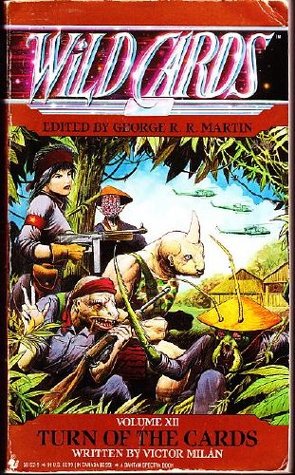
Turn of the Cards by Victor Milan

Let me start off by saying that the wild card series has a way of endearing itself to its readers considering the volume and extent to which the series has grown. Of course, the finesse of workmanship that goes with the series captivates one in further picking up the next book in the series, and that is how, I find myself writing a review for the series in this twelfth book.

The continuity by which the series' has been riddled with can be said to be one its strength and yet it too is the source of a waterloo for the series. What happens when a reader gets enthralled with a series is that we find a connection with the characters, we developed an inkling to these characters' stories and we expect a closure if not a continuation on the foundations we have been fed. We look, or rather we crave for further developments for personalities and characters we have inevitably labelled 'favorite/s' or more pretentiously identified with 'me'... or is ambitiously seen as what 'I' 'you' or 'me' would like to be. We have made it personal for this is the only process whereby one appreciates the written work. And this is precisely the reason why Turn of the Wild Cards garnered a three-star rating, or something lower if not for the Capt. Trips.

Mistral inhere for example is a misnomer. From the conclusion of the superbly done arc that was the jumper-rox-arc, she just suddenly appears pursuing Capt. Trips. Where a concise and substantial caveat could have sufficed, nothing was offered. How the hell did she get back to her body? And what of his father, Cyclone, feared dead in the previous arc. And it begs to be emphasize that in the succeeding books in the series, much of the discontinuity escalates into full blown disjointed story arc presentations, presumably (and i do hope i do stand to be corrected) due to the transfer of the right to create and publish the succeeding books to several publishing companies like TOR and IBooks.

For a person who wants to find the same continuity I am looking for, there's something to look forward to in the seventeenth book of the series Death Draws Five.

Saturday, August 24, 2013

Endymion by Dan Simmons


Originally posted at Goodreads

Somehow I felt that Endymion is the weakest of the series. It seeks to makes a connection with book two and at the same time prepare the events of book four so much so that it almost landed in a predicament where we have nothing going on.

Dan Simmons range is incredible. He has woven in this books what others might only dream of. With the monumental ideas of science fiction, the deepening anchorage on spiritual and religious facets of the story and the indispensable importance of emotional cacophony that is the series have endeared it all to me.

The weak points have rather been emphasized on this book, maybe because of what I have mentioned supra.

There is unneeded extended characterizations with the manner the characters are presented. On page 123 on De Soya's presentation:

"More than three centuries - comes first the Shrike Palace, farther south than the others, its barbed and serrated buttresses reminiscent of the creature that has not been seen here since the days of the pilgrims, then the more subtle Cave Tombs - three in all- their entrances carved out of the pink stone of the canyon wall; then the huge centrally placed crystal monolith; then the obelisk; then the jade tombs; and finally the intricately carved Sphinx with sealed door and outflung wings."

He could have simply done away with this and simply said that De Soya knew the place like the back of his hands from the Cantos. This repeats for several instances and honestly the book could have been shortened by doing so.

I had some trouble visualizing or rather digesting the facts, the story and the plot that have been revealed. I hope for further clarification on the next book.

But as i said, less than 5 pages in and already Dan Simmons had me hooked. This is certainly his gift.

Speaker for the Dead; Xenocide by Orson Scott Card


Originally posted at Goodreads

I had the benefit of having read a handful of books under the sci-fi genre before reading Card. I say a benefit for perhaps it had laid a saturated foundation of sci-fi conventionalities and cliches that had made the Ender's Series not only a new and fresh and enticing piece, but rather an unprecedentedly enjoyable one. I have disconcerted reviewing the second book for a visceral feeling that such review would almost encompass the third, which in hindsight is nothing less of what I deem to have been an accurate prediction.

I grudgingly gave three stars to both second and third books in the series. Card is a great story teller gifted with novel imagination, to say that he is also as consistent as one could possible be in writing is as true as the former statement can be (perhaps the solitary fundamental rationale for rendering the review for both the second and third books).

Ender's Game is one which I could call a true series. Now what this statement evidently precipitates is that the plot is so well thought of that it takes care of the two essential things in a series that is: 1) The plot development in every book is good in itself 2) The plot development in each book serves as indispensable precedent to the next one in the series. Already this sets apart Card and the Ender Game series from the myriad of series that are so drawn-out in all genres because of the reasons we all know too much about. I praise this continuity in Card that other writers can only dream of and so desire to have. Card however strains me beyond relief with his numerous recapitulations that are repetitive, impractical and oh so annoying. Take this for example:

On page 163 of Xenocide
“Not far from the gate, but outside it, stood two fathertrees, the one named Rooter, the other named Human, planted so that from the gate it would seem that Rooter was on the left hand, Human on the right. Human was the pequenino whom Ender had been required to ritually kill with his own hands, in order to seal the treaty between humans and pequeninos. Then Human was reborn in cellulose and chlorophyll, finally a mature adult male, able to sire children.”

On page 172
"Ender ignored the argument, because Jane was whispering in his ear through the jewel-like transceiver he wore there. "

On page 372
“The xenologer Pipo became her surrogate father-- and then became the first human to be tortured to death by the pequeninos. Novinha then spent twenty years trying to keep her lover, Libo-- Pipo's son, and the next xenologer-- from meeting the same fate. She even married another man to keep Libo from getting a husband's right of access to her private computer files, where she believed the secret that had led the piggies to kill Pipo might be found. And in the end, it all came to nothing. Libo was killed just as Pipo was.”

As I said, on this aspect, the book flayed. I guess I have to consider the fact that Card struggled trying to explain to middle-of-the-series-book readers what the precedents were. It was utterly impractical and annoying. The book can only be truly enjoyed by reading it as a true series. If card removed such parts of his writing devoid of meaning, he could have easily staved-off ten pages or more. The second of the series is a 400 page novel, the third a 600 paged one, respectively. Card is great, but a 600 paged novel is taxing credulity, so perhaps the resort to the innumerable recapitulations throughout? For all that, I found myself turning pages both for the occasional jewel, for the sought out eureka moment in Card's story and the unbearable extended internal monologue that by now has characterized Card's manner of writing. And on that concluding moment, I again find myself, looking forward to the conclusion of the series.

Ender's Game by Orson Scott Card


Originally posted at Goodreads

So, here's the search for the Napoleon who will never lose, for the Alexander who will die of old age and for the Caesar who's fidelity to his ideals define him. Here's Ender's Game.

I have put off reading Ender's Game for innumerable times now, for a reason I cannot fully comprehend, which is strange since Ender's Game easily occupy the top spots of the myriad of sci-fi book lists that exists out there. The book's following is noticeable, the appeal conspicuous, the devotion emphatic. Of course, who doesn't want to be the genius? The commander? The leader? The prophetic revelation? The savior? It's fairly easy to fall in the routine (surprising as it is) of kids defeating the bully, both personal and imaginary, and saving the world through video games (who could have thought of a more convenient way?).

The bone I'll be picking however is as conspicuous as the appeal of this book.

I have strangely felt that I was not reading a sci-fi book at times, but a psychological epic, bluntly guilty under such theme of extended internal monologue. Admittedly, there is depth in the book even under the purview of sci-fi conventions. That is to say the psychological meanderings and military motif give it a worthwhile kick. But then again, Ender's Game seemingly exist in a pole, in the extremities, which is conspicuously embodied in 1) The repeating, intense desire to kill both in and outside a military training facility; 2) the love between siblings bordering future incest; 3) and (in perhaps the most fiddling negligible example) sleeping naked in a room of 40 people you have just met. Nuances exists as do occasional irksome parts like this:

"Since he hadn't fired a shot, he had a perfect record on shooting-- no misses at all. And since he had never been eliminated or disabled, his percentage there was excellent."

It is worth emphasizing that there is no statistic if the variable is null.

There was no difficulty relegating the rating to Ender's Game, which due to Goodread's lack of a more defined rating system, is three stars.

Friday, August 23, 2013

Mockingjay By Suzanne Collins

Originally posted at Goodreads

I'm thinking of the perfect way to open this review, and while doing so, I realize that I am genuinely saddened at how the series developed and ended. I liked Hunger Games, I liked it to the point that even after what Collins did with Catching Fire, I still finished Mockinjay, partly because Catching fire was evidently prefatory to Mockinjay and partly because I sincerely hoped till the last pages the book can recover. It did not.

I see that most if not all of my Goodreads friends have rated the book from 4 to 5 stars. I could have given the same rating to Hunger Games, but doing so to Catching Fire and Mockinjay would be taxing credulity.

Collins killed her own creation.

Collins killed the Katniss that has captivated readers from Hunger Games. She killed the independent, headstrong, resolute and determined Katniss. Instead she gave us a Katniss who is fatally fickle-minded, inconsistent, vacillating and hesitant. This points out Collins' failure in developing Katniss' character concomitant with that of the plot, both in the substantially abstract aspect and the literal one. Notice how Collins has perpetuated the use of questions and maybe's in Katniss' extended internal monologues. Katniss was left unsure and questioning all the time. It is worth repeating that one of the reasons I have read this book is the empowerment and divergence from gender norms presented through a female lead. However what remained of such positive assertions were obliterated with the 2nd and 3rd books. They contained nothing but mere vestiges of something that should been worth perpetuating in any literary work. It is truly heartbreaking.

Collins killed the plot too. Systematically done through an incoherent execution and severely erratic pacing. One moment we see a rescue getting organized for Peeta's liberation the next, he's just there. Collins could have cut back on Katniss's internal monologues, because by this point, it is tedious and borders boredom. I half-expected that she would do so, she had every capacity and opportunity to her disposal, considering that there were numerous moments she could have drawn out in the book, like writing out Peeta's rescue but instead we get a sudden surprise that it was successful,(view spoiler) I know Collins wanted those deaths to deliver a wallop of an emotional punch, but it did not. She failed to establish the reason and the need for the deaths. It was simply disjointed. Collins did not need to spend a hundred pages or so on building-up the rebellion through Katniss' long walks over District 12. And most especially revolting, since this book is half dystopian and half romance is how the romance was eventually played out. I was eagerly looking forward at how it will be resolve, at how Katniss will choose between the two, I could swear I could have thrown the book in the thrash when I notice EPILOGUE suddenly looms over the next page. I mean just fu*k it. Fu*k it. Aside from the indecisive use of the kisses and the subtle objectification there was actually no resolute conclusion on the romantic issue was there, or could one hardly call Peeta's reappearance shoveling the snow at Katniss' house the decisive moment? This was the point that Collins should have employed those excessive internal monologues of Katniss and explained why Gale is suddenly out of the picture. Well, if one fundamentally considers, Katniss did not actually choose anybody did she? Peeta chose her from the beginning till the end (bolsters the predicament that Katniss is indecisive). Haymitch was proverbial when he said to Katniss that she does not deserve him a thousand lifetimes over. For all its worth, Peeta's the real martyr here, that is why it was actually a relief that he was hijacked.

Believe it or not, Collins managed to kill the excitement too. The books were overly anticlimatic. The escape from quarter quell being told in hindsight, and so is the conclusion of the supposedly epic rebellion. I mean, Collins simply build it up and up and up and just cuts it. It would have been more riveting if she wrote it straight out.

I finished the series because I was in love with the possibilities presented by the plot I experienced with Hunger Games. I was captivated by that Katniss. And I am saddened of how things turned out. This was something that started out great, turned tepid in the middle and ended up badly. One of the stars in the rating is rationalized by my love for Hunger Games, the other comes from my sister. She's gonna hate me with leaving Mockingjay with only a star, so here's two.

The Hunger Games by Suzanne Collins

Originally posted at Goodreads

At the outset, it is worth mentioning that the reason I read Hunger Games is that the lead is a woman. I have finished a number of YA books (not numerous, but substantial enough) to see a subtle inclination (at least to the ones I have read). Those books were epitomes of woman empowerment at the most, and at the least were divergents from a male-lead, paternalistic, socially constructed society. I find that Hunger Games is no different from those books and certainly no stranger to that, although to what degree I have yet to conclude.

The books is presented through Katniss' POV, I guess this should have said lot of what was forthcoming. I am hesitant to ascribe as form of a fault more than necessity the extended internal monologue and world-building through Katniss. I guess there is simply no other choice considering the manner the book is presented. The problem though is that the mental disposition of Katniss is more of a hodgepodge, that is to say clutter is involved. Sometimes it is questionable that someone who suddenly daydreams of the past and fantasizes of what could have been won the games. Although I am lead to believe that such fickle-mindedness is prevalent among the female sex. But beneath that, I can see how Katniss has been tempered, the verisimilitude of the persona within the setting is riveting.

There is almost none to little character development at all aside from Katniss' is there? This waterloo is intricately embossed with the manner of writing the story. How can one build another character through a single POV?

The book is also labeled as dystopian. To this aspect too much have yet to be developed, and after the first book, I have yet to conclude if I am in the middle of either a gory love story or a dystopian novel. I am picking that second book to answer all this. I have high hopes that this will not be one of those books that are using dystopian themes to perpetuate comical and laughable love stories that are better left unread, or better yet, unwritten. This book comes with a three star rating meaning I'd follow Katniss to death rather than live a thousand lives with a simpleton like Bella.

Conspicuously, and still strangely enough, the tragic love story of 1984 is what comes to mind with Peeta and Katniss' relationship and of course, Battle Royale. I am even inclined to say that the plot was lifted from this Japanese work.