Showing posts with label written by nobel awardees. Show all posts

Sunday, July 27, 2014

The Life of the Bee by Maurice Maeterlinck

Title: The Life of the Bee
Author: Maurice Maeterlinck
Original Publication Date: 1901
Publisher: --
Pages: 176
Genre/s: Non-Fiction


Will we all die if bees disappear?

description
An infograph on the contribution of Bees*

Thankfully, the scientifically accurate answer is NO.  That no however carries serious implications. Bees pollinate more than a third of human food and produce, which in an extinction scenario necessarily affects food security, that aside from the fact that you will struggle to exist in a world without honey.

description

The Life of the Bee is an entomological work by Nobel Laureate Maurice Maeterlinck first published in 1901. It has two versions, The Life of the Bee and The Children's Life of the Bee, the chief differences of which certain parts thought to be too violent and 'scandalous' for children were removed from the latter, like the killing of the male bee population.

To say that this is purely an entomological work would be a clear disjunction from its contents, for it is an examination of human relations as much as it is an entomological work on bees. Maeterlinck  systematically inserts his observations of human society and juxtaposes it to that of the bees, an aspect which I found sometimes to be a nuisance. I found myself looking for the next entomological part and moving on and skipping from the philosophizing. Blame it on the bees, they seem to be a lot more interesting.

description
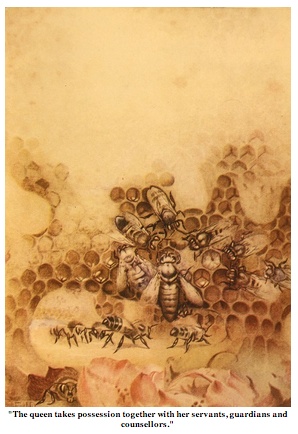
The book has illustrations like this throughout.

As this was published in 1901, there are some notable gaps in knowledge which seemed interesting for providing snippets of what have been, to this inopportune lack of knowledge Maeterlink writes, "It is sad, but let our reason be content to add, so it must be."(55).

The prose is eloquently constructed, but can be considered an inappropriately overblown writing when used in an entomological work.

Like his words on their sting:

"..there is a sort of dreadful dryness, as though a flame of desert has scorched the wounded limb; and one asks  oneself whether these daughters of the sun may not have distilled a dazzling poison from their father's rays in order to defend the treasure they have gathered during his shining hours."(7)

On the description of the hive:

"And if the outlook at first appear rather gloomy, there still are signs of hope wherever the eye may turn. One might almost fancy oneself in one of the castles they tell of in fairy stories, where there are millions of tiny phials along the walls containing the souls of men about to be born. for here too, are lives that have not yet come to life." (56)

description
The Hive

Both quotations are also reflective of operative philosophies Maeterlinck has when writing. Again his identity as part of the symbolist movement left its mark, first, when he wrote on the 'spirit of the hive' as an abstract force by which bees are governed on certain aspects like their swarming, and second, when he engaged on his habit of anthropomorphizing elements of nature to social constructs, in this case, his Father Sun.

This is considered a classic piece in bee literature and I did end up learning a lot.
__________________
*Courtesy BBC Nature


I have reviewed another work by Maurice Maeterlinck:
The Inner Beauty (4 Stars)

This book forms part of my remarkably extensive reading list on Nobel Prize for Literature Laureates

Monday, July 7, 2014

The Inner Beauty by Maurice Maeterlinck

Title: The Inner Beauty
Author:  Maurice Maeterlinck
Original Publication Date: 1910
Pages: 39
Genre/s: Classics, Philosophy


Nothing in the whole world is so athirst for beauty as the soul, nor is there anything to which beauty clings so readily. (5)

This has been a particularly hard piece to read, and by a necessary consequence, to write a review of. Maurice Maeterlicnk is, before anything else, a Nobel laureate (1911) who earned the coveted award for his plays which form a substantial part of the Symbolism Movement. Adherents believed that absolute truths could only be described indirectly, which necessitates a style of writing punctuated by metaphorical and suggestive prose. This is now our caveat by which we seek to assuage any difficulty in tackling this work.

The work is divided in three parts, Inner Beauty, Invisible Goodness, and Silence. This is a spiritual and ruminative work in all its aspects.

"Beauty is the only language of our soul: none other is known to it."(10)

Beauty is of course acts that we could generally and objectively categorize as good in man. Maeterlinck states that every man, even the unhappiest and the most destitute have at the depths of their being, this beauty that he speaks of. This necessarily lays down the premise that men by nature are good, or, in Maeterlinck's words, are naturally beautiful beings, who need only to acquire the habit of dipping into that nature, into that soul, and the greatest act by which we enliven this beauty is by loving.

Is it not in love that are found the purest elements of beauty that we can offer to the soul?(19)

To him, to love means losing every bit of 'ugliness' in our souls. It is the state by which we come closest to God. But to be good, to be able to love with real ardent affection, we must first go through suffering, a harrowing by which we are molded to become better and end up in tune with our soul, our inner beauty. "Grief is love's first food, and every love that has not been fed on a little pure suffering must die like the babe that one had tried to nourish on the nourishment of a man." (20)

And there would always remain between us truth which had not spoken, which we had not even thought of speaking... and only in silence could we perceive it.

And he counsels the reader to search for this intermittent pockets of silences in life which holds the 'real' secrets and calls them 'secret silences'.

One has to forgive my limited and modest uptake of Maeterlinck's philosophy as contained in this work. Admittedly, this is only one way to look and deconstruct this highly suggestive and metaphorical work. It bears mentioning that nowhere was beauty explicitly defined within the work except from derivable contextual references, and even then it was questionable and equivocal. The work, however clearly references  to spirituality and to God, to a human soul, but not religion. The chapter on Invisible Goodness clearly refers back to the Soul and its nature of goodness and nobility. The silence he refers to is also curious as he does not clarify as to whether he refers to spiritual silences or a physical world of a noiseless condition. Indeed he says that:

There is no silence more docile than the silence of love, and indeed it is the only one that we may claim for ourselves alone. The other great silences, those of death, grief or destiny, do not belong to us. They come towards their own hour, following in the track of events, and those whom they do not meet need not reproach themselves. But we can all go forth and meet the silence of love.

But then again he writes,

If I tell someone that I love him - as I may have told a hundred others - my words will convey nothing to him, but the silence that will ensue will make it clear.


This book forms part of my remarkably extensive reading list on Nobel Prize for Literature Laureates

This review, along with my other reviews, has been cross-posted at imbookedindefinitely

Wednesday, July 2, 2014

Memoirs by Pablo Neruda

Title: Memoirs
Author: Pablo Neruda
Original Publication Date: 1974
Pages: 378
Genre/s: Non-Fiction, Memoirs


"Perhaps I didn't live just in myself, perhaps I lived the lives of others…My life is a life put together from all those lives: the lives of the poet." (1)

description
Pablo Neruda

Pablo Neruda,  born Neftali Ricardo Reyes Basoalto, was a Nobel Prize for Literature laureate (1971), a poet whose verses breathe life themselves, whose life, was poetry itself.  Gabriel Garcia Marquez fearlessly called him the  "the greatest poet of the 20th century in any language." Che Guevara in his diaries revered Neruda as his favorite writer, and carried only two books with him till his death, one of which was Neruda’s Cantos General (the reason of which will be readily apparent later on). He was not just a poet; he was THE poet of the people, of the oppressed, the unheard, and the forgotten.

Primera Vida: A Child of the Forest "Perhaps love and nature were, very early on, the source of my poems." (19)

description
Temuco Chile, who wouldn't fall in love with that?

Neruda aptly starts his Memoirs by writing where it all began, in the then frontier lands of Temuco, Chile, emblazoned by nature’s ardor.   Nature made me euphoric (7), Neruda writes and indeed, nature did become an indispensable aspect throughout his poems as the reader would conspicuously experience throughout his works.  He characterized his childhood with modesty and austerity when referring to their economic and fiscal means, and yet one cannot help but feel that he was nothing but rich beyond measure as he reminisced his childhood with picturesque landscapes, forest adventures, and long walks defined by an indescribable affinity with nature.   I have come out of that landscape, that mud, that silence, to roam, to go singing through the world (7).  And sing he did.

Segunda Vida: A Barred Poet, Militant Student, and Gabriela Mistral’s Touch.

 description
A later photo showing Neruda with Mistral, they were both diplomats

As expected, Neruda’s father did not welcome the fact that his son wanted to become a poet amidst their challenging living conditions. The encouragement he failed to find in his father, Neruda found abounding with Gabriela Mistral(later to be a fellow Nobel Laureate (1945)), who introduced him to Russian classics. Neruda was undaunted, he continued to take poetry as a profession and went to a university at Santiago, Chile. While in the university he got acquainted with hunger and intermittent homelessness, his poems were all that kept him defiantly warm and firm.

Tercera Vida: A Diplomatic Affair"I learned what true loneliness was, in those days and years” (49).

description
Neruda visits the USSR

Neruda opted to accept an appointment as a consul after leaving the university and was first assigned in Rangoon, that further lead him to Colombo, Batavia, Singapore, Paris, and Mexico to name a few, the memoirs would suggest that Neruda welcomed the appointment, but other accounts tells that it was dire financial need that compelled him to accept the said appointment.  Whichever the case was, his consulship had a very profound effect on him, meeting a vast number of notable personas, chief of this was Loneliness. Solitude, in this case, was not a formula for building up a writing mood but something as hard as a prison wall; you could smash your head against the wall and nobody came, no matter how you screamed or wept. (92)

Unlike most poets, loneliness was a revolting concept in literary endeavors to someone like Neruda who celebrated love and life. And to combat this loneliness he wrote, “I went so deep into the soul and the life of the people" …i fell and lost my heart to a native girl (90). He sought to immerse himself with the land and the people wherever he was based, this aside from meeting personalities like Nehru, Miguel Asturias (awarded the Nobel in 1967), Picasso, Joliot-Curie, Federico Lorca, Fidel Castro and Che Guevara (later on). "The poet cannot be afraid of the people. Life seemed to be handing me a warning and teaching me a lesson I would never forget: the lesson of hidden honor, of fraternity we know nothing about, of beauty that blossoms in the dark."(89) Indeed this philosophy modeled by this consulship will lead him to directly take part in defending the Spanish Republic through propagandas and more essentially, his poems (an aspect which will be fully utilized in Chile’s very own struggles).

Cuarta Vida:  The People’s Poet, A Senator, and a Communist on the Run "…politics became part of my poetry and my life. In my poems I could not shut the door to the street, just as I could not shut the door to love, life, joy, or sadness in my young poet's heart."(55)

description
Neruda embracing Allende, also from the Left Wing, whom he supported for the Presidency

With his direct participation in the Spanish Civil war, he was removed from his post and returned to Chile. He entered the political scene and was elected a Senator in 1945, and later officially joined the Chilean Communist Party. The President elect of the same term hailed from the same Communist party but turned on against the Party and he banned the PArty altogether in 1948, with Neruda being removed in office, he surreptitiously escaped Chile and lived in exile for the next three years. Throughout those unwelcoming times, Neruda’s greatest weapon was his poems. “At hundreds of rallies, in places remote from one another, I heard the same request: to read my poems. They were often asked for by title.” (170)

His ardent feeling towards the people and his poetry at this point cannot be denied, and it was riveting.

“I have lived for my poetry and my poetry has nourished everything I have striven for. And if I have received many awards, awards fleeting as butterflies, fragile as pollen, I have attained a greater prize, one that some people may deride but not many can attain… That is my reward, not the books and the poems that have been translated, or the books written to explicate or to dissect my words. My reward is the momentous occasion when, from the depths of the Lora coal mine, a man came up out of the tunnel into the full sunlight on the fiery nitrate field, as if rising out of hell, his face disfigured by his terrible work, his eyes inflamed by the dust, and stretching his rough hand out to me, a hand whose calluses and lines trace the map of the pampas, he said to me, his eyes shining: "I have known you for a long time, my brother." That is the laurel crown for my poetry, that opening in the bleak pampa from which a worker emerges who has been told often by the wind and the night and the stars of Chile: "You're not alone; there's a poet whose thoughts are with you in your suffering." (179)

Neruda returned to Chile in the next presidential elections, abandoning his nomination to run for the Presidency and instead supported Allende’s run, who will later win.

Quinta Vida: A Lover’s Life "Perhaps love and nature were, very early on, the source of my poems." (19)

description
Neruda with Mathilde

Love completes the vital elements that comprise Neruda’s impeccably conceived poems. And of course, to write poetry as good as he did, inspiration must have come by the lot. Neruda had the penchant for overlapping love affairs characterized by sudden departures and intermittent unconventional sexual encounters. an encounter even, In my modest opinion, clearly bordered rape by any standards already. The incident concerned a househelp of the lowest caste. Neruda wrote, “One morning, I decided to go all the way. I got a strong grip on her wrist and stared into her eyes. There was no language I could talk with her. Unsmiling, she let herself be led away and was soon naked in my bed. Her waist, so very slim, her full hips, the brimming cups of her breasts made her like one of the thou¬sand-year-old sculptures from the south of India. It was the com¬ing together of a man and a statue. She kept her eyes wide open all the while, completely unresponsive. She was right to despise me. The experience was never repeated. (99) Neruda had three wives and each have been the subject of a set or collection of poems. Matilde Urrutia, however was the inspiration for the 100 Love Sonnets.

--
Neruda died twelve days after Allende was killed (1973) by Pinochet’s attack of the presidential palace. As it stands, Neruda’s cause of death was by prostate cancer, although later claims emerged that he was poisoned for his Pro-Allende stances enough to call for an exhumation of the body, the same act is claimed to have been ordered by the Pinochet Regime. The body was exhumed in 2013 (the Neruda Foundation fought against exhuming the body) and test results revealed in November 2013 negated any existence of chemical compounds. The great poet succumbed to cancer.
____________________________________

Originally entitled  I Confess I Have Lived, Memoirs was first published in 1974, under the editorial ambit of Mathilde Urrutia. Memoirs, is essentially a poem in prose by the manner Neruda wrote this. His lyrical style was unrelenting. Take for example this excerpt on one instance when an earthquake hit,

“…Sometimes it all begins with a vague stirring, and those who are sleeping wake up. Sleeping fitfully, the soul reaches down to pro¬found roots, to their very depth under the earth. It has always wanted to know it. And knows it now. And then, during the great tremor, there is nowhere to run, because the gods have gone away, the vainglorious churches have been ground up into heaps of rubble.(59)”


Or this reaction upon seeing the sea the first time,

“The first time I stood before the sea, I was overwhelmed. The great ocean unleashed its fury there between two big hills, Huilque and Maule. It wasn't just the immense snow-crested swells, rising many meters above our heads, but the loud pounding of a gigantic heart, the heartbeat of the universe.(25)”


This is the general tone by which Memoirs was written so those who relish and live by Neruda’s verses are never truly alienated in this prosaic work.

The entries intermittently jump through pivotal years, but not one chapter failed to contain people and individuals that helped, changed and loved Neruda however monumental or minuscule that was, and so as it goes, he mentions unpublished poets, forgotten names and acquaintances to people who rocked the very foundations of life. Humorous instances are also contained in this work, how he reacted to the alleged awarding of the Nobel, to his pet mongoose, to a hysterically paranoid woman, and the reason why he choose the pen name Neruda. Along with this, Neruda nonchalantly tells of his sexual encounters, of which, of course, there were numerous. If you opened the spoiler above, you will understand my reservation to this seminal Author exist, perhaps, in that instance only.

After reading his Memoirs, what came across is that Neruda is a poet through and through. It’s interesting to read that whatever he was subjected to, in whatever kind of instance or predicament he found himself in, the poet never left. He tells us of the various literary stimuli that lead to a specific work. To Neruda, his poems were not only both his sword and shield, it too was his soul.

“The poet who is not a realist is dead. And the poet who is only a realist is also dead. The poet who is only irrational will only be understood by himself and his beloved, and this is very sad. The poet who is all reason will even be understood by jackasses, and this is also terribly sad. There are no hard and fast rules, there are no ingredients prescribed by God or the Devil, but these two very important gentlemen wage a steady battle in the realm of poetry, and in this battle first one wins and then the other, but poetry itself cannot be defeated.(265)”


_______________________
*Neruda is said to have written only in green ink, probably a color closest to the forest, other yet say that this was his personal symbol for desire and hope


I have reviewed other works by Pablo Neruda:
The Book of Questions (4 Stars)
Twenty Love Poems and a Song of Despair (3 Stars)

This book forms part of my remarkably extensive reading list on Nobel Prize for Literature Laureates

Friday, June 13, 2014

The Book of Questions by Pablo Neruda

Title: The Book of Questions
Author: Pablo Neruda
Original Publication Date: 1974
Pages: 96


You don’t want to answer me.
But the questions do not die.
-(Neruda, 1924)


The Book of Questions is a collection of 316 questions that compose the 74 poems. 316 questions which no rational answers exists, says the introductory part of my copy. No rational answers may exist for these questions, but the rational mind will strive beyond conventions to grasp its meanings. If you will ruminate on this 74 poems, one will find that some answers do exist, albeit spiritual and mercurial answers validated by allusive affinities.

Neruda’s recurring style, his use of nature, and things from nature are indispensable aspects of his, but the only correspondence one will find between the poems is that they are questions, for various thematic characteristics are at play here.

There are some poems one must simply take in visually and revel in the imagery they invoke discarding their literariness.

If all rivers are sweet
where does the sea get its salt?
(Poem V)

For whom do the pistils of the sun burn in the shadow of the eclipse?
How many bees are there in a day?
(Poem XXI)

Some are consummately surrealistic.

What happens to swallows who are late for school?
Is it true they scatter
transparent letters across the sky?
(Poem VII)

Others would seem to be derived from pure sadness.

Do tears yet spilled
wait in small lakes?

Or are they invisible rivers
that run towards sadness?
(Poem LX)

Some are allusions and undeniably metaphors for diurnal activities.

Why does agriculture laugh at the pale tears of the sky?
(Poem XXX)

Some unequivocally express Neruda’s political beliefs.

And to position sad Nixon
with his buttocks over the brazier?
Roasting him on low
with North American napalm?
(Poem XV)

What forced labor does Hitler do in hell?
Does he paint walls or cadavers? Does he sniff the fumes of the dead?
Do they feed him the ashes of so many burnt children?
Or, since his death, have they given him blood to drink from a funnel?
Or do they hammer into his mouth the pulled gold teeth?
(Poem LXX)


And a handful refers to his personal thoughts on the reception of his poetry by the posterity.

What will they say about my poetry who never touched my blood?
(Poem X)

Some too were infused with wit.

And why did cheese decide
to perform heroic deeds in France?
(Poem XX)


The book of questions may just have something for everyone.


Other work by Pablo Neruda:
Twenty Love Poems and a Song of Despair (3 Stars

This book forms part of my remarkably extensive reading list on Nobel Prize for Literature Laureates

Monday, June 9, 2014

Life and Death and Other Legends and Stories by Henryk Sienkiewicz

Title: Life and Death and Other Legends and Stories
Author: Henryk Sienkiewicz
Original Publication Date:2003
Pages: 42

Short and sweet, like life and death!

Life and Death and Other Legends and Stories is a compilation of short stories and musings of Henryk Sienkiewicz (pronounced SYEN-KYE-VITCH)*.

Life and Death: A Hindu Legend.
An allegory on how Brahma divided the world between the Plain of Life and the Plain of Death, respectively leaving its governance to Vishnu and Siva. There is wonderful philosophy at play here when Sienkiewicz crafted this story especially when he forwards that death is the proverbial rest our souls long for and that we need only to see beyond the veil of fear and pain. A veil which opens up to the Plain of Death.
Is He the Dearest One?
Tells us of motherly love for a fallen son.
A Legend of the Sea.
Recounts the voyage of the ship, Purple, and its prideful and indolent crew, who through pride and conceit loss the very thing they treasure.
The Cranes.
Talks about the travels Sienkiewicz went through and his dilemma of homesickness that lead him to compose a certain work entitled "Charcoal Sketches".
The Judgement of Peter and Paul on Olympus.
Is an allegory which presents St. Peter and St. Paul's judgement on Greek gods residing in Olympus. I personally enjoyed this one.

This is one of Sienkiewicz' minor works. He is well known for his historical epic With Fire and Sword.


This book forms part of my remarkably extensive reading list on Nobel Prize for Literature Laureates

Twenty Love Poems and a Song of Despair by Pablo Neruda

Title: Twenty Love Poems and a Song of Despair
Author: Pablo Neruda
Original Publication Date: 1924
Pages: 70

Neruda does not play with the intangible. He does not waste words with the abstract. One simply needs to read and take in the pure and stark versification of the sensualities of life, both in love and lust.

Neruda’s distinct style in poetry is easily distinguishable.

First, his work is intuitive of the austere beauty of nature and his Chilean roots. The verses are reflective of the uncompromising beauty of the environment that he has witnessed in his formative years. The poems allude to the vastness of the pines, the heart of summer, sweet blue hyacinths, still ponds, barren lands, and white bees.


“I will bring you happy flowers from the mountains, 
bluebells,
dark hazels, and rustic basket of kisses.”
(74, Poem XIV)

Second, Neruda also leads us to enjoy the sweetness existing in realm of the senses. He fearlessly incorporates love and lust in his verses.

“My somber heart searches for you, nevertheless,

And I love your joyful body, your slender and flowing voice.”
 (75, Poem XIX)

“Tonight I can write the saddest lines.
I loved her, and sometimes she loved me too.”
(77, Poem XX)

But to read and consume these two aspects of his poetry in a compartmentalized manner would be an affront to why Gabriel Garcia Marquez called Neruda “the greatest poet of the 20th century in any language."* Neruda combines the sensual experience of the individual with the beauty of the natural and the reader is treated to a union unlike any other.

“Body of a woman, white hills, white thighs

You look like a world, lying in surrender.
My rough peasant’s body digs in you
and makes the son leap from the depth of the earth.”
(3 Poem I)

“I go so far a to think that you own the universe.
I will bring you happy flowers from the mountains,
bluebells,
dark hazels, and rustic basket of kisses.
I want
to do with you what spring does with the cherry trees.”
(74, Poem XIV)


notes:
* The fragrance of guava: Conversations with Gabriel García Márquez.

I did not give a short introduction on Neruda reserving most of my comments later on for a review on his memoirs.

My copy is bilingual, a Spanish-English translation by W.S. Wermin, which definitely polished my rusting Spanish speaking skills.

The same copy is infused with Pablo Picasso’s works like this,
description

You get the idea that it seeks to perhaps contribute to the general them of the book, but I have no sound knowledge if this was sanctioned or approved by Neruda in its first translated printing in 1969, five years before he died, or whether the same pictures accompanied the first print in Chile in 1924, or if it appeared only in this copy published by Penguin Books.


This book forms part of my remarkably extensive reading list on Nobel Prize for Literature Laureates
The Red Lily by Anatole France

Title: The Red Lily
Author: Anatole France
Original Publication Date: 1894
Pages: 276

"I need love"

"I need love"
says the title of the first chapter. So basic a need that will define this book's essence.

"I need love"
says Mdm. Therese, and inevitably a love that cannot be found in the arms of his husband leads to adultery and fornication, not just in an isolated occurrence. This is a recurring aspect of France's in his novels, characters which seemed to be designed with the canonical belief to engage in adultery. France's own life inevitably trickles in these instances as he too was known for this kind of passionate indecencies.

"I need love"
says the art. For France's talks about the myriad facets of arts, of passion, of styles, of inspiration for passion for art, of the differences in style, of art itself.

"I need love"
says France's impeccable prose, to that, love need not be asked twice!


Other works by Anatole France:
The Crime of Sylvestre Bonnard(4 Stars)
Revolt of the Angels(4 Stars)
Penguin Island (3 Stars)

This book forms part of my remarkably extensive reading list on Nobel Prize for Literature Awardees

Saturday, June 7, 2014

The Crescent Moon by Rabindranath Tagore

Title: The Crescent Moon
Author: Rabindranath Tagore
Original Publication Date: 1913
Pages: 124


Of the seemingly governing heavenly bodies that grace our diurnal lives, it is, in innumerable instances, the Moon that stands as the epitome of womanhood, and by necessary operation, motherhood. Father Sun and Mother Moon and Children Stars, so it would go. The raison d’etre for such association is conspicuous. The moonlight always seemed so intuitive, warm, subtle and welcoming, as warm as a mother’s embrace, as welcome as a mother’s love.

The crescent moon, which follows a new moon, would suggest new beginnings. But in the cyclic fabric of the Lunar phases, everything may, inevitably, stand for beginnings and endings.

This is what The Crescent Moon contains, poems and rhapsodies about motherhood and their children in varying degrees of this supreme bond. Verses talk about a baby’s heavenly birth, a child’s charming precociousness, a mother’s concern, and the inevitable bittersweet sadness over the emotional transition of a child growing up, the beginnings and endings of the mother and child relationship. This explores the beauty of the child’s world and the boundless nature of a mother’s love. These are the pervasive themes in this book.


“I wish I could travel by the road that crosses baby's mind, and out beyond all bounds;

Where messengers run errands for no cause between the kingdoms of kings of no history;

Where Reason makes kites of her laws and flies them, and Truth sets Fact free from its fetters.” (18)


The 4 star rating should suffice to validate that beyond Gitanjali, Tagore’s sublime touch and masterful grace is still present.

This is my most favored among the lot.


THE BEGINNING

"WHERE have I come from, where did you pick me up?" the baby asked its mother.

She answered half crying, half laughing, and clasping the baby to her breast,-- "You were hidden in my heart as its desire, my darling.

You were in the dolls of my childhood's games; and when with clay I made the image of my god every morning, I made and unmade you then.

You were enshrined with our household deity, in his worship I worshipped you.

In all my hopes and my loves, in my life, in the life of my mother you have lived.

In the lap of the deathless Spirit who rules our home you have been nursed for ages.

When in girlhood my heart was opening its petals, you hovered as a fragrance about it.

Your tender softness bloomed in my youthful limbs, like a glow in the sky before the sunrise.

Heaven's first darling, twin-born with the morning light, you have floated down the stream of the world's life, and at last you have stranded on my heart.

As I gaze on your face, mystery overwhelms me; you who belong to all have become mine.

“For fear of losing you I hold you tight to my breast. What magic has snared the world's treasure in these slender arms of mine?”


Other works by Rabindranath Tagore:
The Gardener (4 Stars)
Gitanjali (4 Stars)
Nationalism (3 Stars)

This book forms part of my remarkably extensive reading list on Nobel Prize for Literature Laureates

A Happy Boy by Bjørnstjerne Bjørnson

Title: A Happy Boy
Author: Bjørnstjerne Bjørnson
Original Publication Date: 1857
Pages: 112


“That poverty hemmed him in on every side, he felt, but for that reason his whole mind was bent on breaking through it.”(43)

A Happy Boy, the second Peasant tale of Bjørnson that I have read, the third (1860) in writing of his four Peasant Tales , the first being Synnøve Solbakken, (1857) followed by Arne (1858). Sadly, it would seem that the first two do not exist except in the original Norwegian texts and completion of his Peasant Tales dictates reading it in the original, nothing less.

A Happy Boy, tells us of Oyvind, the son of a houseman, who happens to meet the love of his life in Marit, the granddaughter of a gard (farm) owner. By their stations in life, the inevitable schism arises. This quandary is solely predicated in Oyvind’s lowly station in life. “I will tell you why I have been so happy before: It was because I did not really love anyone; from the day we love someone we cease to be happy.”(34) Our happy boy is not so happy after all. Oyvind struggles to break free from the familial shackles that fate has imposed, and we are taken through his rise from being the son of a houseman to the pride of the town.

This story is a lot sweeter and simpler than The Fisher Girl| (3 Stars). Again, Bjørnson plays the same card in the Fisher Girl with love as the mechanism by which the story is set in motion. The same peasant struggles and desire within the story exist.

What is more prevalent however is how Bjørnson incorporated the Norwegian faith in the story, more than he did in the The Fisher Girl. This led me to read up on a little bit of Norwegian religious history and find that Norway has always been labeled as a Christian country and that at numerous times in history, Norway sent more missionaries per capita than any other country. What is more interesting is that this Christianity is not under the Holy See but is an entirely new animal. The Church of Norway it is called, with the King of Norway as it head, and professes a Lutheran belief. Interesting isn't it, a union of the church and the state that, it would seem, hasn't screwed the people over. This is probably why the depiction in one scene of the story was like this.

description


Other work by Bjørnstjerne Bjørnson:
The Fisher Girl (3 Stars)

This book forms part of my remarkably extensive reading list on Nobel Prize for Literature Laureates

Wednesday, June 4, 2014

The Fisher Girl by Bjørnstjerne Martinius Bjørnson

Title: The Fisher Girl
Author: Bjørnstjerne Martinius Bjørnson
Original Publication Date: 1868
Pages:137


"To see the peasant in the light of the sagas and the sagas in the light of the peasant"
-(Bjørnson, n.d.)

Bjørnson, born Bjørnstjerne Martinius Bjørnson(1832-1910), declared this to be the principal literary method of his vast creative activity in language, for aside from being awarded the Nobel Prize for Literature in 1903 (which is interesting for he was sitting in the Norwegian Nobel Committee, the body that awarded the said accolade, from 1901-1906) and having been known for being an ardent Norwegian left-wing adherent who wrote the present Norwegian National Anthem, was known for his, Peasant Tales, a series of works portraying the Norwegian peasantry with intimate and loving knowledge, much like this one, The Fisher Girl.

descriptionThe writing framework classified under the peasant tale is not unique to Bjørnson, or in European Literature.  What magnificently demarcated Bjørnson from his contemporaries and predecessors was his writing perspective. Others wrote from an outside perspective undeniably fraught with artificial sentimentality predicated on a condescending attitude. Most perspective writing from ‘without’ have been severely criticized for their fundamental failure to unveil the factual nature of what they were writing about. They fail in a fundamental level for no legitimate grounding exists to write a sound rendering. They were not simply immersed. But Bjørnson had that grounding. He reveled in it, and that made all the difference. Bjørnson himself was of the peasant stock, his formative years were defined by living in an ungrateful soil whose stubbornness rooted in its primal nature to resist cultivation is second only to the tenacity displayed the peasantry to plow the field. By his personal history, he was able to epitomize the peasantry. In the words spoken by his characters, the reader is continuously made to realize the subtle depth of unexpressed feelings festooned by a naïve and honest understanding of a world beyond reach and of comforts absolutely ungraspable.  Whether from a self-imposed sense of inadequacy or innate pride, the characters are identified only by laconic utterances of genuine sincerity.

One will find that The Fisher Girl does not stray from the descriptions I have written above, if anything, it is ineludibly evocative of Bjørnson’s said style.

The Fisher Girl recounts the failed love between Pedro Olsen, (from the line of Peer his grandfather, and Peter, his father) a soul who by the desire of paternal rigidity to impose a conventional trade in life instead lost his purposefulness, and Gunlaug, whose nature dictated the necessity to have something to care for, you would know outright, they were a perfect match. But it is not their story that is told.  When Gunlaug’s father dies, she leaves the town, only to comeback, quite unexpectedly as she had left, with a daughter, whose paternity would seem to be in question albeit the man whence she came from is subtly unequivocal.  What is recounted here is Petra’s history. The Fisher Girl’s story.

In tells of how, not by wickedness but by pure honest indecisiveness and helplessness, Petra agrees to the simultaneous engagement to three men, which stirs the town enough to chase her out and run her mother out of business. She was labeled, derogatively, ‘the Fisher Girl’. She travels to evade the people and the title and in so doing, she falls in love with the stage, with drama. But Petra’s road to success is under construction. And she will, in her earnest desire to play in the stage find that gossip travels light years faster than success.

In Petra’s search for her calling, the conversations are defined by terseness, but one can always feel that she always wants to say more, to mean more, and she does, for her brevity often speaks for itself. In Petra’s excursions, troubles, and love for the drama, Bjørnson’s style comes to life. In her desire to rise above the title, the Fisher Girl, Bjørnson shows us the inescapable struggle of the peasant life, how Petra incrementally whisks away the naivety and inadequacy to set forth a critical moment in life, and always, one can feel, in all its inadequacy, Petra’s sincerity. Inevitably, you get caught in this peasant tale, and in her struggle for liberation from the derogation given her by naivety, when Petra’s title, ‘The Fisher Girl’ is said not for the three men she fished in engagements but nobly recalled because of her gifts in the stage incomparable in human experience, one will find, that life is not so unfair after all.


This book forms part of my reading list on Nobel Prize for Literature Laureates

A free ebook copy is legally downloadable here, along with a voluminous number of other works: Gutenberg

Thursday, May 29, 2014

The Crime of Sylvestre Bonnard by Anatole France

Title: The Crime of Sylvestre Bonnard
Author: Anatole France
Original Publication Date: 1881
Pages: 148


Monsieur Sylvestre Bonnard, a member of The Institute, a philologist who in the twilight of his years lives in a City of Books accompanied by his condescending cat, Hamilcar, and Therese, his adroit and remarkably annoying house help, finds himself committing a crime. And you wonder, what crime he did commit? He commits two actually, both of which stems from love. The former impelled by the haunting quest for redemption of a failed unrequited love, the latter, inevitably constrained by a passion unmatched. Of the two, he was not indicted for the former, and I am sure you will understand and forgive the latter, as I did.

The Crime of Sylvestre Bonnard  is divided into two stories, The Log and Daughter of Clementine, both presented as Bonnard's diary entries. The entries are intermittently  recorded, sometimes years apart. In both stories, Bonnard is the central character, and the connection in the stories are subtly and beautifully formed.

Of all of France's works I've had the pleasure of reading so far, I've come to appreciate he Crime of Sylvestre Bonnard the most. The differences were readily apparent. Bonnard is a warm and gentle kind man. He was not cynical, only true and honest. He wore his heart on his sleeves. "Then he said to her that the troubles in which we often involve ourselves, by trying to act according to our conscience and to do the best we can, are never of the sort that totally dishearten and weary us, but are, on the contrary wholesome trials."(148)The profound human sympathy and grace France is known for defines this book. It was poignant and beautiful, down from the vivid imagery he employed up to the ruminations in life, but still remaining to be critical without any hint of naivety just as he did on his later works. France's development as an author and a person is evident in this work too. Written earlier in his career in 1881 compared to Penguin Island and The Revolt of the Angels written in 1908 and 1912 respectively, both books the majority of which are criticisms on the church and of faith in the divine, the Crime of Sylvestre Bonnard professes however a faith in the church, and France even goes so far as ending this work by leaving a blessing in the name of God! It is so evident that what faith he had lost through those intervening years was still there. And it is interesting and amazing to experience a writer change and develop, and at times contradict himself, almost like how the young Nietzsche is so different to the old Nietzsche. And I like this kind and warm story, it makes you appreciate life.


Other Books by Anatole France:
Revolt of the Angels(4 Stars)
Penguin Island (3 Stars)

This book forms part of my remarkably extensive reading list on Nobel Prize for Literature Awardees

Gitanjali by Rabindranath Tagore


Title:  Gitanjali
Author: Rabindranath Tagore
Original Publication Date:1910
Pages:90


'I read Rabindranath every day, to read one line of his is to forget all the troubles of the world.'

-Unnamed Bengali Doctor addressing W.B. Yeats, contained in the Introduction

Isn’t it just fitting that this masterpiece be introduced by a person no less than William Butler Yeats who is another Nobel Laureate? Tagore received the Nobel in 1913 and Yeats in 1923. It is ostensibly perceivable that Yeats managed to capture the focal points in his Introduction, so quoting parts of Yeats introduction and placing my heartfelt impressions, let me try doing justice to this book, however insufficient that may turn out to be.

Gitanjali is a collection of poems,  ruminations and rhapsodies, or more accurately Song Offerings, and when you do offer something, you offer it to a higher being, a divine existence of which belief is professed, and so, much of the verses are addressed to a Lord, God, and Master.

Yeats in introducing this work to William Rothenstein says:

“For all I know, so abundant and simple is this poetry, the new renaissance has been born in your country.”(7)

And this is true in both instances that I have read Tagore, just as it was in The Gardener, the poetry was actually simple but it communicates at so many levels owing to the depth that is carried by Tagore's ruminations.

“These verses will not lie in little well-printed books upon ladies' tables, who turn the pages with indolent hands that they may sigh over a life without meaning, which is yet all they can know of life, or be carried by students at the university to be laid aside when the work of life begins, but, as the generations pass, travellers will hum them on the highway and men rowing upon the rivers.”(8)

And more than a hundred years since its original publication, where in those hundred years we have witnessed, through history’s questioned objectivity, men doubt the ideals of their forefathers and see thier beloved posterities entirely discard what has been handed down, it is extraordinary to enjoy sometime like Gitanjali, which in all its completeness is certainly worthy to be read beyond its year if not entirely a timeless masterpiece on its own.

“I have carried the manuscript of these translations about with me for days, reading it in railway trains, or on the top of omnibuses and in restaurants, and I have often had to close it lest some stranger would see how much it moved me.”(9)

I too have carried Gitanjali over the days, over a span of daytrips, through the inevitable but longed-for ride home, through talks with friends, and ardent discussions with other students, I sometimes find myself, reading parts of this work, and you really do “forget all the troubles of the world.” But unlike Yeats, I did not hesitate to show the world how much it moved me. If words so masterfully chosen and phrases adroitly matched delivered a gamut of emotions, I welcomed it. If it made me smiled, I smiled, if it made me ponder, I ruminated. I wanted the world to see, I wanted to tell them, this is Gitanjali, and you should read it too.

“These lyrics— which are in the original, my Indians tell me, full of subtlety of rhythm, of untranslatable delicacies of colour, of metrical invention—display in their thought a world I have dreamed of all my live long.”(10)

And in the same vein, I am perpetually grateful and irretrievably wounded that my experience is defined by a translated medium. Now that is one hell of a dilemma. I could feel the “subtlety of rhythm, of untranslatable delicacies of colour, of metrical invention” which must be so richly contained in Bengali, just inches beyond my reach, but still gravely beyond my reach, unrelentingly clawing at my thoughts reading this.   But if there’s one thing that I’ve learned through Tagore, that is, to be thankful for what comes in life. And this is also what I appreciate in Tagore, he loves life, he loves the world, and for that he welcomes death itself in its entirety.

I leave you with a customary quotation.

“On the seashore of endless worlds children meet. The infinite sky is motionless overhead and the restless water is boisterous. On the seashore of endless worlds the children meet with shouts and dances.

They build their houses with sand and they play with empty shells. With withered leaves they weave their boats and smilingly float them on the vast deep. Children have their play on the seashore of worlds.

They know not how to swim, they know not how to cast nets. Pearl fishers dive for pearls, merchants sail in their ships, while children gather pebbles and scatter them again. They seek not for hidden treasures, they know not how to cast nets.

The sea surges up with laughter and pale gleams the smile of the sea beach. Death-dealing waves sing meaningless ballads to the children, even like a mother while rocking her baby's cradle. The sea plays with children, and pale gleams the smile of the sea beach.

On the seashore of endless worlds children meet. Tempest roams in the pathless sky, ships get wrecked in the trackless water, death is abroad and children play. On the seashore of endless worlds is the great meeting of children.”


Other works by Rabindranath Tagore:
The Gardener (4 Stars)
Nationalism (3 Stars)

This book forms part of my remarkably extensive reading list on Nobel Prize for Literature Awardees

A free ebook copy is legally downloadable here, along with a voluminous number of other works: Gutenberg

Nationalism by Rabindranath Tagore

Title: Nationalism
Author: Rabindranath Tagore
Original Publication Date: 1942
Pages: 143

You have to heartily concede it to Tagore, he is still no less poetic writing this essay on nationalism than if he were writing a poem.

“And yet I will persist in believing that there is such a thing as the harmony of completeness in humanity, where poverty does not take away his riches, where defeat may lead him to victory, death to immortality, and where in the compensation of Eternal Justice those who are the last may yet have their insult transmuted into a golden triumph. Let our life be simple in its outer aspect and rich in its inner gain. Let our civilization take its firm stand upon its basis of social co-operation and not upon that of economic exploitation and conflict.”(92)

And really this is what Nationalism is all about. It is maintaining the morality amidst the inevitable mechanical aspects of progress.

Nationalism is more of an essay than an academic work. This contains Tagore’s ruminations on nationalism from his extensive travels. It is divided into chapters on Nationalism in the West, Nationalism in Japan, Nationalism in India, and fittingly it is ended by a poem originally written in Bengali.

The chapter on Nationalism in the West provides us the framework with which Tagore undertook writing on nationalism. Nationalism is, as he claims, created by the concept of the ‘Nation’, “in the sense of the political and economic union of a people, is that aspect which a whole population assumes when organized for a mechanical purpose.”(12) This working definition does not stray from traditional definitions arrived at in the social sciences. Tagore however points out that the ‘Nation’ has a mechanized and amoral aspect that drains man of spirit and morality. “this strenuous effort after strength and efficiency drains man's energy from his higher nature where he is self-sacrificing and creative. For thereby man's power of sacrifice is diverted from his ultimate object, which is moral, to the maintenance of this organization, which is mechanical. Yet in this he feels all the satisfaction of moral exaltation and therefore becomes supremely dangerous to humanity.”(78) A caveat on Tagore’s term on the use of the West, the West refers exclusively to Europe and does not include the Americas (probably both by reason of his sentiments of freedom and the fact that America has just gotten a foothold on the pedestal of world superpowers at that point).

The chapter on Nationalism in Japan reveals Tagore’s admiration for the Japanese Nation and calls it the nation that the Asian region should emulate (this was published in 1942, written earlier and I would almost give anything to satiate my curiosity on Tagore’s reaction on Japan’s participation in the Second World War).

The chapter on Nationalism in India is more of an examination and admonition. Though what is curious to me is that Tagore initially justifies the establishment of the caste system as a legitimate response to the diversity present in Indian society and bolsters this stand by juxtaposing the Indian response to that of the American response which is of futile deferral and discriminatory avoidance. Though Tagore later on calls for an action that rises above the caste system and stays true to the morality he is espousing in this work.

What is so amazing in reading this is Tagore wrote a postcolonial approach in a time when such methods of intellectual discourse are yet to be conceive decades hence, in a time when future notified scholars like Said and his Orientalism and Spivak and his Subaltern are but suckling babes in conceiving their respective postcolonial theories. This point is clear when Tagore wrote that, “You (addressing Japan) must apply your Eastern mind, your spiritual strength, your love of simplicity, your recognition of social obligation, in order to cut out a new path for this great unwieldy car of progress, shrieking out its loud discords as it runs. You must minimize the immense sacrifice of man's life and freedom that it claims in its every movement.”(43)
This statement further resonates with the scholar and the Filipino in me when, “And yet someone must show the East to the West, and convince the West that the East has her contribution to make to the history of civilization.”(75)

Tagore’s writing is also defined by his unwavering idealism and incomparable desire to pursue morality. This leads to his loving belief that men, are innately good. “Man in his fullness is not powerful, but perfect. Therefore, to turn him into mere power, you have to curtail his soul as much as possible. When we are fully human, we cannot fly at one another's throats; our instincts of social life, our traditions of moral ideals stand in the way.”(30)

Tagore’s aim was noble in writing this, but as I said, this is not an academic treatise on Nationalism. Tagore presents us the danger inherent in modernization, the alienation and mechanization of the human spirit, he provides recourse for the invasion of the imperial capitalistic designs of the West, but does not actually provide for a concrete solution to the inevitable force of modernization.

I fittingly  end this review by quoting the last stanza of his beautiful poem.

“Be not ashamed, my brothers, 
to stand before the proud and the powerful
With your white robe of simpleness.”
“Let your crown be of humility,
your freedom the freedom of the soul.
Build God's throne daily
upon the ample bareness of your poverty
And know that what is huge is not great
and pride is not everlasting.”(97)


Other works by Rabindranath Tagore:
The Gardener (4 Stars)
Gitanjali (4 Stars)

This book forms part of my remarkably extensive reading list on Nobel Prize for Literature Awardees

Saturday, May 24, 2014

The Gardener by Rabindranath Tagore

Title: The Gardener
Author: Rabindranath Tagore
Original Publication Date: 1913
Pages: 87


“It is a game of giving and withholding, revealing and screening
  again; some smiles and some little shyness, and some sweet useless struggles.
This love between you and me is simple as a song.

No mystery beyond the present; no striving for the impossible; no
  shadow behind the charm; no groping in the depth of the dark.
This love between you and me is simple as a song.

We do not stray out of all words into the ever silent; we do not
  raise our hands to the void for things beyond hope.
It is enough what we give and we get.
We have not crushed the joy to the utmost to wring from it the
  wine of pain.
This love between you and me is simple as a song.”

One of my favorite excerpts from this wonderful book. It is amazing to read Rabindranath Tagore, a Bengali polymath, a hundred and one years after he received his Nobel Prize for Literature, a hundred and one years after being the first non-European awardee of the Nobel. The Gardener is a book of poetry. In the beginning, a modest servant pleads to the queen to be her gardener. She asks the reason why. He answers, the simplicity of which carries a subtle unfathomable heartbreaking depth. But perhaps, the servant turned gardener was compelled, inescapably, by an unrequited impermissible love for the queen, the kind that makes you queasy and uncharacteristically giddy all around, for much of this book contains aphorism, euphemisms, and ruminations for love in its varying forms, shortcomings and eternal joys, or perhaps the Gardener wanted the queen to know the real beauty of life, as ponderings in life too are contained in it. Tagore's use of colloquial language is spiritual and mercurial. There is depth in his rich use of imagery and allegories and one can read this in varying degrees but it is strange that at the same time it is straightforward in its delivery that it taxes credulity knowing this has been written a century before. And I think, it too is wonderful how he ended this work. Strange and beautiful.

"Who are you, reader, reading my poems an hundred years hence?
I cannot send you one single flower from this wealth of the
  spring, one single streak of gold from yonder clouds.
Open your doors and look abroad.”

“From your blossoming garden gather fragrant memories of the
  vanished flowers of an hundred years before.
In the joy of your heart may you feel the living joy that sang
  one spring morning, sending its glad voice across an hundred
  years."


This book forms part of my remarkably extensive reading list on Nobel Prize for Literature Awardees

Thursday, May 22, 2014

Penguin Island by Anatole France

Title: Penguin Island
Author: Anatole France
Original Publication Date: 1908
Pages: 284


“As if men could live in society without disputes and without quarrels, and as if civil discords were not the necessary conditions of national life and progress… The progress of civilization manifested itself among them by murderous industry, infamous speculation, and hideous luxury.”

Penguin Island is not about penguins, but it is about history. It is a cynical retelling of the human history commenced in the era before pre-history to the modern ages, done in satire. It is certainly satirical and cynical but to what extent is fictional retelling and actual telling is indeterminate. After all, one can simply consider this a bold and fearless work, claiming that what Anatole France has written here is the natural truth of the world that people naively fail to see or perfunctorily acknowledge.

The novel begins when a monk, Mael, who ingenuously unknown to him to have been led by the devil, comes across Penguins, and irretrievably baptizes them on the strength of the precarious belief perpetuated by a sharp dulling of the senses imposed by old age that the said Penguins were humans. The act carries extensive repercussions as the Council of Heaven convenes presided by the Father, deliberating on Mael’s action. The Council, like most parliamentary bodies, fraught with innumerable opinions hastily decides, for the sake of arriving at a decision, to turn the Penguins into humans. “The sacrament of baptism," answered St. Patrick, "is void when it is given to birds, just as the sacrament of marriage is void when it is given to a eunuch.”(44) Hence, a new line of humans were henceforth born into the world. They came to be known as the Penguins and this is their history.

France chose certain points in human history to emulate. He starts off with the Ancient Times, where the concept of private property was to be brutally established. He brings us next to the Middle Ages and the Renaissance, followed by the Modern Times and ends with the Future Times. The story is infused with fictional aspects like the inclusion of the histories of dragons and other notable mythical creatures. The following are the recurring and prevalent points in the eras France chose to write with.

The penguin people were transformed by the power of God. But he cannot fill them with the knowledge and moralities needed in life; these were to be their test. They were but suckling infants in these aspects. France plays this aspect out with the recurring theme of corruption of the penguin (human) soul in its pursuit of knowledge, readily stating at times that man is no different from the common animal. “The separation between man and animal is not complete since there are monsters who proceed from both.”(68)That the penguins were purer, unadulterated, untarnished until they were turned humans was how France sought to impart the point that what we have gained, made us lost the things that were worth keeping. “I notice with sadness, my son, that since they became men the inhabitants of this island act with less wisdom than formerly.” (90) Hence, the annals of Penguin history were peppered with the undulating momentum of the decadence of their pure souls.

The church sought to rectify this dilemma. The didactic needs were exclusively satisfied by the monks of the order of Mael. From this relationship stems an age long conundrum the real world is no stranger to. France incorporated this idea when he extensively wrote on the politics, further leading to the excessive entanglement of the church and the state that screwed us many times over. “The splendour of the truth in those times illumined all souls that had not been corrupted by sophisms. This is the explanation of the unity of belief. A constant practice of the Church doubtless contributed also to maintain this happy communion of the faithful—every Penguin who thought differently from the others was immediately burned at the stake.”(108) In the real world, kings appointed bishops, the priest approved the rule of the ruling king by preaching hell and purgatory to dissidents, the pope calls the people to arms, labeling wars holy in an attempt to conscript the people, farmers and kings alike.

France’s thoughts on the development of the state and the establishment of regimes from the monarchy to the republic are highly intuitive. “Every system of government produces people who are dissatisfied.” (153) We have to remember that this was first published in 1908. His political insights carry incomparable probative value and relevance to our times.<b><i> “The life of a people is but a succession of miseries, crimes, and follies. This is true of the Penguin nation, as of all other nations.”(139)Thus, he moves on, even discussing capitalism, the necessity of war, and its profitability. “The number of wars necessarily increases with our productive activity. As soon as one of our industries fails to find a market for its products a war is necessary to open new outlets.”(150) The forethought France was armed when he wrote this is outstanding, in a time when capitalism has yet to meet the progenitor of its existing unrelenting critiques, the Great Depression in the 1930’s, and where America has yet to be seen as a perpetuator of capitalism and neo-colonialism, we could already read this  “Alca (penguin homeland) is becoming Americanised. Everywhere we are destroying all that is free, unexpected, measured, restrained, human, or traditional among the things that are left us.”(268)

It would seem that France subtly wrote that women controlled the world. “Since the coming of these nuns the innocence and peace of the monks are at an end." "I readily believe it," answered the blessed Mael. "For woman is a cleverly constructed snare by which we are taken even before we suspect the trap. Alas! the delightful attraction of these creatures is exerted with even greater force from a distance than when they are close at hand. The less they satisfy desire the more they inspire it.”(13)It is both interesting and curious to me. Whether I would place it as a genuine attempt of his at unraveling this interesting idea, which is no less real than it really is as of today, or an objectification of the female sexuality confounds me (Anatole France was himself a womanizer). “Woman attracts a civilized man in proportion as her feet make an angle with the ground. If this angle is as much as thirty-five degrees, the attraction becomes acute”.(269) I however am inclined to argue for the former. The Penguin Island is riddled with cunning decisive and witty women, the patron saint of Alca, the woman who saved them from an alleged dragon was a woman, a woman toppled a regime, a woman defined the minister of the republic which led to vicissitudes sought by socialists. This I guess would by necessity imply the exaltation men in this book curry to these women, to which they were led to ruin, sadness, manipulation and a relationship of convenience.

France is subtle but as vicious as can be. In all instances, when men of acclaimed holy stature are tempted, they are tempted unbeknownst to them by the devil himself clothe in holy robes. The act that sets this history in motion is of such kind, and many more instances can be read in the book. This to me may perhaps stand as a representation of the evils within the institutional church that haunted(haunts?) human history, or it could also be my fatal misreading of this novel.


Other Books by Anatole France:
Revolt of the Angels(4 Stars)

This book forms part of my remarkably extensive reading list on Nobel Prize for Literature Awardees.

Friday, May 9, 2014

The Gospel According to Jesus Christ by Jose Saramago

Title: The Gospel According to Jesus Christ
Author: Jose Saramago
Publisher: Harvill Press
Original Publication Date: 1991
Pages: 341


Appreciation of this book dictates that you have to contend with two premises:

First: That Saramago's signature writing is characterized by sentences that are paragraphs long occasionally digressing from the thought of the sentence.

Second:That this book is about the humanization of Jesus Christ necessarily entailing innumerable repercussions to the orthodox belief of his 'socially' constructed divinity.

Of the two, I met with some negligible difficulty with former.

Saramago's writing is incomparably unique and beautiful at the same time. It is unique for his sentences are literally paragraphs long  lengthened by serial commas and seemingly unending semicolons. But Saramago's writing does not lack beauty. In fact even in his long winded sentences, there is fluidity in his labyrinthine like thoughts. It cannot be hardly expected that sentences as long as his comport themselves into solitary thoughts. This is hardly the case as his sentences sometimes tend to digress from the precedents he has laid down. I often find myself pausing irregularly, suddenly turning pages back, and rereading certain passages over again. But once you find the coherence in his thought and the connection between the phrases, one will find writing unlike any other.

The Gospel According to Jesus Christ is an incomparably fearless work. Works like these tend to create an unprecedented outcry from the religious community, as it did in this case, which however did not impede Saramago winning the Nobel Prize for Literature.

In most Christian orthodox beliefs, the arrangement of the written Word, what books to include and not, were contemplated over a time span of centuries and most were in pursuit of a certain desired conclusion, the rendering of Jesus Christ’s divinity. Also, Jesus formative years from 12 years of age to 30 are not recorded or written. This book is a fictional retelling of that life, including the years before his ministry.

This is an attempt on the humanization of the life of Jesus Christ. He is portrayed as flawed, easily angered, subjected to passions, desires and doubts; he is portrayed as <i><b>“human”</i></b>. As an extract, he wrote how Jesus fell in love with Magdalene, learning the warmth and passion of the loins and how through his ministry, she remained to be on her side, as an apostle no less.

The controversy over these kinds of themes and books has always been curious to me. The contention that lies on the alleged challenges to his divinity is misplaced and unnecessary. I guess people tend to forget the fact that Jesus was born of a human mother, but more importantly, he himself was both burdened and liberated by the human flesh. He was subject to pain, hunger, and passion naturally. We have here a perfect human model who was able to rise above the yoke of the world, but in failing to acknowledge that he himself was condemned to the very maladies we are subject to, we tend to be caught in a cyclic self-defeating belief. You see, faith in Jesus Christ should not be that he was faultless, kind, and magnanimous because he was divine. It should be anchored on the idea that he was human, like us, and that he saw kindness in the world, he gave compassion where none was asked, he made the right and honest decisions were conventionality dictated otherwise.

To consider the question of this book as an affront to the faithful is both hilarious and tautological. Faith is a funny thing. It is meant to be tested, to weather it from the storms of challenges, to keep resolute in times of trials and temptations, to be unyielding in the most pressing of times, there lies faith, not in the cradled bosoms of the fearful and the apprehensive.


For a similar book to enjoy, read  Revolt of the Angels by Anatole France (4 Stars)


This book forms part of my remarkably extensive reading list on Nobel Prize for Literature Awardees

Thursday, May 1, 2014

Revolt of the Angels by Anatole France

Title: The Revolt of the Angels
Author: Anatole France
Original Publication Date: 1914
Pages: 282

I read this book as part of my Nobel Prize for Literature Awardees reading list. As it turned out it is one the longest list I will ever try to finish. Sometimes I too wonder where I found the audacity to attempt to foray in this kind of reading list.

The Revolt of the Angels is my initial foray into Anatole France's works, which definitely is not my last one. It was not his first, as France was apparently a poet and a journalist too, but is considered to be his most profound novel. I was a sucker for riveting titles and killer first lines, so I picked this book and read. And read I did.

Anatole France, born 16 April 1844 and died 12 October 1924 was a French poet, journalist, and novelist. His was a lifetime of books. The family business was a bookstore, one which, arguably, could be the best environment to raise a future Nobel Prize awardee. He was schooled in a private Catholic institution which lends credulity to the fact that Anatole France was one hell of a radical as exacerbated by his writings. The rest, as one would say, is history. He was awarded the Nobel Prize in 1921. Shortly, in 1922, as a response by the institution we all know as the Roman Catholic Church, all his works were banned through the Prohibited Books Index, a list which has been abolished since 1966 and contained the likes of Sartre, Rousseau, Voltaire, Descartes, Locke, Hume, Galileo to name a few. Oh what a delight that list was.

The book itself was written in 1914, a time when France was besieged by the incoming Germanic invasion brought around by the First World War and was troubled at home by the numerous Socialist objections. What dominated this part of French history however was the power struggle between the Church and the State, one that is contained in this exceptional book and which probably served as the backbone for this exceptional work. Overly simplifying this dialectical issue, the struggle existed because the Church is seen to be representing the archaic system of institution embodied by the Monarchy against the desire of the Republicans who utterly detested political and class affiliations that are perpetuated by these monarchies. So from here, Anatole France wrote.

I obtained my FREE e-book copy through Project Gutenberg and was translated from the original French by Frederic Chapman. Apparently, licenses on century old books do not exist. As expected of a work in the early 1900s, a lot old English words and words derived from both Latin and French were used like architrave, frieze, verbena, narcissi, demiurge, though let that not deter you from missing on this work. The prose is beautiful as expected from an Nobel Awardee.

Revolt of the Angels tells us of the story of Arcade, a Guardian Angel, the lowest caste of the nine-tiered order of these heavenly beings. It narrates his pursuit of knowledge and how such knowledge led to become the foundation with which he challenge GOD, or as he called it, the DEMIURGE – the creator of the material world – or Ialdabaoth. Yes, this is the same GOD most Christian churches would profess belief to.  The book further tells us how he conspired with other ‘fallen’ guardian angels and plotted the overthrow of Ialdabaoth. Intertwined with Arcade’s story is Maurice’s plight of losing his guardian angel, his dishonor and fornication (to which a certain extent Anatole France himself engaged in).  The novel’s theme perhaps lies in the age-old philosophical conundrum of knowledge (or science) pitted against religion. Perhaps this conundrum is epitomized by Arcade’s statement:

“When the angels possess some notions of physics, chemistry, astronomy, and physiology; when the study of matter shows them worlds in an atom, and an atom in the myriads of planets; when they see themselves lost between these two infinities; when they weigh and measure the stars, analyse their composition, and calculate their orbits, they will recognize that these monsters work in obedience to forces which no intelligence can define, or that each star has its particular divinity, or indigenous god; and they will realize that the gods of Aldebaran, Betelgeuse, and Sirius are greater than Ialdabaoth.” (39)

What comes across to me however is that we human individuals are like Arcade, like these Angels in revolt. We seek the truth behind things. We learn, and learn and still crave for knowledge. But to where does this knowledge lead us? To me too at the same time we are Maurice. Just like him we all seem to have fallen into a trap. We love life itself so much that we fear losing it, that in any semblance of hope or continuity, we have sometimes turned to belief in numerous institutions, uncritical and naïve. That instead of uplifting the human soul, we have formed for ourselves unbreakable shackles that continue to limit our perception of the world.

"I sought out the laws which govern nature, solid or ethereal, and after much pondering I perceived that the Universe had not been formed as its pretended Creator would have us believe; I knew that all that exists, exists of itself and not by the caprice of Iahveh; that the world is itself its own creator and the spirit its own God. Henceforth I despised Iahveh for his imposture, and I hated him because he showed himself to be opposed to all that I found desirable and good: liberty, curiosity, doubt.” (139)

But what does exactly limit our perception? Is it really a religion, a church, a system of belief? Is it not fear and ignorance that severely limits human understanding and compassion, so much so that in the first place, no actual conflict exists between these forces? Is knowledge really the answer? What does this knowledge refer to?

In the closing part of the book, when the Army has been assembled and Arcade went to ask Satan to lead the army on their march, Satan said this in response:

“As to ourselves, celestial spirits, sublime demons, we have destroyed Ialdabaoth, our Tyrant, if in ourselves we have destroyed Ignorance and Fear." “…We were conquered because we failed to understand that Victory is a Spirit, and that it is in ourselves and in ourselves alone that we must attack and destroy Ialdabaoth.” (292)

The beauty of this statement lies in its verisimilitude.  Our demons are given birth by ignorance. It is nurtured by fear and is encouraged by blind obedience. These demons have always been personal in nature. Yet the discrepancy in societal response has become fundamental in nature.  We have raised countless institutions that are impersonal and by being so, wholly unresponsive. And more vital to all of this, we fail to recognize “that it is in ourselves and in ourselves alone that we must attack and destroy Ialdabaoth (292).” 

I have left the institutional church long ago, embarking on a more personal attempt in understanding things. In a sense, I have aspired to be spiritual without being religious, and have met a great many debates and contest on this aspect. Since then however, I have struggled to conquer my own demons. I have sought to eradicate cynicism and suspicion in receiving and responding to others, and have tried to look for that piece of kindness in everybody. The first step is always recognizing that perhaps the fault lies in ourselves, for this too is the hardest step to make.

This here is a good book. It may literally challenge fundamental beliefs of the religious institution, but what it truly offers is a much needed case of retrospection and examination which doesn't hurt to engage in once in a while.  I would recommend it to everyone except that one should still take caution choosing whom you recommend it too. Perhaps if you enjoyed this book like me, a similar theme albeit carried in another plot was written by Jose Saramago, yet another Nobel Prize awardee, entitled The Gospel According to Jesus Christ(3 STARS).