Showing posts with label Non-Fiction. Show all posts

Sunday, July 27, 2014

The Life of the Bee by Maurice Maeterlinck

Title: The Life of the Bee
Author: Maurice Maeterlinck
Original Publication Date: 1901
Publisher: --
Pages: 176
Genre/s: Non-Fiction


Will we all die if bees disappear?

description
An infograph on the contribution of Bees*

Thankfully, the scientifically accurate answer is NO.  That no however carries serious implications. Bees pollinate more than a third of human food and produce, which in an extinction scenario necessarily affects food security, that aside from the fact that you will struggle to exist in a world without honey.

description

The Life of the Bee is an entomological work by Nobel Laureate Maurice Maeterlinck first published in 1901. It has two versions, The Life of the Bee and The Children's Life of the Bee, the chief differences of which certain parts thought to be too violent and 'scandalous' for children were removed from the latter, like the killing of the male bee population.

To say that this is purely an entomological work would be a clear disjunction from its contents, for it is an examination of human relations as much as it is an entomological work on bees. Maeterlinck  systematically inserts his observations of human society and juxtaposes it to that of the bees, an aspect which I found sometimes to be a nuisance. I found myself looking for the next entomological part and moving on and skipping from the philosophizing. Blame it on the bees, they seem to be a lot more interesting.

description
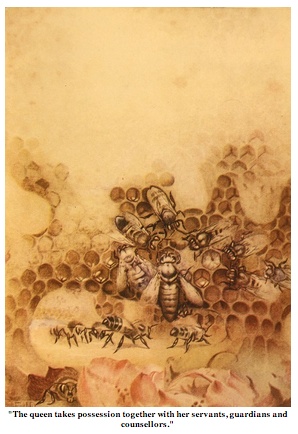
The book has illustrations like this throughout.

As this was published in 1901, there are some notable gaps in knowledge which seemed interesting for providing snippets of what have been, to this inopportune lack of knowledge Maeterlink writes, "It is sad, but let our reason be content to add, so it must be."(55).

The prose is eloquently constructed, but can be considered an inappropriately overblown writing when used in an entomological work.

Like his words on their sting:

"..there is a sort of dreadful dryness, as though a flame of desert has scorched the wounded limb; and one asks  oneself whether these daughters of the sun may not have distilled a dazzling poison from their father's rays in order to defend the treasure they have gathered during his shining hours."(7)

On the description of the hive:

"And if the outlook at first appear rather gloomy, there still are signs of hope wherever the eye may turn. One might almost fancy oneself in one of the castles they tell of in fairy stories, where there are millions of tiny phials along the walls containing the souls of men about to be born. for here too, are lives that have not yet come to life." (56)

description
The Hive

Both quotations are also reflective of operative philosophies Maeterlinck has when writing. Again his identity as part of the symbolist movement left its mark, first, when he wrote on the 'spirit of the hive' as an abstract force by which bees are governed on certain aspects like their swarming, and second, when he engaged on his habit of anthropomorphizing elements of nature to social constructs, in this case, his Father Sun.

This is considered a classic piece in bee literature and I did end up learning a lot.
__________________
*Courtesy BBC Nature


I have reviewed another work by Maurice Maeterlinck:
The Inner Beauty (4 Stars)

This book forms part of my remarkably extensive reading list on Nobel Prize for Literature Laureates

Wednesday, July 2, 2014

Memoirs by Pablo Neruda

Title: Memoirs
Author: Pablo Neruda
Original Publication Date: 1974
Pages: 378
Genre/s: Non-Fiction, Memoirs


"Perhaps I didn't live just in myself, perhaps I lived the lives of others…My life is a life put together from all those lives: the lives of the poet." (1)

description
Pablo Neruda

Pablo Neruda,  born Neftali Ricardo Reyes Basoalto, was a Nobel Prize for Literature laureate (1971), a poet whose verses breathe life themselves, whose life, was poetry itself.  Gabriel Garcia Marquez fearlessly called him the  "the greatest poet of the 20th century in any language." Che Guevara in his diaries revered Neruda as his favorite writer, and carried only two books with him till his death, one of which was Neruda’s Cantos General (the reason of which will be readily apparent later on). He was not just a poet; he was THE poet of the people, of the oppressed, the unheard, and the forgotten.

Primera Vida: A Child of the Forest "Perhaps love and nature were, very early on, the source of my poems." (19)

description
Temuco Chile, who wouldn't fall in love with that?

Neruda aptly starts his Memoirs by writing where it all began, in the then frontier lands of Temuco, Chile, emblazoned by nature’s ardor.   Nature made me euphoric (7), Neruda writes and indeed, nature did become an indispensable aspect throughout his poems as the reader would conspicuously experience throughout his works.  He characterized his childhood with modesty and austerity when referring to their economic and fiscal means, and yet one cannot help but feel that he was nothing but rich beyond measure as he reminisced his childhood with picturesque landscapes, forest adventures, and long walks defined by an indescribable affinity with nature.   I have come out of that landscape, that mud, that silence, to roam, to go singing through the world (7).  And sing he did.

Segunda Vida: A Barred Poet, Militant Student, and Gabriela Mistral’s Touch.

 description
A later photo showing Neruda with Mistral, they were both diplomats

As expected, Neruda’s father did not welcome the fact that his son wanted to become a poet amidst their challenging living conditions. The encouragement he failed to find in his father, Neruda found abounding with Gabriela Mistral(later to be a fellow Nobel Laureate (1945)), who introduced him to Russian classics. Neruda was undaunted, he continued to take poetry as a profession and went to a university at Santiago, Chile. While in the university he got acquainted with hunger and intermittent homelessness, his poems were all that kept him defiantly warm and firm.

Tercera Vida: A Diplomatic Affair"I learned what true loneliness was, in those days and years” (49).

description
Neruda visits the USSR

Neruda opted to accept an appointment as a consul after leaving the university and was first assigned in Rangoon, that further lead him to Colombo, Batavia, Singapore, Paris, and Mexico to name a few, the memoirs would suggest that Neruda welcomed the appointment, but other accounts tells that it was dire financial need that compelled him to accept the said appointment.  Whichever the case was, his consulship had a very profound effect on him, meeting a vast number of notable personas, chief of this was Loneliness. Solitude, in this case, was not a formula for building up a writing mood but something as hard as a prison wall; you could smash your head against the wall and nobody came, no matter how you screamed or wept. (92)

Unlike most poets, loneliness was a revolting concept in literary endeavors to someone like Neruda who celebrated love and life. And to combat this loneliness he wrote, “I went so deep into the soul and the life of the people" …i fell and lost my heart to a native girl (90). He sought to immerse himself with the land and the people wherever he was based, this aside from meeting personalities like Nehru, Miguel Asturias (awarded the Nobel in 1967), Picasso, Joliot-Curie, Federico Lorca, Fidel Castro and Che Guevara (later on). "The poet cannot be afraid of the people. Life seemed to be handing me a warning and teaching me a lesson I would never forget: the lesson of hidden honor, of fraternity we know nothing about, of beauty that blossoms in the dark."(89) Indeed this philosophy modeled by this consulship will lead him to directly take part in defending the Spanish Republic through propagandas and more essentially, his poems (an aspect which will be fully utilized in Chile’s very own struggles).

Cuarta Vida:  The People’s Poet, A Senator, and a Communist on the Run "…politics became part of my poetry and my life. In my poems I could not shut the door to the street, just as I could not shut the door to love, life, joy, or sadness in my young poet's heart."(55)

description
Neruda embracing Allende, also from the Left Wing, whom he supported for the Presidency

With his direct participation in the Spanish Civil war, he was removed from his post and returned to Chile. He entered the political scene and was elected a Senator in 1945, and later officially joined the Chilean Communist Party. The President elect of the same term hailed from the same Communist party but turned on against the Party and he banned the PArty altogether in 1948, with Neruda being removed in office, he surreptitiously escaped Chile and lived in exile for the next three years. Throughout those unwelcoming times, Neruda’s greatest weapon was his poems. “At hundreds of rallies, in places remote from one another, I heard the same request: to read my poems. They were often asked for by title.” (170)

His ardent feeling towards the people and his poetry at this point cannot be denied, and it was riveting.

“I have lived for my poetry and my poetry has nourished everything I have striven for. And if I have received many awards, awards fleeting as butterflies, fragile as pollen, I have attained a greater prize, one that some people may deride but not many can attain… That is my reward, not the books and the poems that have been translated, or the books written to explicate or to dissect my words. My reward is the momentous occasion when, from the depths of the Lora coal mine, a man came up out of the tunnel into the full sunlight on the fiery nitrate field, as if rising out of hell, his face disfigured by his terrible work, his eyes inflamed by the dust, and stretching his rough hand out to me, a hand whose calluses and lines trace the map of the pampas, he said to me, his eyes shining: "I have known you for a long time, my brother." That is the laurel crown for my poetry, that opening in the bleak pampa from which a worker emerges who has been told often by the wind and the night and the stars of Chile: "You're not alone; there's a poet whose thoughts are with you in your suffering." (179)

Neruda returned to Chile in the next presidential elections, abandoning his nomination to run for the Presidency and instead supported Allende’s run, who will later win.

Quinta Vida: A Lover’s Life "Perhaps love and nature were, very early on, the source of my poems." (19)

description
Neruda with Mathilde

Love completes the vital elements that comprise Neruda’s impeccably conceived poems. And of course, to write poetry as good as he did, inspiration must have come by the lot. Neruda had the penchant for overlapping love affairs characterized by sudden departures and intermittent unconventional sexual encounters. an encounter even, In my modest opinion, clearly bordered rape by any standards already. The incident concerned a househelp of the lowest caste. Neruda wrote, “One morning, I decided to go all the way. I got a strong grip on her wrist and stared into her eyes. There was no language I could talk with her. Unsmiling, she let herself be led away and was soon naked in my bed. Her waist, so very slim, her full hips, the brimming cups of her breasts made her like one of the thou¬sand-year-old sculptures from the south of India. It was the com¬ing together of a man and a statue. She kept her eyes wide open all the while, completely unresponsive. She was right to despise me. The experience was never repeated. (99) Neruda had three wives and each have been the subject of a set or collection of poems. Matilde Urrutia, however was the inspiration for the 100 Love Sonnets.

--
Neruda died twelve days after Allende was killed (1973) by Pinochet’s attack of the presidential palace. As it stands, Neruda’s cause of death was by prostate cancer, although later claims emerged that he was poisoned for his Pro-Allende stances enough to call for an exhumation of the body, the same act is claimed to have been ordered by the Pinochet Regime. The body was exhumed in 2013 (the Neruda Foundation fought against exhuming the body) and test results revealed in November 2013 negated any existence of chemical compounds. The great poet succumbed to cancer.
____________________________________

Originally entitled  I Confess I Have Lived, Memoirs was first published in 1974, under the editorial ambit of Mathilde Urrutia. Memoirs, is essentially a poem in prose by the manner Neruda wrote this. His lyrical style was unrelenting. Take for example this excerpt on one instance when an earthquake hit,

“…Sometimes it all begins with a vague stirring, and those who are sleeping wake up. Sleeping fitfully, the soul reaches down to pro¬found roots, to their very depth under the earth. It has always wanted to know it. And knows it now. And then, during the great tremor, there is nowhere to run, because the gods have gone away, the vainglorious churches have been ground up into heaps of rubble.(59)”


Or this reaction upon seeing the sea the first time,

“The first time I stood before the sea, I was overwhelmed. The great ocean unleashed its fury there between two big hills, Huilque and Maule. It wasn't just the immense snow-crested swells, rising many meters above our heads, but the loud pounding of a gigantic heart, the heartbeat of the universe.(25)”


This is the general tone by which Memoirs was written so those who relish and live by Neruda’s verses are never truly alienated in this prosaic work.

The entries intermittently jump through pivotal years, but not one chapter failed to contain people and individuals that helped, changed and loved Neruda however monumental or minuscule that was, and so as it goes, he mentions unpublished poets, forgotten names and acquaintances to people who rocked the very foundations of life. Humorous instances are also contained in this work, how he reacted to the alleged awarding of the Nobel, to his pet mongoose, to a hysterically paranoid woman, and the reason why he choose the pen name Neruda. Along with this, Neruda nonchalantly tells of his sexual encounters, of which, of course, there were numerous. If you opened the spoiler above, you will understand my reservation to this seminal Author exist, perhaps, in that instance only.

After reading his Memoirs, what came across is that Neruda is a poet through and through. It’s interesting to read that whatever he was subjected to, in whatever kind of instance or predicament he found himself in, the poet never left. He tells us of the various literary stimuli that lead to a specific work. To Neruda, his poems were not only both his sword and shield, it too was his soul.

“The poet who is not a realist is dead. And the poet who is only a realist is also dead. The poet who is only irrational will only be understood by himself and his beloved, and this is very sad. The poet who is all reason will even be understood by jackasses, and this is also terribly sad. There are no hard and fast rules, there are no ingredients prescribed by God or the Devil, but these two very important gentlemen wage a steady battle in the realm of poetry, and in this battle first one wins and then the other, but poetry itself cannot be defeated.(265)”


_______________________
*Neruda is said to have written only in green ink, probably a color closest to the forest, other yet say that this was his personal symbol for desire and hope


I have reviewed other works by Pablo Neruda:
The Book of Questions (4 Stars)
Twenty Love Poems and a Song of Despair (3 Stars)

This book forms part of my remarkably extensive reading list on Nobel Prize for Literature Laureates

Thursday, May 1, 2014

The 48 Laws of Power by Robert Greene

Title: The 48 Laws of Power
Author: Robert Greene
Publisher: Viking Adult
Original Publication Date: September 1, 1998
Pages: 480

In the confines of my sociological classes, where my known companions were Locke, Hobbes, Machiavelli, Rousseau, and Mills, saying that I loved this book would perhaps even amount to an affront to the value I have assigned to it back then. 

When I entered law school and got oriented in the ways of the law, the cunning, ruthless, and decisive ways of the legal world, I appreciated this book. 

It was practical and in these present days it simply made sense. In a dog-eat-dog world, you had to arm yourself. This was the perfect weapon. But power can be achieved in a multitude of ways and Greene wrote this handbook in perspective of a certain limited spectrum. 

To avoid any definitional debate and to put this review's foundation on the right track, POWER as used in this book needs to be defined. I would mention Thomas Hobbes' working definition of power as derived from the Leviathan (4 STARS) as  “a man’s . . . present means, to obtain some future apparent good, which is divided into two kinds: (1) natural, derived from inborn abilities of the body and mind, including intellect, strength, wit, and artistic ability, and (2) instrumental, derived from the acquired faculties and advantages of friends, money, or reputation (1651),” but there is greater propensity to consider the definition written by Robert Dahl in his article: The Concept of Power (1957), (here's an online link to the article) stating that, "power is the ability of A to get B to do something he or she would otherwise not do. In the case of authority, B’s behavior is driven by obligation, not force, but the operative condition is the same: B does something he or she would otherwise not do because of A’s will."

The kind this book talks about is rooted in deception, it is sustained by cunning, and realized by manipulation. Yes, that is the kind of power this book seeks to achieve. So if dear reader, you seek such kind of power, continue on and revel in this book. The draconian, the Machiavellian, the power hungry, the deceiver, the cynic, now this one's for you. 

To which in the same sense I would caution the veracious and the pure souls in reading this. If you're one seeking the generous and the warm kind, I would go as far to suggest that you instead read the succeeding selections, for this book is effective like that, it can change someone. 

The Art of Loving by Erich Fromm (3 STARS)
A General Theory of Love by Thomas Lewis
A Lover's Discourse: Fragments by Roland Barthes
Because love is a powerful force just like that. :)

The title says it all. This book contains 48 laws of power to which one chapter is adroitly dedicated to the discussion of each law. The chapters' form can be generally characterized through first a discussion of the law itself and a recommendation on how to apply and realize this law. Greene further indurates these discussions by providing the nuances in every law and countering the said nuances themselves. The foregoing discussion is followed either by an allegory or an anecdote lifted from the lives of people who have been notable in the fields of war, politics, and deception, a list which the likes of Talleyrand, Clausewitz, Bonaparte, and Bismarck populate. Green concludes the chapters by providing a summary of the discussion through an approximated equivalent imagery representation and a brief quotation from a notable individual to probably stand as an authority on the matter. 

The writing is simple and direct as it should be for books categorized under the self-help genre. The typesetting is interesting, it somehow adds to the appeal of this book. Every chapter contains stories separate from the allegories and anecdotes directly infused in the discussion of the law itself (personally, I give thanks to this book for introducing me to Clausewitz, Gracian, and several other authors and books). These references are pivotal if not indispensable as Greene derives the strength of his arguments and laws from historical figures. Of course, his statements, however overreaching and cynical at times, seem to resonate with a certain veracity when kings, emperors, warlords, and philosophers of incomparable renown are included in the picture. What is surprising though is that a number of his references come from Baltasar Gracian, a Jesuit. 

Coming across the numerous reviews of this book, the discussion and debate of whether this book is amoral or immoral, sometimes bordering what some people designate as 'evil' strikes me as discussion that can be easily resolved, if not clarified. You see, people are not simply engaging in a definitional debate here. The contention of what is good and evil is a value judgement dispute, something that has been in place even before the history of man was conceived. I say this in recognition of the dangers that cultural relativity presents. This right here is the dilemma, if everything is relative, can there exist a universal moral code operative not only over a single class or culture but for the entire race that would help us in qualifying the contents of this book? Kant and his Categorical Imperative would agree that it exists, but let us not stray to far from this review. 

The point of all this is that, if you think  selectively trusting your friends (Law #2), concealing your intentions (Law #3), taking credit for others work (Law #5)... is good, then you may as well validly and relatively argue that this is a "good, heaven-sent" book, and so too does the converse work and I will leave you at that.  

The truth however is that a fine line does exist between what is good and evil. True, it is a fine line, but it is not something that is indiscernible. The sad thing is that most people choose to turn a blind eye rather than being critical and responsive. People furthermore tend  to consciously complicate simple things resulting in the unduly blurring of the boundaries, leading to our own undoing.   

If it helps, here's what Robert Greene thinks of what you've just read; 
"Everyone assumes I practise all of my own laws but I don’t. I think anybody who did would be a horrible ugly person to be around." (The Telegraph, 2010)

For all that, this still occupies a special space on the permanent bookshelf on my reading table, along with Machiavelli, The Little Prince, my hard won thesis, my camera's manuals and my journal, cradled securely by my direwolf bookends. It remains to be special, certainly not as valuable as when I first read it, but still worthy of the place it occupies.

If your looking for an academic read on power, read Power: A Radical View by Steven Lukes (4 STARS), a book containing a number of articles by key contributors in the field like Hobbes, Foucault, and Dahl. It explores the conception, aspects, derivatives and several perspectives in viewing power.

Wednesday, October 2, 2013

The Art of Loving by Erich Fromm

Title: The Art of Loving
Author: Erich Seligmann Fromm
Publisher: Harper and Brothers
Original Publication Date: 1956
Pages: 184

There's a lot of grain of truth in this theorizing and objectification of love that Erich Fromm successfully wrote. Let me quote with liberality such instances more so for the inherent beauty and magnificence of such statements.

One page xix

"It (book) wants to convince the reader that all his attempts at love are bound to fail; unless he tries most actively develop his total personality so as to achieve a productive orientation."

On page 22

"Love is an activity, not a passive effect; it is a 'standing in' not a 'falling for.' In the most general way the active character of love can be described by stating that love is primarily giving, not receiving."

On page 56

"To love somebody is not just a strong feeling — it is a decision, it is a judgement, it is a promise. If love were only a feeling, there would be no promise to base the promise to love each other forever. A feeling may comes as it may go. How can I judge that it will stay forever, when my act does not involve judgement and decision?"

On page 71

"Most people believe that love is constituted by the object not by the faculty. Because one does not see that love is an activity, a power of the soul, one believes that all that is necessary to find is the right object - and that everything goes by itself afterward. This attitude can be compared to a man who wants to paint but who, instead of learning the art, claims that he has just to wait for the right object and that he will paint beautifully when he finds it. If I truly love one person I love all persons, I love the world, I love life. If I can say to someone 'I love you,' I must be able to say, 'I love in you everybody, I love through you the world, I love in you also myself."

From a scholar and an academician's perspective, Art of Loving is highly reminiscent and indicative of the great scholar Fromm is. His arguments are well thought out and psychologically anchored. The conclusions are convincingly rationalized. My propensity to disagree however trickles in regarding certain points in his arguments.

Fromm situates fatherly love as love that is conditional in contrast to motherly love as unconditional. This condition, Fromm writes, depends on the child's capacity to please, satisfy and fulfill every fatherly expectation, requirement and demand. Now before anything else, the strength of this forthcoming argument is not anchored on personal disposition (for I am neither a father nor a husband yet) nor is it on a personal father-son relationship but on the patent criticism on Freud's study —that much of adult psychological development is founded on the child's experience (because it perpetuates that development is not progress and change but accumulation of the same static component). Now for you Fathers out there, is Fatherly love truly conditional? Does it really depend upon any fulfillment of a condition? Isn't it a bit partial, bordering sexism for fatherly love to be labeled as conditional? This is pivotal since Fromm forwards the argument that conditional fatherly love is the significant half component for the development of a mature being capable of truly loving. Cannot fatherly love be demanding, hard-driving, expectant and directing while at the same time be unconditional? Because in contrast to what Fromm writes, that the failure to transcend the conditional fatherly love results to one extreme end of the stick, the incomplete and incapable-of-loving person, perhaps such incapability have resulted from such conditional fatherly love in a very fundamental manner. Fromm's proposition of this kind of a fatherly love however carries something more portentous because as much as reality has put it, the general rule is non-fulfillment of such 'condition' and the fulfillment being the exception which necessarily forwards the conclusion that most individuals are incapable of loving.

The social milieu (having been published at 1956) at the time of the writing of this book is gleamed from the very words and arguments Fromm has employed. Take for example Fromm's argument on homosexuality, capitalism, and on criticism on Freud.

What surprised me however is Fromm's repeated employment of biblical passages and resources. In hindsight this should have come with no surprise at all as no better book talks (categorically and objectively) about love than the Bible, and this is true whether one reads it as a religious keystone or as a plain literary work.

Basically one of the theses of this book is that an individual has to be a complete individual by himself/herself. And I have always believed this to be true and found that acclaimed romantic statement 'you complete me!' to be a grossly incorrect statement. Fromm hits that mark masterfully.

Considering it all, Art of Loving is one enlightening work, something I'd never fail to recommend.

Thursday, September 5, 2013

A Book of Five Rings by Miyamoto Musashi


Title: A Book of Five Rings: A Classic Guide to Strategy
Author: Miyamoto Musashi (宮本 武蔵)
Publisher: Gramercy (1988)
Original Publication Date: circa 1645
Pages: 96

Superb. Somehow when he speaks of the way, Star Wars' Jedi's way come into mind. However, I have yet to find a work that does not to pale in comparison with Sun Tzu's Art of War. A book of five rings talks about the way of the long sword (primary samurai sword), everything affecting it, and how, a successful master strategist could apply the "individual aspect to those of a battle of a ten to thousand warring individuals." I however miserably fail at this endeavor. I simply cannot visualize the acclaimed application of the contents to a full-scale battle (perhaps a veracious sign that I have not been born with the makings of a strategist). The book is rather concise in form and owing to the brevity and nature of the topic by which Musashi wrote, he could't have done any better. As in Musashi's words one must either "study this well" or "research diligently" to rationalize substantial parts of the work.

What the Dog Saw and Other Adventures by Malcolm Gladwell

Title: What the Dog Saw and Other Adventures

Publisher: Little Brown & Company
Original Publication Date: 2009
Pages: 688

Have you ever read a book because you were impressed with the writer? Loved the writer? And want to read his other works? This is one book which falls into that category for me, and again, such experience betrays.

I got bored with this book. Malcolm Gladwell is a great writer, that much is a fact, however, in comparison to his other books, 'what the dog saw...' did not fare well. For one, his writing always presented a grand theory or idea which captivates the reader through well researched pieces of information and undeniably entertaining facts, while this book is the exact opposite being a compilation of articles he previously wrote, yes there were highs and lows with the book but the lows easily outnumbered the good articles and i just suddenly realized i was skipping some pages, telling myself 'don't wanna read that' 'boring' and so on and so forth and i was nothing but thankful to finish it, at last. This boredom i talk of is attributable to the fact that his claims and ideas in his other books were convincing for as long as he kept a well versed and thoroughly backed argument, and this is what the article lacked, precisely due to the reason that they were only articles. Some were too complex and abstract that an article for a piece did not give it justice.

Saturday, August 24, 2013

The First Filipino by Leon Maria Guerrero

Originally posted at Goodreads

For all the years, studies and romanticisms of Rizal, he has somewhat remained, an enigma. This is not surprising.

The vast number of scholars that have attempted a great many times to deconstruct and understand Rizal on his writings have fallibly tainted Rizal’s political ideologies and perspectives in doing so. Some even failed to see that what they have deconstructed was not Rizal, but an image hewn from themselves.

Some of this were, Agoncillo who regarded Rizal as a “revolutionary reformist” or “reformist revolutionary” while Constantino declared Rizal’s genuine agenda were the Hispanization of the Indio and the assimilation of the Philippines to Spain, which proved little to clear the matter but in essence has founded the contradiction that has bedeviled nationalist historians. Romeo Cruz however puts it differently by saying that Rizal’s purported assimilation is the union of sectionalism – loyalty entrenched in the Filipino people and nationalism – this he refers to the loyalty directed to Spain. The belief that these sentiments are subversive and seditious to the national cause is wrong, for nationalism does not favor class and the nature by which it is defined.

Floro F. Quibuyen maintains that this view is inherently flawed on the aspect that most of our scholars’ personal standpoint is levied upon the Enlightenment terms when Rizal is studied. Viewing the matter in the Enlightenment terms merits a view in terms of the liberal concept of the nations–state. The state exercises power in making and enforcing laws in behalf of the people it stands for. But Rizal’s vision went beyond the liberal concepts conceived by the Enlightenment period.

Does this rudimentary predicament afflict Leon Maria Guerrero's work?

In the pursuit of veracity more than brevity, I quote and support the introduction in saying that:

"... it presents him in the guise of the original and singular philosopher he is, as well as the great stylist and thinker of clarity, precision, and profundity he also is."

An achievement in itself.

The question looms however, and whether one accepts the answer entirely depends on no one else but the reader as much as the material. Is Rizal worthy to be the first Filipino? Is it fitting?

As any historical work, the historical narrative is to be subjected upon critical objective examination. Points of contention undeniably exist, which are realistically inevitable, in the historicization. This subjective scholar preference I'm pointing exists for example on Leon Guerrero's choice with which to start his discussion (Gomburza), which also implicitly carries his nationalistic orientation (that is much to be desired).

Still, as it stands, a great scholarly work.