Showing posts with label 2 Stars. Show all posts

Wednesday, June 4, 2014

Women's Work by Kari Aguila


Title: Women's Work
Author: Kari Aguila
Original Publication Date: November 16, 2013
Pages: 298


I knew my male to female author ratio was severely disproportionate with the scale undeniably tipping on the expected side. So I try, along with my many reading projects, to incorporate the ideal that such imbalance be rectified if not in an achievable and realistically acceptable equilibrium then at least the consolatory mindset that nobility exists in a task faithfully pursued such as this.

Then I thought, what better way to pursue this end, when by happenstance, I stumbled upon this book, which claims to present women’s struggles in a post-apocalyptic world, written no less by a female author.

Women's Work tells us the story of Kate and her family who struggles to survive in world ridden no less by male chauvinists who by all measures are extremist in their professed bigotry. In this world, the women have taken over all aspects, and when I say all, I meant everything. The men have not only been relegated but were also reeducated of their social roles. They stay in the house, are not allowed to speak in town or council meetings, they are, in all respects, abrogated of any capacity less the frivolous and mundane.

The concept was a fascinating one, the reversal of the socially constructed gender roles, the reaction of the male population to such extreme reversal, these were some of the things I was expecting in
Women's Work, but what struck me more was that this was the quandary of a single mother finding love in a society where a Man is not defined by any new established social convention but by the acts of his predecessors of the same biological orientation. This too was a novel more for the parenting of a single mother. There is less of the expected grand narrative of the noble struggle of survival in a post-apocalyptic world but only the fear of imagined and anticipated horrors that sublimely define the characters’ psychologies.

There are a number of things you have to get around to appreciate this.

The world building premise is anchored on the arrangement that the male contemporaries have orchestrated the government to pass laws banning birth control without the husband’s consent, to the regulation of what they could and could not wear, leading to more pivotal and drastic actions like the banning and removal of women from politics and the military. The premise world is an extremely male chauvinistic society.  If you get around that you can move on with the story, which leads us to the next point.

The novel presents a comprehensive and absolute dichotomy between the male and the female sexes, an instance which, even in fiction I might add, is highly improbable unless we discount the existence of certain radical, idealistic individuals, or group of individuals. This is the perfect embodiment of a class fighting for its own liberation from domination and believes itself to be fighting for human freedom and was able to appeal to an idea present  in all who are oppressed which however in the long and virtually continuous battle for freedom, the classes who were fighting against oppression at one stage sided with the enemies of freedom when victory was won and new privileges were to be defended. Because it tries to take on this grand extremist scenario of men vs. women, the story failed on the microcosm, I was expecting a more immersed perspective in presenting the difficulties of a woman in a possible post-apocalyptic world, like that of raising a young boy in such well delineated social arrangement, or that of the greater need for security. I have to point out that the concern for security in relation to the man in this novel cannot be included, for even in the beginning, subtle sexual proclivities can be read between Kate and the man, no real concern for security exist there.

The children too are a tad unrealistic. They were perfect, much too perfect. They followed all commands, did not answer back, did not worry about their father lost in the war, they communicated with their parents. Because they were perfect, they were all the same and hence no reasonable character development existed. Because they were perfect, they were an anachronistic existence in a post-apocalyptic world. It’s just hard to imagine that these children whose life are peppered with bomb craters, raider threats, women armed with arrows and knives are presented in such a faultless existence.

To me, the characters fail because they are perfect. The power struggle fails because the conflict is grounded on the belief that the differences among genders are defined only by their biological orientations.

The writing style is admirable, with the occasional rough transitions and forced conversations, considering this to be the first work of the author. Still, much thanks, Kari, for my copy! I look forward to your growth as writer!

Thursday, May 29, 2014

The Alchemist by Paulo Coelho

Title: The Alchemist
Author: Paulo Coelho
Original Publication Date: 1988
Pages: 197


Only the devil will leave you in a waiting room for three hours without any reading material. So I took this as an omen and went ahead and looked for a new dentist. But before I found one, the Soul of the World orchestrated the natural flow of things so that I should come across a copy of this book, and my diaphanous frustration compelled me to buy and read this work I've avoided until today. I have this particular belief that books I see in most houses that I've been to, if not all, are overrated. To me, The Alchemist was no exception. I read it under 3 or 4 hours which is probably because of the simplicity both in the story and in the prose, both were straightforward and linear. But it was nothing like Hemingway's style. It is retrospective but please, do not even imagine comparing this work to Siddhartha(4 Stars), as some people have the apparent audacity to do. Siddhartha is the work you read to experience a trance-like retrospective examination of life, in comparison, the only thing that made its mark in The Alchemist was the fantasy part, which I have to admit I see as a considerable digression for a ruminative retrospective novel. It does talk about love as the universal language of the world, that all of us are one but I had this feeling that The Alchemist barely scratched the surface of this reservoir of ruminative philosophy which led to an occasional overtly pretentious and over-reaching feel. Coelho's telling us that the happiness we seek is within us, as evinced by how this novel started and ended, what I can't curiously reconcile however is the fact that it was someone else's dream that completed his journey, as if negating the very message it seeks to impart. Just my two cents anyway.

Saturday, May 24, 2014

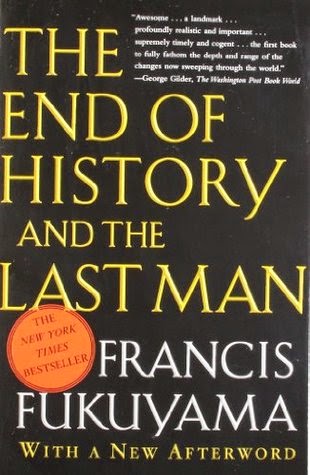
The End of History and The Last Man by Francis Fukuyama

Title: The End of History and The Last Man
Author:  Francis Fukuyama
Original Publication Date: 1992
Pages: 464

"But it is not necessarily the case that liberal democracy is the political system best suited to resolving social conflicts per se. A democracy's ability to peacefully resolve conflicts is greatest when those conflicts arise between so called "interest groups" that share a larger, pre-existing consensus on the basic values or rules of the game, and when the conflicts are primarily economic in nature. But there are other kinds of non-economic conflicts that are far more intractable, having to do with issues like inherited social status and nationality, that democracy is not particularly good at resolving.”

Francis  Fukuyama was born on  October  27,  1952 to Yoshio  Fukuyama,  a second  generation  Japanese  American,  and  Toshiko  Kawata  Fukuyama. Fukuyama’s childhood years were spent in New York city and in 1967, the family moved to State College, Pennsylvania, where he then attended high school. His Bachelor of Arts in Classics was obtained in 1974 from Cornell  University  and  taught  right  after  in  the  Yale  University  Department  of Comparative Literature during 1974 – 1975.  In 1981,  he  received  his  Doctor  of  Philosophy  in  Political  Science  from  Harvard University by doing a dissertation on Soviet foreign policy. Francis Fukuyama was a member of the Political Science Department of the RAND Corporation which conducts researches about public policies in Santa Monica,California  from  1979  to  1980,  1983  –  1989,  and  then  in  1995  –  1996 . In 1981 and 1982, Francis Fukuyama was an official member of the Policy Planning Staff of the United States Department of State where he focused on Middle Eastern issues. In 1989, he returned to the same body, but this time as a deputy director for European political and military affairs. While he was a member of this said policy planning staff, he published an essay entitled “The End of History?” in a small foreign policy journal named The National Interest.

The End of History and the Last Man is a book expanding the essay “The End of History?” that Francis Fukuyama wrote in 1981. It sparked extraordinary debate both in the United States and abroad. Francis Fukuyama’s analytical philosophy is anchored in the fact that the article was written five months  before the collapse of  the Berlin wall  where ideological  contentions between democracies and communism were in head to head disputation. His  employment  at  those  times  and  his  origin  of  education  has  surely predicated his preferences in writing the article and eventually the book. Being a RAND corporation researcher and as a member of the United States Department Policy Planning Staff would have surely molded his very reasons for writing such. As an officially employed citizen of the United States, one cannot deny that fact that he must advocate to the principles of the State and government that has employed, nurtured  and  protected  him,  and  that  is  liberal  democracy.  We  may  say  that because he is of the government, he wrote the “End of History?” to impinge on disintegration of the Berlin wall.

The End of History and the Last Man posits the idea of writing a universal history of human development with the end of liberal democracy. The prevalent extension  of  not  only  liberal  political  but  also  economic  ideas  throughout  the communist  world  and  to  third  world  countries  presupposes  that  mankind  has reached its ideological evolutionary process. Although the occurrence of events in the  simplistic  sense  of  history  still  occurs,  the  evolution  of  human  society  has reached its end with liberal democracy and not with communism.

Francis Fukuyama points significant emphasis on the French and American Revolutions. He stresses that the amalgamated ideals formed in the momentous revolutions were the indispensable foundations of the end of man’s history, liberal democracy.  His  periodization  ends  with  all  states  having  the  same  form  of government.

It rejects Marx’s idea of human development with communism as the end goals of the system. And just as any post – modern theory rejects grand narratives in existence,so does it support and enact one of its own. This is what Francis Fukuyama’s work is doing, it rejects the various numerous ideas of the development of human society and  presents  that  grand  narrative  that  societal  development  ends  with  the institutionalization of liberal democracy in every state.

Perhaps the biggest critique about Francis Fukuyama and his book The End of History and The Last man is that he has this tendency to show his biases on his writings. His position in the government of the nation is clearly felt in the arguments of the origin of liberal democracy and the end of which he speaks of in essence perpetuates the imperialistic aims of a world super power.

Thursday, May 1, 2014

Demon (The Gaea Trilogy #3) by John Varley


Title: Demon (The Gaea Trilogy #3)
Author: John Varley
Publisher: Berkley Books
Original Publication Date: 1984
Pages: 464

What if you could talk to god, and ask one thing? What would you ask of him or her?

John Varley played with this concept in this trilogy together with ideas of cultural variations, religion and psychological developments. It was exciting, novel and conspicuously distinctive from most science-fiction works of today.

The book was written in 1979, and in 1980, it was listed as the first official winner of the Locus Award in Science-Fiction. But considering that time frame, all the books in the series are an easy read and arguably a page turner. If I recall correctly, I labeled the books as currently reading months earlier but in actual time consumption, I finished all three in less than a week.

I liked how in Varley’s world building, he presented numerous interesting ideas on cultural development and religion. The idea of the self-sustaining alien environment is appealing and just like the mysteries carried in Rendezvous with Rama and 2001: A Space Odyssey, the idea of a more advance entity gracing us is riveting.

But what made me rate the books from the average three to a measly two is as conspicuous as the books’ appeal.

I did not like any of his characters. They were designed with weak foundations and even weaker developments. Simply put, they were not enthralling. In the later parts of the trilogy, I still failed to neither identify nor maintain a veritable connection with the crew.

The further reason is that Varley’s books can be abridged in two simple story arcs. The first is the discovery to the overthrow of the god and second the sex, yes you read that right, sex. Let me set this straight that outright, there is no fundamental issue between these two topics, the problem lies in the story itself. You see, when John Varley first presented Titan, the process of reproduction between the Aliens was nothing but interesting. I admit it was unique and well thought out. In the later parts of the trilogy however, when the process have been deconstructed and it has worn out its appeal and novelty,  the science and the beauty of the process was relegated to nothing but mere physical intercourse (including humans of course). So what happens is that the whole story is actually an intercourse (no pun intended) between these two pieces of the puzzle, something like this, sex-discovery-sex-plotting-sex-conspiring-sex-overthrow, so you see the problem, or is it a problem at all?

Would I recommend this trilogy? Perhaps not. I actually engaged in finishing the three books because I could not literally bear leaving something hanging, even if that means plodding through another two books.

As for me, if I could ask a god, I would, in his infinite capacity inquire, when George R.R. Martin would actually come around finishing his GoT series.

Thursday, April 24, 2014

Eleanor & Park by Rainbow Rowell

Title: Eleanor & Park
Author: Rainbow Rowell
Publisher: Orion
Original Publication Date: April 12, 2012
Pages: 325

Sad stories make for good books. The better statement would be that sad stories are treasure troves for writers to make books about.

At least this statement holds true for Eleanor and Park as it does for most YA Romance books, in the likes of John Green's, Daniel Handler's or the other various books in this genre. I read this book after reading a number of Saramago's books which are laden with sentences paragraphs long, Eleanor & Park, was, as one would say it, a welcome break. As it would turn out, the reading itself was not however a welcoming experience.

STORY
There was a sense of familiarity with this book, which is sadly, not of the good kind you experience reading coveted stories of childhood like that of Atticus Finch, or of even of the fictional world of Le Guin's where deliverance from nostalgia is an unwelcomed visitor. No. Unlike the desire to embrace and revel in this book's familiarity, one tends to get tired and exhausted. The first romance between two teens, both with familial problems and issues of their own is lifted straight out of cliche and hackneyed themes. I've read it a number of times and in every case, the essential struggle, if not the sole aim, is to find something new the book, the story, the characters, the author is offering. Sadly, the book was not able to discharge this burden.

HISTORICAL SETTING
I'm not a pundit but it doesn't need one to see that the story development and the social and factual setting of this story, in 1986, is in conflict and inconsistent. Discrimination and preferential treatment in those days were not as subtle as it is of this age. I simply felt that there was a lot of potential in Park as this half Korean kid whose mother was directly taken from Korea right after the American perversion, sorry, assertion of capitalistic designs disguised through its affirmation of its unilaterally defined democratic principles in the Vietnam War. The point is, I think Park would have been more interesting if he wasn't defined by the traditional sibling rivalry which to some extent Rowell did endeavor on, only she did not expound on it.

NARRATIVE FORMAT
As standard YA Romance novels go, the book falls under the stream of consciousness thought, albeit the narrative is directed by the alternating POVs of the male and female protagonist. The narrative is interlaced with conversations that are direct and crisp, which makes this book really an easy read and hastily contributes to that well neglected reading challenge. The problem with the alternating POVs is that sometimes it borders repetitiveness, though it may also stand for recognition of the emphasis and weight of the moment in the book.

Wednesday, October 2, 2013

Taking on the Dead by Annie Wells

Title: Taking on the Dead (Famished Trilogy Book #1)
Author: Annie Wells
Publisher: Create Space/ Independently Published
Original Publication Date: 2012
Pages: 322

I have substantially pondered the rating I would give to this book with finality. First because this is an independently published book, a fact that should always be afforded respect if not praise for it is no mystery both to writers and even to non-writers like me how hard it is to establish names in the market, more so to move beyond great names in the myriad of genres like Tolkien, Lewis or Le Guin in Fantasy, or of Asimov, Clarke or Heinlein in Science-Fiction (or of Max Brooks in the Horror-Zombie Genre?). Second is that this book has claimed (this word is most appropriate as will be discussed later) to be under the proliferating Horror-Zombie genre. However, it is a greater sin to rate this with something it does not deserve. If a book should break those veils Tolkien and the likes have unconsciously erected albeit in a successful and (portentously) ageless manner, it should be by its merits alone, and by merits alone that this two star rating is founded upon.

The Zombie Factor
I am a fan of the mindless, flesh eating, human craving zombies. Somehow, in this fictional setting, a thinking, evolving, zombie is untenable and its essence against the basic tenets of the zombie horror genre. Why? The appeal of the zombie genre has been anchored upon the story of survival of humanity, but this story of survival undeniably comes hand in hand with the zombies. This survival has two faces, the possibility of extinction on the one hand, and on the other, triumph over this fictional anathema. Put a thinking zombie in here and the balance tilts to either what is called human extinction removing the conspicuous appeal of human triumph and power or    could either be a book, meant more for humor or for the YA shelves of romance. Enter Taking on the Dead! Where there is no need for a zombie literary pundit to tell that zombies are either subplots or plot devices. It is a subplot because the book is not about survival but of personal feelings, specifically the female sexual feeling of the main character. It is a plot devices because zombies momentarily appear to further personal (sexual) relations of the female protagonist with the numerous male characters. The middle of the book is solely dedicated to romance of the female protagonist.

Character Development
I don't know how the author has visualized the main character, it turned ultimately as an in inconsistent persona. The author wanted to paint a protagonist who knows how to survive in the post-apocalyptic world by saying that she had resource materials, can jack a car and survived alone for four years since the outbreak. For all that, she turned out to be stupid, real stupidity or forced stupidity, i don't know, all that matter is she is stupid. (e.g. Who takes a bath in a lake fully naked unarmed?)

The men are all objects of the pent up libido of our main character, that is all I can say.

The supporting cast is the literary embodiment of racial stereotypes. The asian-american as practitioner of martial arts, the african-american as the street gangster/rocker type.

The Writing
The writing is, like most YAs, (drumroll) in the prevalent stream of consciousness occasionally interjected with conversations. So it is an easy read.

There are a number of awkward passages within the book. Like this:

"Ice seemed to spread through me."

Better Fit for the YA Romance than the Zombie Genre
I fault myself for not taking caution after reading the prologue:

"Sometime later, we got off the Ferris Wheel, both heated, clinging to each other, and ready for another tryst when we went off the beaten path to use the foul port-a- potties. When I think about it now, I know the outbreak began early in the day. We passed several wrecks, heard many helicopters and sirens, and probably saw a few zombies, but were too wrapped up in ourselves to notice. I blame it on being in love, but I swear to myself now if I saw a person walking down the street covered in blood or eating someone, I would have paid attention. Maybe."

The paragraph was portentous. It had the picture of a romantic, sexual, stupid oblivious makings of the book. I mean come on, who ever you are, however in love you are, you can't be oblivious to several wrecks, helicopters and sirens. That's just being plain stupid.

Thursday, September 5, 2013

The Final Odyssey by Arthur Clarke

Title: The Final Odyssey
Author: Sir Arthur Charles Clarke
Publisher: Del Ray
Original Publication Date: 1997
Pages: 272

It is noteworthy to consider how Arthur Clarke opened the third book, and what the ramifications to the entire series were. With wanting pragmatism, he wrote that:

"Just as 2010: Odyssey Two was not a direct sequel to 2001: A Space Odyssey, so this book is not a linear sequel to 2010. They must all be considered as variations on the same theme, involving many of the same characters and situations, but not necessarily happening in the same universe.

Developments since Stanley Kubrick suggested in 1964 (five years before men landed on the Moon!) that we should attempt 'the proverbial good science-fiction movie' make total consistency impossible, as the later stories incorporate discoveries and events that had not even taken place when the earlier books were written. 2010 was made possible by the brilliantly successful 1979 Voyager flybys of Jupiter, and I had not intended to return to that territory until the results of the even more ambitious Galileo Mission were in."

Deriving not only from what Clarke tried to project as a caveat but as well as from general systemic observations from the series, I find the pressing need to elaborate on the following points.

Clarke cautions his readers not to treat the apparently labeled series as well, a series of books characterized with continuity and relativity. This is clear when he phrased that 'it' was not a direct sequel and must be considered as variations of the same theme. For the reader however this is rather demanding if not theoretically impossible considering the method, characters and story arcs Clarke choose to write with. Putatively and substantially seen in this simple manner:

Book One: Dave Bowman mysteriously disappears while in transit on his mission

Book Two: Dave Bowman returns as a part of the Monoliths and another mission is launched in pursuit of ascertaining what had happened, Dr. Floyd Heywood becomes one of the major personas by this point

Book Three: Floyd Heywood returns in the scene of another space exploration

Book Four: Frank Poole re-emerges as what could be labeled as the single persona in the fourth book establishing a connection with the series.

For one who has read the series, the meager attempt to express the thought in the words above should suffice. After all the recurring references while reading the books there is hardly any need for me to elaborate on this.

Arguendo however, if we find the utter need to satisfy some inner justice and lend credence to Clarke's desire to treat the succeeding books not as sequels but stand-alones (and i believe this is what he meant when he said that they were "to be considered as variations of the same theme"), the books, with intrepid audacity, fall into a position that is not only demeriting but which I fear could unfortunately be an unprecedented fatal waterloo for the whole of Space Odyssey books. I qoute myself by saying that:

"The book did not feel a book at all while reading it (something i've started to feel in the first book already), but more something like of a novella, or a piece greater book that is the series. I'm starting to get the impression that the 4 books should have been published as one judging by what the content has encompassed so far"

Nothing has proven to be quite substantial in the series to merit a change in this perspective. In the contrary, I find that the deeper I was into it, the further my pretense was affirmed, conclusively in varying instances.

I too find it rather irritating, as short as the books already were, that Clarke included a chapter or three from the previous books, lifting them by the whole, which presumably he wanted to function as ardent nostalgic chapters reminding the reader of events that have passed. I find them nothing but repetitive vestiges that can choke the living hell out of the reader (to be fair that was an exaggeration). It was redundant, draggy, convenient and a poor excuse for an imagined attack of writer's block (and this is what I've honestly felt).

To be critical however, Space odyssey is still a page-turner as it is (whether of excitement with the next chapter or with boredom with the lifted ones). Arthur Clarke writes in a gripping manner that catches you until the last of the pages. I give credit to his imagination contained in the writing. For me they were fresh, novel and exciting. The mystery of the monoliths can keep the reader enthralled as far as the story goes, the very idea of the monoliths was exciting in itself. The biggest letdown of this series/variations on the same theme however lies in the revelation that it failed to deliver (sole reason why the fourth book was rated two stars). After all that excitement, I opened the Pandora's box only to see, nothing.

What the Dog Saw and Other Adventures by Malcolm Gladwell

Title: What the Dog Saw and Other Adventures

Publisher: Little Brown & Company
Original Publication Date: 2009
Pages: 688

Have you ever read a book because you were impressed with the writer? Loved the writer? And want to read his other works? This is one book which falls into that category for me, and again, such experience betrays.

I got bored with this book. Malcolm Gladwell is a great writer, that much is a fact, however, in comparison to his other books, 'what the dog saw...' did not fare well. For one, his writing always presented a grand theory or idea which captivates the reader through well researched pieces of information and undeniably entertaining facts, while this book is the exact opposite being a compilation of articles he previously wrote, yes there were highs and lows with the book but the lows easily outnumbered the good articles and i just suddenly realized i was skipping some pages, telling myself 'don't wanna read that' 'boring' and so on and so forth and i was nothing but thankful to finish it, at last. This boredom i talk of is attributable to the fact that his claims and ideas in his other books were convincing for as long as he kept a well versed and thoroughly backed argument, and this is what the article lacked, precisely due to the reason that they were only articles. Some were too complex and abstract that an article for a piece did not give it justice.

Norwegian Wood by Haruki Murakami

Somehow a very predictable plot. When I say this what I mean is that Norwegian Wood is discernably portraying Japanese culture, impeccably. I'm struggling to grasp the novel theme inside this work that makes Murakami so celebrated, and distinct as claimed – a struggle in vain (Perhaps there is none, and my inherent failure to connect with Murukami's elegiac writing is barred by my preferences. One thing that have always remained in earnest interest is that misery does love company and perhaps a reason why melacholic writings proliferate under this arrangement. A depressed book for a depressed world). Even Murakami is baffled at the popularity of this work. Until then I'm inclined to agree that Murukami is really not worth a Nobel after all.

Now, off to his other works which I hear treat suicides more thoughtfully, or perhaps nothing else beats a talking cat.

Catcher in the Rye by J.D. Salinger

Boy, that goddamn killed me!

Reading is never an easy thing. Surprisingly I still find that there are books that are laboriously... fatal. It killed me, it really did.

Now, where the hell do I goddamn start? I'm obviously done with the use of profanities.Some things are just not good enough, certainly not with the use of profanities in this case. The concluding paragraph on chapter seven for instance has this:

"When I was all set to go, when I had my bags and all, I stood for a while next to the stairs and took a last look down the goddam corridor. I was sort of crying. I don't know why. I put my red hunting hat on, and turned the peak around to the back, the way I liked it, and then I yelled at the top of my goddam voice, "Sleep tight, ya morons!" I'll bet I woke up every bastard on the whole floor. Then I got the hell out. Some stupid guy had thrown peanut shells all over the stairs, and I damn near broke my crazy neck."

How can Holden be so irritatingly inconsistent of a character and yet at the same time be so annoyingly repetitive. In hindsight it actually is of no surprise, it is rather a perfectly unfortunate complement.

If "Holden was born in the world not just strongly attracted to beauty but, almost, hopelessly impaled on it,"(as an antihero who decidely hated phonies, he hated this world) still if this is what he considers one of the things he labels a phony, it is contradictorily funny, at best and at worst, is an ironic manifestation of the hypocrite that he is, seeing that he has this decisive use for the word ugly. More than anything that merits of a hypocrite label is how well and how much he lies saying "he could go for hours" (as he showed on the train with his schoolmate's mother). A condescending and rather conceited reason he has for lying is that he hates explaining things to people, thinking that it's easier to lie than to explain the truth to people. Holden Caulfield is not really self-aware that is to say, he can't see that he himself is a phony.

Laden with inconsistencies, I got the feeling that I was reading a book with a child that was not depressed in any meaning of the word, but who is rather a child with a savant syndrome.

Page 38:

"My brother Allie had this left-handed fielder's mitt. He was left-handed."

Holden was repetitively stupid.

If the point of the anti-hero is to annoy, then it did succeed, too well, far to well that I absolutely hated Holden.

A lot of people loved, venerated and labelled this book a classic. Some say the reason they do so is that, God forbid, they identify with Holden and in that process, it changed their lives. This is not surprising for Holden is, without any discernible difficulty, the book itself. I however recommend that rather than fraternizing with Holden, one should seek a cathartic outburst, and if failure still lingers, nothing beats employing professional help.

Lest some incomparably emotionally attached reader lambast me and do educate me that all I've been talking about is Holden and not the book, and I do, to some extent acknowledge that, here then is my leverage.

The book actually had barely any plot at all. This is precisely what I meant when I said that I toiled and labored going through this book. I would gratify at the fact that I could be rectified concerning this point. Adding to such disposition, the stream-of-consciousness narration writing style in the book did not help at all (n.b. most YA novels proliferate under such school).

For all that is now between me and this book, I too have to acknowledge the fact that Salinger wrote this at the end of WWII, an anti-hero theme which gave light to the themes of teenage angst and alienation in a world that the youth are nothing but alienated, in a world that precisely needed it.

A clear undeniable precursor of things to come.