Showing posts with label 3 Stars. Show all posts

Monday, July 7, 2014

South of the Border, West of the Sun by Haruki Murakami

Title: South of the Border, West of the Sun
Author: Haruki Murakami
Original Publication Date: 1992
Pages: 190
Genres: Fiction, Magical Realism, Contemporary Fiction


In denying a foothold to any portentous propensity of being needlessly repetitive, but more so in the interest of brevity, I opted to start forthcoming reviews, of which there seem to be many as this Murakami fever I have uncannily contracted has sternly refused abatement, with the Murakami Bingo! Murakami may have a definitive 'murakami' style but it still operates within a framework with formulaic themes and recurring plot devices.

description

So here we go!
Mysterious Woman? Operative truth!
Unexpected Phone Call? Check!
Old Jazz Record? Check!
Urban Ennui? Check!
Running? Check!
Weird Sex? Check!

So the Murakami in [South of the Border, West of the Sun is more of the Murakami of Norwegian Wood than his surrealist magical-realism books like Kafka on the Shore and Dance Dance Dance. It is however the usual Murakami of losing and longing, of searching and failing. This piece puts us in Hajime's shoes from his childhood to his middle years. To put it bluntly, this is a story of mid-life crises and marital infidelities. Murakami has written a real universal character that we occasionally find ourselves communing with in more ways than we personally acknowledge. We all go out in the world, frantically searching for something, something we only feel in vague stirrings, and sometimes, in our definite inevitable folly, something we don't know of. Whether we seek something that exist or something we have subconsciously created out of a desperate need to define ourselves has never been the question, for the search itself has always been the answer, hasn't it? That is why, strangely enough, even though I have yet to attain numerically sound midlife crises, get married and have children, I found myself sympathizing if not empathizing with Hajime.

“All good books are alike in that they are truer than if they had really happened and after you are finished reading one you will feel that all that happened to you and afterwards it all belongs to you: the good and the bad, the ecstasy, the remorse and sorrow, the people and the places and how the weather was. If you can get so that you can give that to people, then you are a writer.” (Ernest Hemingway)

The good and the bad, the ecstasy, the remorse and sorrow, the people and the places and how the weather was,  all belonged to me, all became mine. Thank you, Murakami, for yet another wonderful sojourn!


I have reviewed other books by Haruki Murakami
Dance Dance Dance (3 Stars)
Kafka on the Shore (4 Stars)
Norwegian Wood (2 Stars)
The Wind-Up Bird Chronicle(2 Stars)

This review, along with my other reviews, has been cross-posted at imbookedindefinitely

Wednesday, July 2, 2014

Dance Dance Dance (The Rat Series #4) by Haruki Murakami

Title: Dance Dance Dance (The Rat Series #4)
Author: Haruki Murakami
Original Publication Date: 1988
Pages: 323
Genre/s: Fiction, Magical Realism


“Dance," said the Sheep Man. "Yougottadance. Aslongasthemusicplays. Yougotta dance. Don'teventhinkwhy. Starttothink, onyourfeet, yourfeetstop, wegetstuck. Wegetstuck, you'restuck. Sodon'tpayanymind, nomatterhowdumb. Yougottakeepthestep. Yougottalimberup. Yougottaloosenwhat-youbolteddown. Yougottauseallyougot. Weknowyou're tired, tiredandscared. Happenstoeveryone, okay? Justdon'tletyourfeetstop.” (179)

description
A Rendition of The Sheep Man

What did you expect? A normal talking conventional character? Of course not. There’s nothing like that here, or anywhere in Murakami’s work it would seem.

“I often dream about the Dolphin Hotel."(6)

Dance Dance Dance follows a nameless narrator haunted by recurring dreams of a hotel, The Dolphin Hotel, he was brought to by a high-end call girl. Whether it is the hotel or the call girl that keeps bringing him back, he cannot recall, nor seem to totally forget. He decided, after a life of indecisiveness, to finally return to the Hotel, only to find the place to have been lost to a capitalist investment of the same nature and the same name. He struggles to establish connections in the world, he wanted, as he was advised to ‘dance’, and in these mishaps, to look for a lost love, he was accompanied by stoic-faced laconic-responsed thirteen-year old girl gifted with limited clairvoyance and meets an old high-school acquaintance.

I was almost irretrievably tempted to write this review in the Sheep Man’s language above, one without the proper spaces between words, but after trying  it on the first few sentences, I found that it is even harder to control actions that border reflex and the subconscious, like that of tapping the space bar.

“You're probably right. As you say, I've lost and I'm lost and I'm confused. I'm not anchored to anything.”(87)

The idea that the unnamed narrator is drawn to the Dolphin Hotel made me shiver first, for an uncanny reason I quickly associated this with that of The Shining’s Outlook Hotel. The terror and fear which characterized my reading experience with it is exchanged by curiosity and interest in this piece however. Stripping this books plethora of surrealistic aspects, we are left with a bare handed tale of a lost man who has nothing but lost connections. And that is not mere tautology for Murakami’s work’s always concern an individual who is lost or has lost something leading us to narratives which are always unique, lyrical, and impeccably fluid. These narratives, which are always open to unfathomable elucidations of the metaphors and allusions they offer don’t always provide a closure, in fact they hardly ever do, don’t they?

"The human mind dwells deep in darkness. Only the person himself knows the real reason, and maybe not even then." (359)

The impeccable lyrical prose would, however, seem to me to be, mere icing on the cake. What compelled me to read another Murakami within a week of finishing Kafka on the Shore was how tangible, how alive, he has brought his characters to life in surrealistic world. They are alive in their search for meanings, in their struggle to make human connections in an unforgiving world, they were the struggles of the everyday individual, they were mine too.

Murakami’s style is deftly his own. Me may be in a fickle love-hate relationship considering your other works, but just as you have written, there are certain individuals who exclusively bring you to euphoric places, and in a literary perspective you do fit the bill as one of those authors. Through your words, I am transported into this unique wonderful surreal world and still remain, human, very human indeed.

And added bonus is that whenever I finish your work, I get to play this bingo! Now, where does Dance Dance Dance, figure into this.

 description


I have reviewed other books by Haruki Murakami
Kafka on the Shore (4 Stars)
Norwegian Wood (2 Stars)
The Wind-Up Bird Chronicle(2 Stars)

This review, along with my other reviews, has been cross-posted at imbookedindefinitely

Monday, June 9, 2014

Life and Death and Other Legends and Stories by Henryk Sienkiewicz

Title: Life and Death and Other Legends and Stories
Author: Henryk Sienkiewicz
Original Publication Date:2003
Pages: 42

Short and sweet, like life and death!

Life and Death and Other Legends and Stories is a compilation of short stories and musings of Henryk Sienkiewicz (pronounced SYEN-KYE-VITCH)*.

Life and Death: A Hindu Legend.
An allegory on how Brahma divided the world between the Plain of Life and the Plain of Death, respectively leaving its governance to Vishnu and Siva. There is wonderful philosophy at play here when Sienkiewicz crafted this story especially when he forwards that death is the proverbial rest our souls long for and that we need only to see beyond the veil of fear and pain. A veil which opens up to the Plain of Death.
Is He the Dearest One?
Tells us of motherly love for a fallen son.
A Legend of the Sea.
Recounts the voyage of the ship, Purple, and its prideful and indolent crew, who through pride and conceit loss the very thing they treasure.
The Cranes.
Talks about the travels Sienkiewicz went through and his dilemma of homesickness that lead him to compose a certain work entitled "Charcoal Sketches".
The Judgement of Peter and Paul on Olympus.
Is an allegory which presents St. Peter and St. Paul's judgement on Greek gods residing in Olympus. I personally enjoyed this one.

This is one of Sienkiewicz' minor works. He is well known for his historical epic With Fire and Sword.


This book forms part of my remarkably extensive reading list on Nobel Prize for Literature Laureates

Twenty Love Poems and a Song of Despair by Pablo Neruda

Title: Twenty Love Poems and a Song of Despair
Author: Pablo Neruda
Original Publication Date: 1924
Pages: 70

Neruda does not play with the intangible. He does not waste words with the abstract. One simply needs to read and take in the pure and stark versification of the sensualities of life, both in love and lust.

Neruda’s distinct style in poetry is easily distinguishable.

First, his work is intuitive of the austere beauty of nature and his Chilean roots. The verses are reflective of the uncompromising beauty of the environment that he has witnessed in his formative years. The poems allude to the vastness of the pines, the heart of summer, sweet blue hyacinths, still ponds, barren lands, and white bees.


“I will bring you happy flowers from the mountains, 
bluebells,
dark hazels, and rustic basket of kisses.”
(74, Poem XIV)

Second, Neruda also leads us to enjoy the sweetness existing in realm of the senses. He fearlessly incorporates love and lust in his verses.

“My somber heart searches for you, nevertheless,

And I love your joyful body, your slender and flowing voice.”
 (75, Poem XIX)

“Tonight I can write the saddest lines.
I loved her, and sometimes she loved me too.”
(77, Poem XX)

But to read and consume these two aspects of his poetry in a compartmentalized manner would be an affront to why Gabriel Garcia Marquez called Neruda “the greatest poet of the 20th century in any language."* Neruda combines the sensual experience of the individual with the beauty of the natural and the reader is treated to a union unlike any other.

“Body of a woman, white hills, white thighs

You look like a world, lying in surrender.
My rough peasant’s body digs in you
and makes the son leap from the depth of the earth.”
(3 Poem I)

“I go so far a to think that you own the universe.
I will bring you happy flowers from the mountains,
bluebells,
dark hazels, and rustic basket of kisses.
I want
to do with you what spring does with the cherry trees.”
(74, Poem XIV)


notes:
* The fragrance of guava: Conversations with Gabriel García Márquez.

I did not give a short introduction on Neruda reserving most of my comments later on for a review on his memoirs.

My copy is bilingual, a Spanish-English translation by W.S. Wermin, which definitely polished my rusting Spanish speaking skills.

The same copy is infused with Pablo Picasso’s works like this,
description

You get the idea that it seeks to perhaps contribute to the general them of the book, but I have no sound knowledge if this was sanctioned or approved by Neruda in its first translated printing in 1969, five years before he died, or whether the same pictures accompanied the first print in Chile in 1924, or if it appeared only in this copy published by Penguin Books.


This book forms part of my remarkably extensive reading list on Nobel Prize for Literature Laureates

The Red Lily by Anatole France

Title: The Red Lily
Author: Anatole France
Original Publication Date: 1894
Pages: 276

"I need love"

"I need love"
says the title of the first chapter. So basic a need that will define this book's essence.

"I need love"
says Mdm. Therese, and inevitably a love that cannot be found in the arms of his husband leads to adultery and fornication, not just in an isolated occurrence. This is a recurring aspect of France's in his novels, characters which seemed to be designed with the canonical belief to engage in adultery. France's own life inevitably trickles in these instances as he too was known for this kind of passionate indecencies.

"I need love"
says the art. For France's talks about the myriad facets of arts, of passion, of styles, of inspiration for passion for art, of the differences in style, of art itself.

"I need love"
says France's impeccable prose, to that, love need not be asked twice!


Other works by Anatole France:
The Crime of Sylvestre Bonnard(4 Stars)
Revolt of the Angels(4 Stars)
Penguin Island (3 Stars)

This book forms part of my remarkably extensive reading list on Nobel Prize for Literature Awardees

Saturday, June 7, 2014

A Happy Boy by Bjørnstjerne Bjørnson

Title: A Happy Boy
Author: Bjørnstjerne Bjørnson
Original Publication Date: 1857
Pages: 112


“That poverty hemmed him in on every side, he felt, but for that reason his whole mind was bent on breaking through it.”(43)

A Happy Boy, the second Peasant tale of Bjørnson that I have read, the third (1860) in writing of his four Peasant Tales , the first being Synnøve Solbakken, (1857) followed by Arne (1858). Sadly, it would seem that the first two do not exist except in the original Norwegian texts and completion of his Peasant Tales dictates reading it in the original, nothing less.

A Happy Boy, tells us of Oyvind, the son of a houseman, who happens to meet the love of his life in Marit, the granddaughter of a gard (farm) owner. By their stations in life, the inevitable schism arises. This quandary is solely predicated in Oyvind’s lowly station in life. “I will tell you why I have been so happy before: It was because I did not really love anyone; from the day we love someone we cease to be happy.”(34) Our happy boy is not so happy after all. Oyvind struggles to break free from the familial shackles that fate has imposed, and we are taken through his rise from being the son of a houseman to the pride of the town.

This story is a lot sweeter and simpler than The Fisher Girl| (3 Stars). Again, Bjørnson plays the same card in the Fisher Girl with love as the mechanism by which the story is set in motion. The same peasant struggles and desire within the story exist.

What is more prevalent however is how Bjørnson incorporated the Norwegian faith in the story, more than he did in the The Fisher Girl. This led me to read up on a little bit of Norwegian religious history and find that Norway has always been labeled as a Christian country and that at numerous times in history, Norway sent more missionaries per capita than any other country. What is more interesting is that this Christianity is not under the Holy See but is an entirely new animal. The Church of Norway it is called, with the King of Norway as it head, and professes a Lutheran belief. Interesting isn't it, a union of the church and the state that, it would seem, hasn't screwed the people over. This is probably why the depiction in one scene of the story was like this.

description


Other work by Bjørnstjerne Bjørnson:
The Fisher Girl (3 Stars)

This book forms part of my remarkably extensive reading list on Nobel Prize for Literature Laureates

Wednesday, June 4, 2014

The Fisher Girl by Bjørnstjerne Martinius Bjørnson

Title: The Fisher Girl
Author: Bjørnstjerne Martinius Bjørnson
Original Publication Date: 1868
Pages:137


"To see the peasant in the light of the sagas and the sagas in the light of the peasant"
-(Bjørnson, n.d.)

Bjørnson, born Bjørnstjerne Martinius Bjørnson(1832-1910), declared this to be the principal literary method of his vast creative activity in language, for aside from being awarded the Nobel Prize for Literature in 1903 (which is interesting for he was sitting in the Norwegian Nobel Committee, the body that awarded the said accolade, from 1901-1906) and having been known for being an ardent Norwegian left-wing adherent who wrote the present Norwegian National Anthem, was known for his, Peasant Tales, a series of works portraying the Norwegian peasantry with intimate and loving knowledge, much like this one, The Fisher Girl.

descriptionThe writing framework classified under the peasant tale is not unique to Bjørnson, or in European Literature.  What magnificently demarcated Bjørnson from his contemporaries and predecessors was his writing perspective. Others wrote from an outside perspective undeniably fraught with artificial sentimentality predicated on a condescending attitude. Most perspective writing from ‘without’ have been severely criticized for their fundamental failure to unveil the factual nature of what they were writing about. They fail in a fundamental level for no legitimate grounding exists to write a sound rendering. They were not simply immersed. But Bjørnson had that grounding. He reveled in it, and that made all the difference. Bjørnson himself was of the peasant stock, his formative years were defined by living in an ungrateful soil whose stubbornness rooted in its primal nature to resist cultivation is second only to the tenacity displayed the peasantry to plow the field. By his personal history, he was able to epitomize the peasantry. In the words spoken by his characters, the reader is continuously made to realize the subtle depth of unexpressed feelings festooned by a naïve and honest understanding of a world beyond reach and of comforts absolutely ungraspable.  Whether from a self-imposed sense of inadequacy or innate pride, the characters are identified only by laconic utterances of genuine sincerity.

One will find that The Fisher Girl does not stray from the descriptions I have written above, if anything, it is ineludibly evocative of Bjørnson’s said style.

The Fisher Girl recounts the failed love between Pedro Olsen, (from the line of Peer his grandfather, and Peter, his father) a soul who by the desire of paternal rigidity to impose a conventional trade in life instead lost his purposefulness, and Gunlaug, whose nature dictated the necessity to have something to care for, you would know outright, they were a perfect match. But it is not their story that is told.  When Gunlaug’s father dies, she leaves the town, only to comeback, quite unexpectedly as she had left, with a daughter, whose paternity would seem to be in question albeit the man whence she came from is subtly unequivocal.  What is recounted here is Petra’s history. The Fisher Girl’s story.

In tells of how, not by wickedness but by pure honest indecisiveness and helplessness, Petra agrees to the simultaneous engagement to three men, which stirs the town enough to chase her out and run her mother out of business. She was labeled, derogatively, ‘the Fisher Girl’. She travels to evade the people and the title and in so doing, she falls in love with the stage, with drama. But Petra’s road to success is under construction. And she will, in her earnest desire to play in the stage find that gossip travels light years faster than success.

In Petra’s search for her calling, the conversations are defined by terseness, but one can always feel that she always wants to say more, to mean more, and she does, for her brevity often speaks for itself. In Petra’s excursions, troubles, and love for the drama, Bjørnson’s style comes to life. In her desire to rise above the title, the Fisher Girl, Bjørnson shows us the inescapable struggle of the peasant life, how Petra incrementally whisks away the naivety and inadequacy to set forth a critical moment in life, and always, one can feel, in all its inadequacy, Petra’s sincerity. Inevitably, you get caught in this peasant tale, and in her struggle for liberation from the derogation given her by naivety, when Petra’s title, ‘The Fisher Girl’ is said not for the three men she fished in engagements but nobly recalled because of her gifts in the stage incomparable in human experience, one will find, that life is not so unfair after all.


This book forms part of my reading list on Nobel Prize for Literature Laureates

A free ebook copy is legally downloadable here, along with a voluminous number of other works: Gutenberg

Thursday, May 29, 2014

Nationalism by Rabindranath Tagore

Title: Nationalism
Author: Rabindranath Tagore
Original Publication Date: 1942
Pages: 143

You have to heartily concede it to Tagore, he is still no less poetic writing this essay on nationalism than if he were writing a poem.

“And yet I will persist in believing that there is such a thing as the harmony of completeness in humanity, where poverty does not take away his riches, where defeat may lead him to victory, death to immortality, and where in the compensation of Eternal Justice those who are the last may yet have their insult transmuted into a golden triumph. Let our life be simple in its outer aspect and rich in its inner gain. Let our civilization take its firm stand upon its basis of social co-operation and not upon that of economic exploitation and conflict.”(92)

And really this is what Nationalism is all about. It is maintaining the morality amidst the inevitable mechanical aspects of progress.

Nationalism is more of an essay than an academic work. This contains Tagore’s ruminations on nationalism from his extensive travels. It is divided into chapters on Nationalism in the West, Nationalism in Japan, Nationalism in India, and fittingly it is ended by a poem originally written in Bengali.

The chapter on Nationalism in the West provides us the framework with which Tagore undertook writing on nationalism. Nationalism is, as he claims, created by the concept of the ‘Nation’, “in the sense of the political and economic union of a people, is that aspect which a whole population assumes when organized for a mechanical purpose.”(12) This working definition does not stray from traditional definitions arrived at in the social sciences. Tagore however points out that the ‘Nation’ has a mechanized and amoral aspect that drains man of spirit and morality. “this strenuous effort after strength and efficiency drains man's energy from his higher nature where he is self-sacrificing and creative. For thereby man's power of sacrifice is diverted from his ultimate object, which is moral, to the maintenance of this organization, which is mechanical. Yet in this he feels all the satisfaction of moral exaltation and therefore becomes supremely dangerous to humanity.”(78) A caveat on Tagore’s term on the use of the West, the West refers exclusively to Europe and does not include the Americas (probably both by reason of his sentiments of freedom and the fact that America has just gotten a foothold on the pedestal of world superpowers at that point).

The chapter on Nationalism in Japan reveals Tagore’s admiration for the Japanese Nation and calls it the nation that the Asian region should emulate (this was published in 1942, written earlier and I would almost give anything to satiate my curiosity on Tagore’s reaction on Japan’s participation in the Second World War).

The chapter on Nationalism in India is more of an examination and admonition. Though what is curious to me is that Tagore initially justifies the establishment of the caste system as a legitimate response to the diversity present in Indian society and bolsters this stand by juxtaposing the Indian response to that of the American response which is of futile deferral and discriminatory avoidance. Though Tagore later on calls for an action that rises above the caste system and stays true to the morality he is espousing in this work.

What is so amazing in reading this is Tagore wrote a postcolonial approach in a time when such methods of intellectual discourse are yet to be conceive decades hence, in a time when future notified scholars like Said and his Orientalism and Spivak and his Subaltern are but suckling babes in conceiving their respective postcolonial theories. This point is clear when Tagore wrote that, “You (addressing Japan) must apply your Eastern mind, your spiritual strength, your love of simplicity, your recognition of social obligation, in order to cut out a new path for this great unwieldy car of progress, shrieking out its loud discords as it runs. You must minimize the immense sacrifice of man's life and freedom that it claims in its every movement.”(43)
This statement further resonates with the scholar and the Filipino in me when, “And yet someone must show the East to the West, and convince the West that the East has her contribution to make to the history of civilization.”(75)

Tagore’s writing is also defined by his unwavering idealism and incomparable desire to pursue morality. This leads to his loving belief that men, are innately good. “Man in his fullness is not powerful, but perfect. Therefore, to turn him into mere power, you have to curtail his soul as much as possible. When we are fully human, we cannot fly at one another's throats; our instincts of social life, our traditions of moral ideals stand in the way.”(30)

Tagore’s aim was noble in writing this, but as I said, this is not an academic treatise on Nationalism. Tagore presents us the danger inherent in modernization, the alienation and mechanization of the human spirit, he provides recourse for the invasion of the imperial capitalistic designs of the West, but does not actually provide for a concrete solution to the inevitable force of modernization.

I fittingly  end this review by quoting the last stanza of his beautiful poem.

“Be not ashamed, my brothers, 
to stand before the proud and the powerful
With your white robe of simpleness.”
“Let your crown be of humility,
your freedom the freedom of the soul.
Build God's throne daily
upon the ample bareness of your poverty
And know that what is huge is not great
and pride is not everlasting.”(97)


Other works by Rabindranath Tagore:
The Gardener (4 Stars)
Gitanjali (4 Stars)

This book forms part of my remarkably extensive reading list on Nobel Prize for Literature Awardees

Thursday, May 22, 2014

Rizal Without the Overcoat by Ambeth Ocampo

Title: Rizal Without the Overcoat
Author: Ambeth Ocampo
Publisher: Anvil Publishing,Inc.
Original Publication Date: 1990
Pages: 272


"Jose Rizal Mercado y Alonso (1861-96) is the Philippine national hero because an American governor gave him that recognition. President Taft did not choose Aguinaldo because he was too militaristic; Rizal fitted the ideal of national leader for the Filipinos. (Arcilla 1984:88)"<

Jose Rizal is touchy subject for most Filipino scholars. It is worth emphasizing that unlike the designation of the Narra as the National tree, or the Mango as the National fruit, ejusdem generis, there is no law designating Rizal as the Philippine national hero. So contrary to popular belief, the post of 'THE' National Hero is, in all its actuality, lodged in a genuine debate, and not merely in a verbal one.

If you are interested in reading a more academic approach of why Rizal is worthy of being labeled as the Philippine national hero, read Leon M. Guerrero's book The First Filipino.

The title is not a mere designation. Rizal Without the Overcoat endeavors to present Rizal, without the overcoat, the overcoat of the European influence embossed upon this enamored persona though his European education. In some sense, this could be certainly taken as a post-colonial approach in viewing Rizal.

The book is a compilation of articles Ambeth Ocampo wrote in a Philippine newspaper, which says a lot about his writings. Ocampo's writing has been designated as 'popular history' and it is not without any grounding at all. Popular history is history writing striving for a very wide audience of non-specialists. Reading this made me feel I was going through a Rizal trivia book, it was enjoyable (who doesn't love trivias?), and had its moments. Of course the necessary critiques of this form includes the style, analytical depth and the wealth of resources/references which in Ocampo's case has suffered from existential dearth. Be critical in reading Ocampo, you may just subliminally fall into his bandwagon.

But is there a need to remove the overcoat? Who is Rizal but the man who sought education in the foreign shores to liberate his people? Is he too not defined by the knowledge, motivations, social stimuli he encountered wearing that overcoat? Is the overcoat not a part of who Rizal truly is?


P.S.
Entirely not part of this book's review!
I seem to keep reading the statement that Rizal wrote for the people, for the masses, for the 'Indios'! Rizal did not write for the masses, the two seminal novels were originally written in Spanish, a Lingua Franca known only to the Filipino landed elite, the landlords, and even to them a limited number was capable of reading. More importantly, books were a luxury then compared to today. Noli and El Fili were inaccessible when it first came out.

Penguin Island by Anatole France

Title: Penguin Island
Author: Anatole France
Original Publication Date: 1908
Pages: 284


“As if men could live in society without disputes and without quarrels, and as if civil discords were not the necessary conditions of national life and progress… The progress of civilization manifested itself among them by murderous industry, infamous speculation, and hideous luxury.”

Penguin Island is not about penguins, but it is about history. It is a cynical retelling of the human history commenced in the era before pre-history to the modern ages, done in satire. It is certainly satirical and cynical but to what extent is fictional retelling and actual telling is indeterminate. After all, one can simply consider this a bold and fearless work, claiming that what Anatole France has written here is the natural truth of the world that people naively fail to see or perfunctorily acknowledge.

The novel begins when a monk, Mael, who ingenuously unknown to him to have been led by the devil, comes across Penguins, and irretrievably baptizes them on the strength of the precarious belief perpetuated by a sharp dulling of the senses imposed by old age that the said Penguins were humans. The act carries extensive repercussions as the Council of Heaven convenes presided by the Father, deliberating on Mael’s action. The Council, like most parliamentary bodies, fraught with innumerable opinions hastily decides, for the sake of arriving at a decision, to turn the Penguins into humans. “The sacrament of baptism," answered St. Patrick, "is void when it is given to birds, just as the sacrament of marriage is void when it is given to a eunuch.”(44) Hence, a new line of humans were henceforth born into the world. They came to be known as the Penguins and this is their history.

France chose certain points in human history to emulate. He starts off with the Ancient Times, where the concept of private property was to be brutally established. He brings us next to the Middle Ages and the Renaissance, followed by the Modern Times and ends with the Future Times. The story is infused with fictional aspects like the inclusion of the histories of dragons and other notable mythical creatures. The following are the recurring and prevalent points in the eras France chose to write with.

The penguin people were transformed by the power of God. But he cannot fill them with the knowledge and moralities needed in life; these were to be their test. They were but suckling infants in these aspects. France plays this aspect out with the recurring theme of corruption of the penguin (human) soul in its pursuit of knowledge, readily stating at times that man is no different from the common animal. “The separation between man and animal is not complete since there are monsters who proceed from both.”(68)That the penguins were purer, unadulterated, untarnished until they were turned humans was how France sought to impart the point that what we have gained, made us lost the things that were worth keeping. “I notice with sadness, my son, that since they became men the inhabitants of this island act with less wisdom than formerly.” (90) Hence, the annals of Penguin history were peppered with the undulating momentum of the decadence of their pure souls.

The church sought to rectify this dilemma. The didactic needs were exclusively satisfied by the monks of the order of Mael. From this relationship stems an age long conundrum the real world is no stranger to. France incorporated this idea when he extensively wrote on the politics, further leading to the excessive entanglement of the church and the state that screwed us many times over. “The splendour of the truth in those times illumined all souls that had not been corrupted by sophisms. This is the explanation of the unity of belief. A constant practice of the Church doubtless contributed also to maintain this happy communion of the faithful—every Penguin who thought differently from the others was immediately burned at the stake.”(108) In the real world, kings appointed bishops, the priest approved the rule of the ruling king by preaching hell and purgatory to dissidents, the pope calls the people to arms, labeling wars holy in an attempt to conscript the people, farmers and kings alike.

France’s thoughts on the development of the state and the establishment of regimes from the monarchy to the republic are highly intuitive. “Every system of government produces people who are dissatisfied.” (153) We have to remember that this was first published in 1908. His political insights carry incomparable probative value and relevance to our times.<b><i> “The life of a people is but a succession of miseries, crimes, and follies. This is true of the Penguin nation, as of all other nations.”(139)Thus, he moves on, even discussing capitalism, the necessity of war, and its profitability. “The number of wars necessarily increases with our productive activity. As soon as one of our industries fails to find a market for its products a war is necessary to open new outlets.”(150) The forethought France was armed when he wrote this is outstanding, in a time when capitalism has yet to meet the progenitor of its existing unrelenting critiques, the Great Depression in the 1930’s, and where America has yet to be seen as a perpetuator of capitalism and neo-colonialism, we could already read this  “Alca (penguin homeland) is becoming Americanised. Everywhere we are destroying all that is free, unexpected, measured, restrained, human, or traditional among the things that are left us.”(268)

It would seem that France subtly wrote that women controlled the world. “Since the coming of these nuns the innocence and peace of the monks are at an end." "I readily believe it," answered the blessed Mael. "For woman is a cleverly constructed snare by which we are taken even before we suspect the trap. Alas! the delightful attraction of these creatures is exerted with even greater force from a distance than when they are close at hand. The less they satisfy desire the more they inspire it.”(13)It is both interesting and curious to me. Whether I would place it as a genuine attempt of his at unraveling this interesting idea, which is no less real than it really is as of today, or an objectification of the female sexuality confounds me (Anatole France was himself a womanizer). “Woman attracts a civilized man in proportion as her feet make an angle with the ground. If this angle is as much as thirty-five degrees, the attraction becomes acute”.(269) I however am inclined to argue for the former. The Penguin Island is riddled with cunning decisive and witty women, the patron saint of Alca, the woman who saved them from an alleged dragon was a woman, a woman toppled a regime, a woman defined the minister of the republic which led to vicissitudes sought by socialists. This I guess would by necessity imply the exaltation men in this book curry to these women, to which they were led to ruin, sadness, manipulation and a relationship of convenience.

France is subtle but as vicious as can be. In all instances, when men of acclaimed holy stature are tempted, they are tempted unbeknownst to them by the devil himself clothe in holy robes. The act that sets this history in motion is of such kind, and many more instances can be read in the book. This to me may perhaps stand as a representation of the evils within the institutional church that haunted(haunts?) human history, or it could also be my fatal misreading of this novel.


Other Books by Anatole France:
Revolt of the Angels(4 Stars)

This book forms part of my remarkably extensive reading list on Nobel Prize for Literature Awardees.

The Demolished Man by Alfred Bester

Title: The Demolished Man
Author: Alfred Bester
Publisher: Millenium
Original Publication Date: March 1952
Pages: 250


“But man is not made for defeat," he said. "A man can be destroyed but not defeated.” (Hemingway, 1952)

The human spirit cannot be defeated, but it can be destroyed, in this case, the complete eradication of what you once were, the complete destruction of the psyche, the birth of The Demolished Man.

Awarded the first ever Hugo Awards in 1953,The Demolished Man is considered to have had an extensive impact to the genre that rippled through the ages especially in the cyberpunk generation. But 62 years after it first came out, reading it today felt worn-out and clichéd, I guess in the science fiction genre, it just got ‘old’.

An idea similarly grounded to that of Philip K. Dick’s The Minority Report, The Demolished Man operates in a world where crime is but a concept thanks to Espers, individuals who are capable of ESP, which of course involves reception of information not gained through the recognized physical senses but is sensed with the mind.

No murder, designated as a triple AAA felony, has been committed in over 70 years since the latent capacity for ESP emerged, until a fatal game of Sardine was played in the Beaumont Mansion. The prime suspect, Ben Reich, is the owner of the company, Monarch, second only to the D’Courtney Cartel to its lucrativeness. The victim, Craye D’Courtney, the namesake and owner of the most profitable cartel, had his head blown off by an unknown weapon. Enter Lincoln Power, a 1st class Esper and Prefect of the Police Psychotic Division who investigates the historic murder case which inevitably leads him to a collision course and hunting expedition for the world-shaker Ben Reich. Voila! You have The Demolished Man.

I am arguably compelled to label this as a mystery, police, and investigative novel rather than a sci-fi book. Really, the plot is all about the investigation of the murder, the search for evidence, and the incarceration of the criminal. This is a mystery novel done the science fiction way.  But that aspect was actually the fun enjoyable part of the book. The morally challenged banters, the deceptive maneuverings, and the cunning and shrewd exchanges between Reich and Powell were exhilarating.

Of course, the concept of intent versus positive act in crimes was included in this book, albeit it was not played out as well or as extensively as was done in The Minority Report.

What I failed to appreciate however was how Bester chose to lay down his world building and science fiction elements, his style.

For example, the explanation of the varying levels of Esper classification was carried out in a rough unrealistic fashion.

“First, the background, Mr. Reich: There are approximately one hundred thousand (100,000) 3rd Class Espers in the Esper Guild. An Esper 3 can peep the conscious level of a mind---can discover what a subject is thinking at the moment of thought. A 3rd is the lowest class of telepath. Most of Monarch's security positions are held by 3rds. We employ over five hundred...”  (15)

The instance above plays out when Reich turns to one of his employees, but the facts therein stated are not the things an owner/CEO does not know when he runs and owns a company that employ Espers. What happens here is that Bester directly laid down the ideas thread bare, without any effort at subtly building his world. This instance is repeated again when he tried to connive with one of his Esper employees to which in response he gets this;

“You don't understand. We're born in the Guild. We live with the Guild. We die in the Guild. We have the right to elect Guild officers, and that's all. The Guild runs our professional lives. It trains us, grades us, sets ethical standards, and sees that we stick to them. It protects us by protecting the layman, the same as medical associations. We have the equivalent of the Hippocratic Oath. It's called the Esper Pledge. God help any of us if we break it... as I judge you're suggesting I should.”(19) 

The point is, these are things that are not introduced through a normal conversation, they made certain characters stupid and seemingly oblivious to the operative facts of the world they were supposed to be living in.

Another aspect of Bester’s style that bothered me was how he transitioned between scenes in his story. They felt rough at times and I experienced this momentary feeling of displacement and surprise that I’m reading another unrelated scene.

It was okay (2.5 Stars), but I will not recommend it to people when they ask me about sci-fi books. Instead, why not read the Hyperion Cantos and have a science fiction experience of a lifetime. And please do forgive me for using Hemingway as attention step for this review. :)


This book form part of my HUGO AWARDS reading list.

Friday, May 9, 2014

The Gospel According to Jesus Christ by Jose Saramago

Title: The Gospel According to Jesus Christ
Author: Jose Saramago
Publisher: Harvill Press
Original Publication Date: 1991
Pages: 341


Appreciation of this book dictates that you have to contend with two premises:

First: That Saramago's signature writing is characterized by sentences that are paragraphs long occasionally digressing from the thought of the sentence.

Second:That this book is about the humanization of Jesus Christ necessarily entailing innumerable repercussions to the orthodox belief of his 'socially' constructed divinity.

Of the two, I met with some negligible difficulty with former.

Saramago's writing is incomparably unique and beautiful at the same time. It is unique for his sentences are literally paragraphs long  lengthened by serial commas and seemingly unending semicolons. But Saramago's writing does not lack beauty. In fact even in his long winded sentences, there is fluidity in his labyrinthine like thoughts. It cannot be hardly expected that sentences as long as his comport themselves into solitary thoughts. This is hardly the case as his sentences sometimes tend to digress from the precedents he has laid down. I often find myself pausing irregularly, suddenly turning pages back, and rereading certain passages over again. But once you find the coherence in his thought and the connection between the phrases, one will find writing unlike any other.

The Gospel According to Jesus Christ is an incomparably fearless work. Works like these tend to create an unprecedented outcry from the religious community, as it did in this case, which however did not impede Saramago winning the Nobel Prize for Literature.

In most Christian orthodox beliefs, the arrangement of the written Word, what books to include and not, were contemplated over a time span of centuries and most were in pursuit of a certain desired conclusion, the rendering of Jesus Christ’s divinity. Also, Jesus formative years from 12 years of age to 30 are not recorded or written. This book is a fictional retelling of that life, including the years before his ministry.

This is an attempt on the humanization of the life of Jesus Christ. He is portrayed as flawed, easily angered, subjected to passions, desires and doubts; he is portrayed as <i><b>“human”</i></b>. As an extract, he wrote how Jesus fell in love with Magdalene, learning the warmth and passion of the loins and how through his ministry, she remained to be on her side, as an apostle no less.

The controversy over these kinds of themes and books has always been curious to me. The contention that lies on the alleged challenges to his divinity is misplaced and unnecessary. I guess people tend to forget the fact that Jesus was born of a human mother, but more importantly, he himself was both burdened and liberated by the human flesh. He was subject to pain, hunger, and passion naturally. We have here a perfect human model who was able to rise above the yoke of the world, but in failing to acknowledge that he himself was condemned to the very maladies we are subject to, we tend to be caught in a cyclic self-defeating belief. You see, faith in Jesus Christ should not be that he was faultless, kind, and magnanimous because he was divine. It should be anchored on the idea that he was human, like us, and that he saw kindness in the world, he gave compassion where none was asked, he made the right and honest decisions were conventionality dictated otherwise.

To consider the question of this book as an affront to the faithful is both hilarious and tautological. Faith is a funny thing. It is meant to be tested, to weather it from the storms of challenges, to keep resolute in times of trials and temptations, to be unyielding in the most pressing of times, there lies faith, not in the cradled bosoms of the fearful and the apprehensive.


For a similar book to enjoy, read  Revolt of the Angels by Anatole France (4 Stars)


This book forms part of my remarkably extensive reading list on Nobel Prize for Literature Awardees

Monday, April 14, 2014

The Maze Runner (Maze Runner Trilogy #1) by James Dashner

Title: The Maze Runner (Maze Runner Trilogy #1)
Author: James Dashner
Publisher: Delacorte Press
Original Publication Date: October 6, 2009
Pages: 374

The Maze Runner is like Pandora's box. As the mysteries haven't been revealed just as Pandora's box haven't been opened, it remains to have this unlimited, unknown potential. This statement comes after reading the main trilogy under Maze Runner, and is a subtle way of saying, that  I really liked how James Dashner conceived this world, but did not so much as appreciate how he ended it. Tragic and disappointing.

Tuesday, April 1, 2014

Patient Zero by Jonathan Maberry

Title: Patient Zero (Joe Ledger #1)
Author: Jonathan Mabbery
Publisher: Martin & Griffith
Original Publication Date: March 2009
Pages: 421

This is also one of those books that use the Zombies as mere plot devices rather than being the plot themselves, hence, it too is an error to classify this under the Zombie genre, something I should have known better by through the sub-labeling of the series under the title Joe Ledger. The further testament to the veracity of this statement lies in the succeeding books in the series. If you're into covert military operations pick this books. It's enjoyable for its action packed sequences. To the end however, I commend Maberry for using the zombies as a stepping stone to launch his series, intentionally or not.

Wednesday, October 2, 2013

The Metamorphosis by Franz Kafka

Title: The Metamorphosis
Author: Franz Kafka
Publisher: Kurt Wolff Verlag
Original Publication Date: 1915
Pages: 195

Between the alienation experienced by Gregor and his family, the inescapable lost humanity though a failure of communication, and the apparently weird and unexplained but interestingly exciting story, deeper meanings in the book escape me (for I am led to believe there are), perhaps a second reading will put it within my grasps.

The Art of Loving by Erich Fromm

Title: The Art of Loving
Author: Erich Seligmann Fromm
Publisher: Harper and Brothers
Original Publication Date: 1956
Pages: 184

There's a lot of grain of truth in this theorizing and objectification of love that Erich Fromm successfully wrote. Let me quote with liberality such instances more so for the inherent beauty and magnificence of such statements.

One page xix

"It (book) wants to convince the reader that all his attempts at love are bound to fail; unless he tries most actively develop his total personality so as to achieve a productive orientation."

On page 22

"Love is an activity, not a passive effect; it is a 'standing in' not a 'falling for.' In the most general way the active character of love can be described by stating that love is primarily giving, not receiving."

On page 56

"To love somebody is not just a strong feeling — it is a decision, it is a judgement, it is a promise. If love were only a feeling, there would be no promise to base the promise to love each other forever. A feeling may comes as it may go. How can I judge that it will stay forever, when my act does not involve judgement and decision?"

On page 71

"Most people believe that love is constituted by the object not by the faculty. Because one does not see that love is an activity, a power of the soul, one believes that all that is necessary to find is the right object - and that everything goes by itself afterward. This attitude can be compared to a man who wants to paint but who, instead of learning the art, claims that he has just to wait for the right object and that he will paint beautifully when he finds it. If I truly love one person I love all persons, I love the world, I love life. If I can say to someone 'I love you,' I must be able to say, 'I love in you everybody, I love through you the world, I love in you also myself."

From a scholar and an academician's perspective, Art of Loving is highly reminiscent and indicative of the great scholar Fromm is. His arguments are well thought out and psychologically anchored. The conclusions are convincingly rationalized. My propensity to disagree however trickles in regarding certain points in his arguments.

Fromm situates fatherly love as love that is conditional in contrast to motherly love as unconditional. This condition, Fromm writes, depends on the child's capacity to please, satisfy and fulfill every fatherly expectation, requirement and demand. Now before anything else, the strength of this forthcoming argument is not anchored on personal disposition (for I am neither a father nor a husband yet) nor is it on a personal father-son relationship but on the patent criticism on Freud's study —that much of adult psychological development is founded on the child's experience (because it perpetuates that development is not progress and change but accumulation of the same static component). Now for you Fathers out there, is Fatherly love truly conditional? Does it really depend upon any fulfillment of a condition? Isn't it a bit partial, bordering sexism for fatherly love to be labeled as conditional? This is pivotal since Fromm forwards the argument that conditional fatherly love is the significant half component for the development of a mature being capable of truly loving. Cannot fatherly love be demanding, hard-driving, expectant and directing while at the same time be unconditional? Because in contrast to what Fromm writes, that the failure to transcend the conditional fatherly love results to one extreme end of the stick, the incomplete and incapable-of-loving person, perhaps such incapability have resulted from such conditional fatherly love in a very fundamental manner. Fromm's proposition of this kind of a fatherly love however carries something more portentous because as much as reality has put it, the general rule is non-fulfillment of such 'condition' and the fulfillment being the exception which necessarily forwards the conclusion that most individuals are incapable of loving.

The social milieu (having been published at 1956) at the time of the writing of this book is gleamed from the very words and arguments Fromm has employed. Take for example Fromm's argument on homosexuality, capitalism, and on criticism on Freud.

What surprised me however is Fromm's repeated employment of biblical passages and resources. In hindsight this should have come with no surprise at all as no better book talks (categorically and objectively) about love than the Bible, and this is true whether one reads it as a religious keystone or as a plain literary work.

Basically one of the theses of this book is that an individual has to be a complete individual by himself/herself. And I have always believed this to be true and found that acclaimed romantic statement 'you complete me!' to be a grossly incorrect statement. Fromm hits that mark masterfully.

Considering it all, Art of Loving is one enlightening work, something I'd never fail to recommend.

Thursday, September 5, 2013

A Book of Five Rings by Miyamoto Musashi


Title: A Book of Five Rings: A Classic Guide to Strategy
Author: Miyamoto Musashi (宮本 武蔵)
Publisher: Gramercy (1988)
Original Publication Date: circa 1645
Pages: 96

Superb. Somehow when he speaks of the way, Star Wars' Jedi's way come into mind. However, I have yet to find a work that does not to pale in comparison with Sun Tzu's Art of War. A book of five rings talks about the way of the long sword (primary samurai sword), everything affecting it, and how, a successful master strategist could apply the "individual aspect to those of a battle of a ten to thousand warring individuals." I however miserably fail at this endeavor. I simply cannot visualize the acclaimed application of the contents to a full-scale battle (perhaps a veracious sign that I have not been born with the makings of a strategist). The book is rather concise in form and owing to the brevity and nature of the topic by which Musashi wrote, he could't have done any better. As in Musashi's words one must either "study this well" or "research diligently" to rationalize substantial parts of the work.

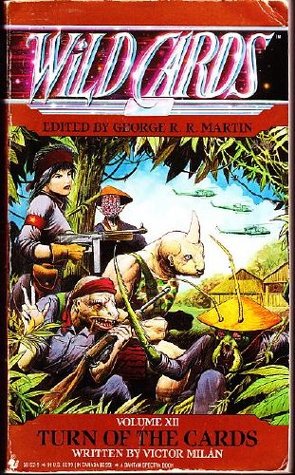
Turn of the Cards by Victor Milan

Let me start off by saying that the wild card series has a way of endearing itself to its readers considering the volume and extent to which the series has grown. Of course, the finesse of workmanship that goes with the series captivates one in further picking up the next book in the series, and that is how, I find myself writing a review for the series in this twelfth book.

The continuity by which the series' has been riddled with can be said to be one its strength and yet it too is the source of a waterloo for the series. What happens when a reader gets enthralled with a series is that we find a connection with the characters, we developed an inkling to these characters' stories and we expect a closure if not a continuation on the foundations we have been fed. We look, or rather we crave for further developments for personalities and characters we have inevitably labelled 'favorite/s' or more pretentiously identified with 'me'... or is ambitiously seen as what 'I' 'you' or 'me' would like to be. We have made it personal for this is the only process whereby one appreciates the written work. And this is precisely the reason why Turn of the Wild Cards garnered a three-star rating, or something lower if not for the Capt. Trips.

Mistral inhere for example is a misnomer. From the conclusion of the superbly done arc that was the jumper-rox-arc, she just suddenly appears pursuing Capt. Trips. Where a concise and substantial caveat could have sufficed, nothing was offered. How the hell did she get back to her body? And what of his father, Cyclone, feared dead in the previous arc. And it begs to be emphasize that in the succeeding books in the series, much of the discontinuity escalates into full blown disjointed story arc presentations, presumably (and i do hope i do stand to be corrected) due to the transfer of the right to create and publish the succeeding books to several publishing companies like TOR and IBooks.

For a person who wants to find the same continuity I am looking for, there's something to look forward to in the seventeenth book of the series Death Draws Five.