Showing posts with label review. Show all posts

Wednesday, October 2, 2013

On Love by Alain de Botton

Title: On Love
Author: Alain de Botton
Publisher: Grove Press
Original Publication Date: 1993
Pages: 194

I have been having different slices of the same loaf. And I plan to continue on finishing the platter until kingdom come. After reading Fromm's Art of Loving, Alain de Botton's On Love was consequently partaken of.

At the outset, Art of Loving must be considered as a league of its own. The theorizing Fromm achieved was incomparable in that love, like any other concept in the social sciences, could be easily demystified, unraveled and explained by the use of inquiry and reason; even though what Fromm wrote in the intro that every endeavor committed to such pursuit is bound to end in failure still held true until the bitter end of his book. An aspect which De Botton's work did not tackle (and conclude with) in a  significantly different matter.

If Fromm wrote about the origins of love and how love can be successfully pursued as an art in itself in a very scholarly manner, De Botton on the other hand wrote on the inception of love and the processes it goes through, albeit ending in an unideal and rather depressing manner. For all it's worth however, On love manages to encapsulate the reader for the very personal, realistic and relatable (most especially) manner De Botton has chosen to write this book.

The book is divided in essays on particular issues connected through out a developing relationship. We are treated to numbered paragraphs under these essays. The riveting aspect of this book however lies in the manner De Botton was so successful in enlacing the theoretical aspects to the fictional aspect that objectified and so perfectly represented his theories and arguments. De Botton not only theorize love well, he presented the readers with something they can objectively relate to through Chloe's fictional love story, and in doing so, managed to humanize what was conceived in abstract. More than that, it managed to establish a connection with the reader, by a common thread of experience in the story. De Botton did not only theorize actions of love like putting meaning where there is none, holding hands, happiness, betrayal and fear of loving again and of loving again, he wrote about it through Chloe. De Botton is one great love story writer that most YA Romance novelist will ever dream of.

The sentences were beautifully written, incomparably so. I remember reading Hemingway and having the same reaction. De Botton simply writes beautifully.

If there were any limitations to this book, we have to concede that it is written in a certain perspective, a man's perspective, which sometimes arguably is guilty of permeating the objectiveness of the arguments.

Taking on the Dead by Annie Wells

Title: Taking on the Dead (Famished Trilogy Book #1)
Author: Annie Wells
Publisher: Create Space/ Independently Published
Original Publication Date: 2012
Pages: 322

I have substantially pondered the rating I would give to this book with finality. First because this is an independently published book, a fact that should always be afforded respect if not praise for it is no mystery both to writers and even to non-writers like me how hard it is to establish names in the market, more so to move beyond great names in the myriad of genres like Tolkien, Lewis or Le Guin in Fantasy, or of Asimov, Clarke or Heinlein in Science-Fiction (or of Max Brooks in the Horror-Zombie Genre?). Second is that this book has claimed (this word is most appropriate as will be discussed later) to be under the proliferating Horror-Zombie genre. However, it is a greater sin to rate this with something it does not deserve. If a book should break those veils Tolkien and the likes have unconsciously erected albeit in a successful and (portentously) ageless manner, it should be by its merits alone, and by merits alone that this two star rating is founded upon.

The Zombie Factor
I am a fan of the mindless, flesh eating, human craving zombies. Somehow, in this fictional setting, a thinking, evolving, zombie is untenable and its essence against the basic tenets of the zombie horror genre. Why? The appeal of the zombie genre has been anchored upon the story of survival of humanity, but this story of survival undeniably comes hand in hand with the zombies. This survival has two faces, the possibility of extinction on the one hand, and on the other, triumph over this fictional anathema. Put a thinking zombie in here and the balance tilts to either what is called human extinction removing the conspicuous appeal of human triumph and power or    could either be a book, meant more for humor or for the YA shelves of romance. Enter Taking on the Dead! Where there is no need for a zombie literary pundit to tell that zombies are either subplots or plot devices. It is a subplot because the book is not about survival but of personal feelings, specifically the female sexual feeling of the main character. It is a plot devices because zombies momentarily appear to further personal (sexual) relations of the female protagonist with the numerous male characters. The middle of the book is solely dedicated to romance of the female protagonist.

Character Development
I don't know how the author has visualized the main character, it turned ultimately as an in inconsistent persona. The author wanted to paint a protagonist who knows how to survive in the post-apocalyptic world by saying that she had resource materials, can jack a car and survived alone for four years since the outbreak. For all that, she turned out to be stupid, real stupidity or forced stupidity, i don't know, all that matter is she is stupid. (e.g. Who takes a bath in a lake fully naked unarmed?)

The men are all objects of the pent up libido of our main character, that is all I can say.

The supporting cast is the literary embodiment of racial stereotypes. The asian-american as practitioner of martial arts, the african-american as the street gangster/rocker type.

The Writing
The writing is, like most YAs, (drumroll) in the prevalent stream of consciousness occasionally interjected with conversations. So it is an easy read.

There are a number of awkward passages within the book. Like this:

"Ice seemed to spread through me."

Better Fit for the YA Romance than the Zombie Genre
I fault myself for not taking caution after reading the prologue:

"Sometime later, we got off the Ferris Wheel, both heated, clinging to each other, and ready for another tryst when we went off the beaten path to use the foul port-a- potties. When I think about it now, I know the outbreak began early in the day. We passed several wrecks, heard many helicopters and sirens, and probably saw a few zombies, but were too wrapped up in ourselves to notice. I blame it on being in love, but I swear to myself now if I saw a person walking down the street covered in blood or eating someone, I would have paid attention. Maybe."

The paragraph was portentous. It had the picture of a romantic, sexual, stupid oblivious makings of the book. I mean come on, who ever you are, however in love you are, you can't be oblivious to several wrecks, helicopters and sirens. That's just being plain stupid.

The Diary of Adam and Eve by Mark Twain

Title: The Diary of Adam and Eve
Author: Mark Twain
Publisher: Harper and Brothers
Original Publication Date: 1905
Pages: 112

A take on the socially constructed gender roles and biases through a narrative anchored on the belief of the creation.

The Metamorphosis by Franz Kafka

Title: The Metamorphosis
Author: Franz Kafka
Publisher: Kurt Wolff Verlag
Original Publication Date: 1915
Pages: 195

Between the alienation experienced by Gregor and his family, the inescapable lost humanity though a failure of communication, and the apparently weird and unexplained but interestingly exciting story, deeper meanings in the book escape me (for I am led to believe there are), perhaps a second reading will put it within my grasps.

The Art of Loving by Erich Fromm

Title: The Art of Loving
Author: Erich Seligmann Fromm
Publisher: Harper and Brothers
Original Publication Date: 1956
Pages: 184

There's a lot of grain of truth in this theorizing and objectification of love that Erich Fromm successfully wrote. Let me quote with liberality such instances more so for the inherent beauty and magnificence of such statements.

One page xix

"It (book) wants to convince the reader that all his attempts at love are bound to fail; unless he tries most actively develop his total personality so as to achieve a productive orientation."

On page 22

"Love is an activity, not a passive effect; it is a 'standing in' not a 'falling for.' In the most general way the active character of love can be described by stating that love is primarily giving, not receiving."

On page 56

"To love somebody is not just a strong feeling — it is a decision, it is a judgement, it is a promise. If love were only a feeling, there would be no promise to base the promise to love each other forever. A feeling may comes as it may go. How can I judge that it will stay forever, when my act does not involve judgement and decision?"

On page 71

"Most people believe that love is constituted by the object not by the faculty. Because one does not see that love is an activity, a power of the soul, one believes that all that is necessary to find is the right object - and that everything goes by itself afterward. This attitude can be compared to a man who wants to paint but who, instead of learning the art, claims that he has just to wait for the right object and that he will paint beautifully when he finds it. If I truly love one person I love all persons, I love the world, I love life. If I can say to someone 'I love you,' I must be able to say, 'I love in you everybody, I love through you the world, I love in you also myself."

From a scholar and an academician's perspective, Art of Loving is highly reminiscent and indicative of the great scholar Fromm is. His arguments are well thought out and psychologically anchored. The conclusions are convincingly rationalized. My propensity to disagree however trickles in regarding certain points in his arguments.

Fromm situates fatherly love as love that is conditional in contrast to motherly love as unconditional. This condition, Fromm writes, depends on the child's capacity to please, satisfy and fulfill every fatherly expectation, requirement and demand. Now before anything else, the strength of this forthcoming argument is not anchored on personal disposition (for I am neither a father nor a husband yet) nor is it on a personal father-son relationship but on the patent criticism on Freud's study —that much of adult psychological development is founded on the child's experience (because it perpetuates that development is not progress and change but accumulation of the same static component). Now for you Fathers out there, is Fatherly love truly conditional? Does it really depend upon any fulfillment of a condition? Isn't it a bit partial, bordering sexism for fatherly love to be labeled as conditional? This is pivotal since Fromm forwards the argument that conditional fatherly love is the significant half component for the development of a mature being capable of truly loving. Cannot fatherly love be demanding, hard-driving, expectant and directing while at the same time be unconditional? Because in contrast to what Fromm writes, that the failure to transcend the conditional fatherly love results to one extreme end of the stick, the incomplete and incapable-of-loving person, perhaps such incapability have resulted from such conditional fatherly love in a very fundamental manner. Fromm's proposition of this kind of a fatherly love however carries something more portentous because as much as reality has put it, the general rule is non-fulfillment of such 'condition' and the fulfillment being the exception which necessarily forwards the conclusion that most individuals are incapable of loving.

The social milieu (having been published at 1956) at the time of the writing of this book is gleamed from the very words and arguments Fromm has employed. Take for example Fromm's argument on homosexuality, capitalism, and on criticism on Freud.

What surprised me however is Fromm's repeated employment of biblical passages and resources. In hindsight this should have come with no surprise at all as no better book talks (categorically and objectively) about love than the Bible, and this is true whether one reads it as a religious keystone or as a plain literary work.

Basically one of the theses of this book is that an individual has to be a complete individual by himself/herself. And I have always believed this to be true and found that acclaimed romantic statement 'you complete me!' to be a grossly incorrect statement. Fromm hits that mark masterfully.

Considering it all, Art of Loving is one enlightening work, something I'd never fail to recommend.

Monday, September 16, 2013

Looking for Alaska by John Green

Title: Looking For Alaska
Author: John Green
Publisher: Dutton Children's Books
Original Publication Date: 2005
Pages: 231

Here's the second book borne out of having been lost in a labyrinth that is Tolstoy (it is true that YA are easy reads, with respect to Looking for Alaska though, that is an understatement).

John Green's first book that I have first read, which interestingly, did not leave any hint of novelty. The reason is conspicuous enough. The plot is conventional and prevalent (predictable too). Who hasn't read, or heard of, of teenagers who know everything, of people who believe they stand at the top of the world only to be confronted by something beyond comprehension? Relegating the plot, perhaps the characters echo of redemption. I am again to be disheartened. The characters were the embodiment of stereotypes. Miles (stereotypical nerd) who leaves for boarding school only to search for his "Great Perhaps". What is surprising however is that Miles forgets this Great Perhaps of his only to reemerge in the last parts. One can hardly argue that his stay was his Great Perhaps, as the stereotypical nerd, he gets pushed and nicknamed Pudge, (where's any hint of a Great Perhaps?) with no attempt ror what so ever of shaking off occurred, in the contrary, Miles subdued himself to it, he pays for Colonel's cigarettes, and is of course forever chided by Alaska. Colonel (stereotype of a cool friend who strives because of a definitive family background). Alaska as the stereotype of the hot and smart girl who I guess Green envisioned to be near perfect in light of his feminism (who doesn't ever go beyond the pseudo-feminist bickering), a roomful of books and precal tutorials. So everybody likes her, but hell, you can't have her because once you thought so she'll start spouting that she's oh so loyal, right after making out with her.

Miles lost any redemption towards his Great Escape, something the author conventionally concludes through their predicament of "looking for Alaska". And if to add insult to injury, they never really did find Alaska, emphatically that is, did they?

The appeal is easy to see. The character's are in a school, no less of a boarding school, and yet they have access to booze, sex, and smoke. They can carry out any prank with little injury. So I guess Green cast his characters in a mold embossed with intelligence, love for learning and books not only to offset, but to some extent justify, what his characters do. Who would, from the young (who want to experience such), the YA (who are experiencing such), and the young once (who have experienced such), not get caught up in such a subjectively pleasing read?

So yeah, we give in to the occasional emotional torrent to which the work's success must have been anchored. We give in to the dreaded  effects of bullying, to the alienation, to the incomparable feeling of first love or lust, whether it be real or not, and to lost love, to chasing ghosts. We give in  to the pursuit of redemption, of Looking for Alaska through pulling the best imaginable prank ever in Culvert history. After all there is something somewhere to which we can relate to what Green has written, however minuscule or insubstantial that is.

I guess, if I were a teenager, I would have given it a 4 or even a 5. I admit I liked Mile's devotion to last words (got me curious to a great extent I'll be picking up a book on this), but somehow, the prank they pulled off was seemingly anti-climatic. I expected something more. Or then again, I am totally in the wrong for every word in this review, after all, it is American culture Green is writing into.

addendum
In an attempt dictated by convenience and compelled by the material, I have somehow visualized this review.

not viewable, here's the <a href="http://imageshack.us/photo/my-images/856/40020854.jpg"> link </a>
**i dread repeating words, which in this case is not only fitting but inevitable  in lieu of the indistinctness of the plot.

Thursday, September 5, 2013

Hyperion by Dan Simmons

Title: Hyperion (Hyperion Cantos #1)
Author: Dan Simmons
Publisher: Bantam Spectra 
Original Publication Date: 1989
Pages: 482

Whenever I come across an epic masterpiece a great difficulty in talking about it (in this sense, reviewing it) arises. Perhaps an empirical testament that Hyperion is nothing short of a masterpiece is that I have mulled over what I have to say over this work for an uncharacteristically numerous number of days (and still, ironically, I came up with technically nothing). I will struggle to mark my statement with brevity, lest I contradict myself and lose credence that Hyperion, is one that every sci-fi fan should read.

Every story has been told, one way or another, the gift of the author is in retelling that story and in such retelling, create a story of magnificence of his own. This is to say that Hyperion is a modern-sci-fi-setting retelling of the Canterbury tales. Six stories, woven into one epic masterpiece. This holds true to Hyperion, as one would later see. To say that Dan Simmons, in writing Hyperion, is gifted would be an understatement. He is a genius and his work a revelation. Once again, I am plunged to experience the unfathomable urge to read the book's sequel.

The Fall of Hyperion by Dan Simmons


Title: The Fall of Hyperion
Author: Dan Simmons
Publisher: Bantam Spectra
Original Publication Date: 1990
Pages: 517

I had a hard time getting a copy of this book considering the fame it has enjoyed. Perhaps such effects has bolstered the value of this book.

At the outset I would like to emphasize that Fall of Hyperion is more likely a part of the first book just as Endymion and Rise of Endymion are one, in other words, the series is actually more in the content of two books divided and stretched over four, pursued for the contingency that readers may experience some difficulty wading over a thousand paged story. At this point I actually do not mind if it was, Dan Simmons is great, and I would gladly add him up to the likes of people who can write a thousand paged story.

I love writers who do not talk down to their readers, who present complex ideas and let their readers understand, and who create a world and lets us visualize it.

The book still fundamentally carries the same format. POVs of the pilgrims later to be merged for the concluding parts. Dan Simmons did this in a masterful manner.

I revel at how he has created and developed the characters. They have remained true all throughout.

Sometimes I however pause at Dan Simmons' bombardment, literal bombardment of high-fallutin technical words that is categorically his world building and descriptive environment. I guess this is a standard of science fiction works, but to an extent Simmons is beyond any standard science-fiction work, and that tells a lot. Further, I see the embers of the story delving in parts that have been left in philosophical debates and religious contentions. I am interested at how Simmons will later play this on out. The work still delivers a wallop of a punch on the emotional level, and this is testament to how good Dan Simmons is. Take for example the moment where General Morpugo was leading the ship with his son saying 'I love you, Son'. This military man, who was fashioned to be uptight at all bearings, shattered all conceptions, and delivered such effect that it must be one of my favorite moments in the second book.

The Final Odyssey by Arthur Clarke

Title: The Final Odyssey
Author: Sir Arthur Charles Clarke
Publisher: Del Ray
Original Publication Date: 1997
Pages: 272

It is noteworthy to consider how Arthur Clarke opened the third book, and what the ramifications to the entire series were. With wanting pragmatism, he wrote that:

"Just as 2010: Odyssey Two was not a direct sequel to 2001: A Space Odyssey, so this book is not a linear sequel to 2010. They must all be considered as variations on the same theme, involving many of the same characters and situations, but not necessarily happening in the same universe.

Developments since Stanley Kubrick suggested in 1964 (five years before men landed on the Moon!) that we should attempt 'the proverbial good science-fiction movie' make total consistency impossible, as the later stories incorporate discoveries and events that had not even taken place when the earlier books were written. 2010 was made possible by the brilliantly successful 1979 Voyager flybys of Jupiter, and I had not intended to return to that territory until the results of the even more ambitious Galileo Mission were in."

Deriving not only from what Clarke tried to project as a caveat but as well as from general systemic observations from the series, I find the pressing need to elaborate on the following points.

Clarke cautions his readers not to treat the apparently labeled series as well, a series of books characterized with continuity and relativity. This is clear when he phrased that 'it' was not a direct sequel and must be considered as variations of the same theme. For the reader however this is rather demanding if not theoretically impossible considering the method, characters and story arcs Clarke choose to write with. Putatively and substantially seen in this simple manner:

Book One: Dave Bowman mysteriously disappears while in transit on his mission

Book Two: Dave Bowman returns as a part of the Monoliths and another mission is launched in pursuit of ascertaining what had happened, Dr. Floyd Heywood becomes one of the major personas by this point

Book Three: Floyd Heywood returns in the scene of another space exploration

Book Four: Frank Poole re-emerges as what could be labeled as the single persona in the fourth book establishing a connection with the series.

For one who has read the series, the meager attempt to express the thought in the words above should suffice. After all the recurring references while reading the books there is hardly any need for me to elaborate on this.

Arguendo however, if we find the utter need to satisfy some inner justice and lend credence to Clarke's desire to treat the succeeding books not as sequels but stand-alones (and i believe this is what he meant when he said that they were "to be considered as variations of the same theme"), the books, with intrepid audacity, fall into a position that is not only demeriting but which I fear could unfortunately be an unprecedented fatal waterloo for the whole of Space Odyssey books. I qoute myself by saying that:

"The book did not feel a book at all while reading it (something i've started to feel in the first book already), but more something like of a novella, or a piece greater book that is the series. I'm starting to get the impression that the 4 books should have been published as one judging by what the content has encompassed so far"

Nothing has proven to be quite substantial in the series to merit a change in this perspective. In the contrary, I find that the deeper I was into it, the further my pretense was affirmed, conclusively in varying instances.

I too find it rather irritating, as short as the books already were, that Clarke included a chapter or three from the previous books, lifting them by the whole, which presumably he wanted to function as ardent nostalgic chapters reminding the reader of events that have passed. I find them nothing but repetitive vestiges that can choke the living hell out of the reader (to be fair that was an exaggeration). It was redundant, draggy, convenient and a poor excuse for an imagined attack of writer's block (and this is what I've honestly felt).

To be critical however, Space odyssey is still a page-turner as it is (whether of excitement with the next chapter or with boredom with the lifted ones). Arthur Clarke writes in a gripping manner that catches you until the last of the pages. I give credit to his imagination contained in the writing. For me they were fresh, novel and exciting. The mystery of the monoliths can keep the reader enthralled as far as the story goes, the very idea of the monoliths was exciting in itself. The biggest letdown of this series/variations on the same theme however lies in the revelation that it failed to deliver (sole reason why the fourth book was rated two stars). After all that excitement, I opened the Pandora's box only to see, nothing.

A Book of Five Rings by Miyamoto Musashi


Title: A Book of Five Rings: A Classic Guide to Strategy
Author: Miyamoto Musashi (宮本 武蔵)
Publisher: Gramercy (1988)
Original Publication Date: circa 1645
Pages: 96

Superb. Somehow when he speaks of the way, Star Wars' Jedi's way come into mind. However, I have yet to find a work that does not to pale in comparison with Sun Tzu's Art of War. A book of five rings talks about the way of the long sword (primary samurai sword), everything affecting it, and how, a successful master strategist could apply the "individual aspect to those of a battle of a ten to thousand warring individuals." I however miserably fail at this endeavor. I simply cannot visualize the acclaimed application of the contents to a full-scale battle (perhaps a veracious sign that I have not been born with the makings of a strategist). The book is rather concise in form and owing to the brevity and nature of the topic by which Musashi wrote, he could't have done any better. As in Musashi's words one must either "study this well" or "research diligently" to rationalize substantial parts of the work.

What the Dog Saw and Other Adventures by Malcolm Gladwell

Title: What the Dog Saw and Other Adventures

Publisher: Little Brown & Company
Original Publication Date: 2009
Pages: 688

Have you ever read a book because you were impressed with the writer? Loved the writer? And want to read his other works? This is one book which falls into that category for me, and again, such experience betrays.

I got bored with this book. Malcolm Gladwell is a great writer, that much is a fact, however, in comparison to his other books, 'what the dog saw...' did not fare well. For one, his writing always presented a grand theory or idea which captivates the reader through well researched pieces of information and undeniably entertaining facts, while this book is the exact opposite being a compilation of articles he previously wrote, yes there were highs and lows with the book but the lows easily outnumbered the good articles and i just suddenly realized i was skipping some pages, telling myself 'don't wanna read that' 'boring' and so on and so forth and i was nothing but thankful to finish it, at last. This boredom i talk of is attributable to the fact that his claims and ideas in his other books were convincing for as long as he kept a well versed and thoroughly backed argument, and this is what the article lacked, precisely due to the reason that they were only articles. Some were too complex and abstract that an article for a piece did not give it justice.

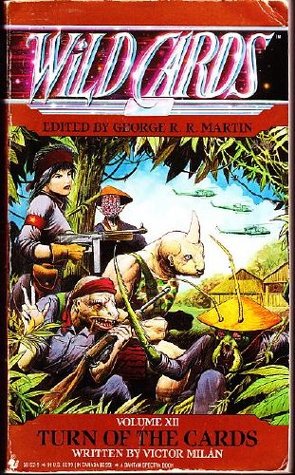
Turn of the Cards by Victor Milan

Let me start off by saying that the wild card series has a way of endearing itself to its readers considering the volume and extent to which the series has grown. Of course, the finesse of workmanship that goes with the series captivates one in further picking up the next book in the series, and that is how, I find myself writing a review for the series in this twelfth book.

The continuity by which the series' has been riddled with can be said to be one its strength and yet it too is the source of a waterloo for the series. What happens when a reader gets enthralled with a series is that we find a connection with the characters, we developed an inkling to these characters' stories and we expect a closure if not a continuation on the foundations we have been fed. We look, or rather we crave for further developments for personalities and characters we have inevitably labelled 'favorite/s' or more pretentiously identified with 'me'... or is ambitiously seen as what 'I' 'you' or 'me' would like to be. We have made it personal for this is the only process whereby one appreciates the written work. And this is precisely the reason why Turn of the Wild Cards garnered a three-star rating, or something lower if not for the Capt. Trips.

Mistral inhere for example is a misnomer. From the conclusion of the superbly done arc that was the jumper-rox-arc, she just suddenly appears pursuing Capt. Trips. Where a concise and substantial caveat could have sufficed, nothing was offered. How the hell did she get back to her body? And what of his father, Cyclone, feared dead in the previous arc. And it begs to be emphasize that in the succeeding books in the series, much of the discontinuity escalates into full blown disjointed story arc presentations, presumably (and i do hope i do stand to be corrected) due to the transfer of the right to create and publish the succeeding books to several publishing companies like TOR and IBooks.

For a person who wants to find the same continuity I am looking for, there's something to look forward to in the seventeenth book of the series Death Draws Five.

Norwegian Wood by Haruki Murakami

Somehow a very predictable plot. When I say this what I mean is that Norwegian Wood is discernably portraying Japanese culture, impeccably. I'm struggling to grasp the novel theme inside this work that makes Murakami so celebrated, and distinct as claimed – a struggle in vain (Perhaps there is none, and my inherent failure to connect with Murukami's elegiac writing is barred by my preferences. One thing that have always remained in earnest interest is that misery does love company and perhaps a reason why melacholic writings proliferate under this arrangement. A depressed book for a depressed world). Even Murakami is baffled at the popularity of this work. Until then I'm inclined to agree that Murukami is really not worth a Nobel after all.

Now, off to his other works which I hear treat suicides more thoughtfully, or perhaps nothing else beats a talking cat.

The Weird of the White Wolf by Michael Moorcock

I was giddy picking this book up. I was looking for a good series in the field of epic fantasy after reading full blown novels and saw that the Elric series is revered in the genre. I finished the two books and did not stop until well within the third of the series. However, the seemingly unprecedented fears of reading Moorcock and the Elric saga emerging within the second book (which for me) seemed to have been nothing but unfounded was embossed within the third books as if fundamentally attached to the series, at best, and at worst, with Moorcock's writing. I place a caveat as need be. I did not read the succeeding books in the series, nevertheless, I will carry on, with intrepid audacity, rendering a review that would seem conclusive for the entirety of the Elric saga. Who knows, the edit button is never far from reach if i may chance to pickup the other books in the series, which i doubt with great veracity.

Elric was off at a good start, if I can remember, Elric is the first antihero scheme i have read under the genre. In hindsight, it proved disheartening. The series lacked the grandiosity that is fantasy (for me, defines books under the fantasy genre). The world building, which is vital to a fantasy series categorically failed. Conceivably due to the fact that the series' books are almost always composed of three novellas rather than being a single composite work. Withal, Moorcock did not seem to have deliberately expounded on his world building aside from laying the essential necessities of the Elric series. The character/story arc, although credited as idiomatic as it were, just went too wide losing sight of the main arc. They were entertaining yes but in the end it leaves you candidly empty. This arc failure is because of Moorcock's concept of the Eternal Champion (please google it) of which i will not go into pains elaborating but to me simply is (sad to say) another marketing strategy to get you to read his other works. I do no want to read another book to understand a character. If a renvoi is in the making so that i can enjoy your books, then that's consequentially disappointing. But this did not lead me to stop, no, I read the next book and that's where the proverbial straw was lying.

DIMINUTIVE ASPOILER CAUTION!

A. Moorcock was simply repetitive in his stories. There were a handful of plot repetitions of some of which i ought to mention.

1. There will always be a sleeping girl!

Which of course Elric will help.

2. After helping a high-born short of being a perfect lady, our man Elric will always leave her.

3. Elric will never lose because he can summon a god, or when that god is defeated, a stronger god, or a stronger one or so on.....

This repetitive sequences simply sucked the life of the story barely leaving Elric with any character or persona at all.

B. Numerous PLOT HOLES (easily discoverable)

C. Story conclusions are what would rather seem convenient to the arc rather than well thought out inferences. (Elric can just summon a God to end whatever the hell is pestering him - but then again this may be a selling point of the series).

Considered however as revolutionary and radical with the presentations of fantasies in the tone of an antihero theme (one of the earliest of its kind), Moorcock is still something that an avid fan of the genre should not miss.

White Fang by Jack London

Reading Jack London's White Fang was beyond any expectation. The manner by which he has so vividly written in an animal's point of view leads one to incredulous experiences and conclusions while wholly experiencing the enthralling story. I'm almost inclined to argue - with an implausible idea - that London is white fang himself experiencing firsthand all that he has written. This statement does not render absurdity but rather should be further taken as an evidence giving credence that London's White Fang has perfectly captured the wolf experience, however fictitious it may be. I did not give it however a perfect five star rating due to the manner by which it is written as short as it is, that in itself is not even a flaw but a matter of personal preference. White Fang is surely a must read.

Catcher in the Rye by J.D. Salinger

Boy, that goddamn killed me!

Reading is never an easy thing. Surprisingly I still find that there are books that are laboriously... fatal. It killed me, it really did.

Now, where the hell do I goddamn start? I'm obviously done with the use of profanities.Some things are just not good enough, certainly not with the use of profanities in this case. The concluding paragraph on chapter seven for instance has this:

"When I was all set to go, when I had my bags and all, I stood for a while next to the stairs and took a last look down the goddam corridor. I was sort of crying. I don't know why. I put my red hunting hat on, and turned the peak around to the back, the way I liked it, and then I yelled at the top of my goddam voice, "Sleep tight, ya morons!" I'll bet I woke up every bastard on the whole floor. Then I got the hell out. Some stupid guy had thrown peanut shells all over the stairs, and I damn near broke my crazy neck."

How can Holden be so irritatingly inconsistent of a character and yet at the same time be so annoyingly repetitive. In hindsight it actually is of no surprise, it is rather a perfectly unfortunate complement.

If "Holden was born in the world not just strongly attracted to beauty but, almost, hopelessly impaled on it,"(as an antihero who decidely hated phonies, he hated this world) still if this is what he considers one of the things he labels a phony, it is contradictorily funny, at best and at worst, is an ironic manifestation of the hypocrite that he is, seeing that he has this decisive use for the word ugly. More than anything that merits of a hypocrite label is how well and how much he lies saying "he could go for hours" (as he showed on the train with his schoolmate's mother). A condescending and rather conceited reason he has for lying is that he hates explaining things to people, thinking that it's easier to lie than to explain the truth to people. Holden Caulfield is not really self-aware that is to say, he can't see that he himself is a phony.

Laden with inconsistencies, I got the feeling that I was reading a book with a child that was not depressed in any meaning of the word, but who is rather a child with a savant syndrome.

Page 38:

"My brother Allie had this left-handed fielder's mitt. He was left-handed."

Holden was repetitively stupid.

If the point of the anti-hero is to annoy, then it did succeed, too well, far to well that I absolutely hated Holden.

A lot of people loved, venerated and labelled this book a classic. Some say the reason they do so is that, God forbid, they identify with Holden and in that process, it changed their lives. This is not surprising for Holden is, without any discernible difficulty, the book itself. I however recommend that rather than fraternizing with Holden, one should seek a cathartic outburst, and if failure still lingers, nothing beats employing professional help.

Lest some incomparably emotionally attached reader lambast me and do educate me that all I've been talking about is Holden and not the book, and I do, to some extent acknowledge that, here then is my leverage.

The book actually had barely any plot at all. This is precisely what I meant when I said that I toiled and labored going through this book. I would gratify at the fact that I could be rectified concerning this point. Adding to such disposition, the stream-of-consciousness narration writing style in the book did not help at all (n.b. most YA novels proliferate under such school).

For all that is now between me and this book, I too have to acknowledge the fact that Salinger wrote this at the end of WWII, an anti-hero theme which gave light to the themes of teenage angst and alienation in a world that the youth are nothing but alienated, in a world that precisely needed it.

A clear undeniable precursor of things to come.

The Wind-Up Bird Chronicle by Haruki Murakami

Redeeming. The innumerable opinions and notes on this work do not give justice to the masterpiece that it is. Now this is distinctively Murukami, epic, superb, astounding, is what I would have said, but alas, as clichés are, the book is boring.

The surreality the readers love about this book (and of Murakami) is a trap. The story carries an atmosphere where anything can happen, which antithetically results in nothing happening. That is only the tip of the iceberg though (a cliché of which I'd say, Murakami did nothing to avoid employing). What bugs (cliché) me however is that Murakami knowingly wrote a 600-paged novel tackling an epic story only to leave out things unexplained, unsubstantiated and unanswered.

Surreal. Defined by Merriam-Webster as:

1. marked by the intense irrational reality of a dream; also: unbelievable, fantastic

Under the definition Murakami hits the spot (cliché). The book was irrational and dream like. In some instances (cliché) the prose is simply too verbose it was practically begging for brevity to make some sense, but not even the kind that would give you a minuscule fragmented understanding of the story. Not to mention it was repetitious (perhaps the fault lies in the translation of the material? perhaps this too is a compliment).

Someone on this site said that the book is a flawed masterpiece. I interject, out of sheer audacity more than the cheated feeling of reading a 600-paged novel absolutely arriving nowhere, that technically a masterpiece is something done with extraordinary skill and a flaw is an imperfection or weakness. This is what is now either a masterpiece or a flawed work of art. Either way, I give up on Murakami.

To his credit I enjoyed a subplot (on the WWII) better than anything contained in the book. But alas, even that was lost and forgotten.

Tuesday, September 3, 2013

This is How You Lose Her by Junot Diaz


I get the fact that Junot Diaz is a pioneering author when it comes to writing the experience of Dominican immigrants approximating the American dream. I also get that the gritty writing, the occasional offensive Spanish references, and the objectively sexual portrayal is his trademark. What I don't get however is what this book is all about. One doesn't need to be a literary pundit to know that Diaz is telling us that CHEATING is how you lose her and Diaz presents this to the readers by writing every male character in the books as a cheating fornicating bastard. So yeah, definitely, this is how you lose her, sadly, this was how you lost me too. But I guess there must be something profound here, meriting the adulation this book has garnered, so please do tell, that this book has a message aside from that one redundant thing that says, Cheating fucks you up. Genius!

Saturday, August 24, 2013

The Name of the Wind by Patrick Rothfuss

The book gathered an exceptionally high rating, was recommended by a Goodreads friend and is under my beloved epic fantasy genre, clearly necessitating a well founded text-based review, lest I be berated by some die hard fan out there. Withal, I apologize for an uncharacteristically long winded review. 

At the risk of being redundant, let me restate that all stories have been told, and retold, one way or another. This carries serious implications. First is that a lot of published books are nothing but replications and poor imitations which are but mere mockeries of the original masterpieces. Second is that a certain preferential degree of liking has to be attributed to the reader (albeit in connection to how good the writer is), that is some people may have either come to appreciate this substantial nuance, relegate it to the background (something that is really hard to learn) or disdain the book for such (subjectively) fatal aspect. Third is that this could be an objectively effective measure in gauging how good a writer is because a great author is someone who either creates an original and novel masterpiece or is someone who takes what has been written, incorporates conventional aspects, employs  prosaic themes but nonetheless comes up with a masterpiece. The Name of the Wind lies in the middle of all this in a peculiar manner. 

The plot is, too put it in a blunt but veracious way, unoriginal.  The gifted/special boy subjected to life's most savage tribulations coming to power thorough education/training to be hailed the greatest hero who ever live later on has been perpetuated to taxing degrees in this genre. The idea of naming the wind or the elements for that matter is also not unprecedented. Countless times while reading this, I was vividly reminded of Ursula Le Guin's Earthsea Cycle, just without the gritty, profound and captivating meanings in the prose. I do not agree however that the deus-ex-machina/wish-fulfillment/infallible-hero/superman plot some claim to be perpetuated was actually employed to  such encompassing degree. Conspicuously, Kvothe is fallible albeit exceptionally adroitly. He is gifted and must undergo training, but not miraculously powerful. 

The magical system is guilty of being in dearth of explanation, rationalization and at least a claim of any verisimilitude. Perhaps (maybe without fault on Rothfuss) because I have just read Mistborn by Brandon Sanderson which boast of an incomparably novel and well-thought of magical system. 

One of the most common critique in the fantasy genre is the objectification of the female sex and its relegation as mere plot devices. This book is, no exception to that. Notice that every female in this story is described as seemingly sexually attractive to Kvothe (even his mother!).
On chapter 16:
“My mother, slender, fresh, and bright, pale and smooth-skinned in the firelight..."

 Denna, or whatever her names is for that matter must be fundamentally considered or at least can be objectively approximated to a whoring girl if not a desperate courtesan. For all its worth, Rothfuss managed to elicit an irritating  reaction in regard of Denna. 

The name of the wind is peculiar because in the same manner that it perpetuates conventional plot devices, it also employed themes that are revolutionary if not novel in the fantasy genre. One of these is pitting science against music( or the arts) and not with religion. Another is the subtle use of kindness in Kvothe's life journey rather than full-blown overly-exaggerated life trials.  Case in point is the farmer in Chapter 19 or of the shoemaker in Chapter 32. What I revel the most in however is the manner by which Rothfuss delivered in Kvothe's struggle to win his silver pipes. Personally, the time when he was playing in the Eolian was the strongest moment for the book. It was utterly riveting. Lest I forget, up to now, I have yet to make sense of why  the University, which is supposedly the bastion of reason and logic, employed means that were so barbaric, i.e. whipping. Any thoughts?

There are also waterloos on the technicalities of writing. The first could be more personal rather than objective but merits mention. Rothfuss is found of using imagery and metaphors in writing. Somehow I find this bordering appropriateness to sheer lack of capacity to tell. 

On Chapter 47:
“And there was Ambrose. To deem us simply enemies is to lose the true flavor of our relationship. It was more like the two of us entered into a business partnership in order to more efficiently pursue our mutual interest of hating each other”

On Chapter 50:
“I couldn’t stand being near music and not be a part of it. It was like watching the woman you love bedding down with another man”

On Chapter 58:
“She smiled at me then. It was warm and sweet and shy, like a flower unfurling. It was friendly and honest and slightly embarrassed. When she smiled at me, I felt”

I will stop with that for brevity's sake. There are negligible albeit  basic errors in construction. 

On Chapter  44:
“We were none of us particularly drunk”

On Chapter 45:
“And we were both of us very young.”

On Chapter 88:
“Otherwise the story don’t make a lick of sense. It was a demon he called up, and it drank up the fellow’s blood, and everyone who saw was powerful shook up by it”

And even tough this story is told through Kvothe's recollection, there are numerous shifting of point-of-views in narration. From first person there comes a third person omniscient narrator. At times this could be problematic, and at times appropriate and indispensable since a third person omniscient narrator makes sense of things. This leads us to the next contention which is Rothfuss oftenly talks down and tells rather than shows. This statement for example tops the list. 

On Chapter 92:
“THAT SHOULD DO FOR now, Imagine,” Kvothe said,gesturing for Chronicler to lay down his pen. “We have all the groundwork now. A foundation of story to build upon.”

He could't have been any more conspicuous talking down to his readers than this statement. For the record, That is perfectly clear since the plot hardly moved at all with the first book. My biggest complaint is that book one was simply too Loooooooooooooooooooooooooooooooooong. A lot of chapters could have been done away with, without compromising the story, plot and character development, and quality. He could have dispensed the detailed horse-ride, the excessive chapters on Kvothe's vagrancy in Tarbean (it was perfectly clear that he was poor, homeless, hungry, beaten and desperate by a good length with one chapter, to extend it to three or four chapters is simply taxing the readers), or the 150+ pages concerning the killing of the Draccus, I hope that such event did not only contribute to the already blurry relationship Kvothe has with Denna and was not only a plot device contributing to Kvothe's supposedly notoriety, but is something else and something more. 

As a stand alone, this book titters between the edge of something that has wasted my time and something I have to be patient with. Perhaps its merits lies in its completion. 

The Tombs of Atuan by Ursula Le Guin

Originally posted at Goodreads

The story on grand personal struggles continue giving credence to the feeling that one is reading a stand alone fictional tale rather than a book from an epic-fantasy genre. Exceptional fluidity, gritty and resolved, Le Guin's writing is as distinct as it can be. And yes, labeling this YA does not seem to do it justice. To profound to be a YA.

As usual, the book's delivery depends on the relative experience of the struggle and symbolism and not on the story itself per se.